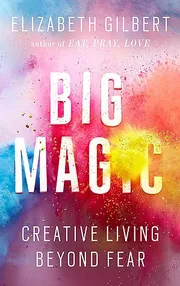
Big Magic
by Elizabeth Gilbert · 2014
Suits adults and mature teens interested in creativity, work or personal growth.
312 pages, about 5 to 7.5 hours.
Gilbert's warm, anecdotal pep talk on living a creative life. 37% taste match
What it covers
Big Magic is a work of nonfiction in the self-help and personal growth tradition, written by Elizabeth Gilbert and first published in 2014. It focuses on creativity and the way inspiration works, drawing on the author's own experience of making things. Topics include courage, confidence, curiosity, and the fears that tend to hold people back from pursuing what they love. The book also touches on the idea of magical thinking as a way of approaching creative work and everyday life.
Gilbert's approach combines a spiritual outlook with a practical one, covering the attitudes, habits, and approaches that support a creative life. The book speaks to a broad range of readers, including those hoping to write a book, make art, bring fresh thinking to their work, return to a long-postponed dream, or bring more mindfulness and passion to daily routines. It runs to roughly 312 pages and has appeared in 31 editions.
Themes
Creative abilityConfidenceConduct of lifeSELF-HELP / Motivational & InspirationalCourageMagical thinkingSELF-HELP / Personal Growth / GeneralInspiration
- Want to read 436
- Reading now 25
- Read 29
Most people shelving it are saving it for later.
Of 490 readers who put it on a shelf, 89% want to read it, 5% are reading it now, 6% have finished it and 0% stopped before the end.
By the numbers
- The median edition runs 312 pages. Counting about 275 words a page and an adult reading pace of 250 words a minute, that is about 5.7 hours of reading.
- Open Library tracks 31 editions from 20 publishers, the earliest dated 2014 and the latest 2023, across 4 languages.
- On reader demand it ranks in the top 2% of the modern books in our catalog (15,152 of them).
- Libraries shelve it under Dewey 153.35 and Library of Congress class BF-0408.00000000.G464 2016.
 BookWard’s take
Gilbert's warm, anecdotal pep talk on living a creative life
Big Magic is Elizabeth Gilbert's case for pursuing creativity without suffering for it. It is personal and anecdotal rather than rigorous, and that is where it parts company with a taste for harder-edged argument. The real strength is the voice: chatty, confident and unmistakably Gilbert. The outlook is openly hopeful, and the feeling runs warm rather than restrained, which can wear on a reader who prefers some reserve. The motivational genre is well-worn ground, though Gilbert's magical-thinking spin on inspiration gives it some freshness. At 312 pages it moves briskly, with short sections that keep things lively, and it is driven more by ideas than by story, which suits a reader who wants a notion to chew on. Treat it as encouragement rather than evidence, and it does the job well.
At 312 pages in short sections, it stays compact for its subject, close to BookWard's preference for the tight and short.
Brief chapters and a conversational style keep it moving, close to BookWard's fast-paced taste.
The core message of courage and curiosity is familiar, with a distinctive spin in treating ideas as living things.
Conversational and clear, with the occasional flourish, so it sits mid-range and plain-leaning.
As a guide with no plot or cast, the plot-versus-character dial does not apply.
Encouragement and joy run through the whole book, making it one of the most hopeful reads you could pick.
A sequence of themed chapters built from short pieces, conventional for the genre.
Gilbert is playful and self-deprecating throughout, though the purpose stays earnest.
The tone is gentle and affirming, with only passing mentions of fear and struggle.
It aims to move and uplift, with a warmth that reads as moderately intense.
See all 50 dialsEvery position, side by side with this book
Where it lines up
- PaceBookWard 8 · book 7
- Authorial voiceBookWard 9 · book 8
- Sagging middleBookWard 8 · book 6
Where it pulls apart
- Familiar tropesBookWard 10 · book 4
- Internal logicBookWard 10 · book 5
- Rigor (nonfiction)BookWard 9 · book 3
At 312 pages in short sections, it stays compact for its subject, close to BookWard's preference for the tight and short.
Gilbert opens with her thesis and personal stories, so it engages quickly, though without the immediate grip BookWard prizes.
Creative-living advice is a crowded genre, but Gilbert's magical-thinking framing keeps it from being pure formula.
Her claims hold together as a philosophy of creativity, but they rest on belief and anecdote rather than airtight argument.
Brief chapters and a conversational style keep it moving, close to BookWard's fast-paced taste.
The core message of courage and curiosity is familiar, with a distinctive spin in treating ideas as living things.
This is advice, not a story with characters, so character depth does not apply.
A guide has no plot to resolve, so ending resolution does not apply.
Warm, encouraging and openly emotional, it leans sentimental where BookWard prefers restraint.
It aims to encourage, not to unsettle, so shock for effect does not apply.
Gilbert draws on personal experience and storytelling rather than research, which falls short of BookWard's appetite for rigor.
Gilbert's chatty, confident and playful voice is unmistakably her own, which BookWard values highly.
The book is built around ideas about creativity, illustrated by anecdotes, so it leans idea-led.
Gilbert explains her views outright and directly, the opposite of BookWard's preference for showing in scene.
Short, self-contained chapters keep energy fairly steady, though a few ideas get restated.
Conversational and clear, with the occasional flourish, so it sits mid-range and plain-leaning.
As a guide with no plot or cast, the plot-versus-character dial does not apply.
Encouragement and joy run through the whole book, making it one of the most hopeful reads you could pick.
A sequence of themed chapters built from short pieces, conventional for the genre.
Gilbert is playful and self-deprecating throughout, though the purpose stays earnest.
Plain language and short chapters make this an easy, quick-to-absorb read.
Everything comes through Gilbert's own perspective and experience.
It moves through topics rather than time, with anecdotes drawn from her life as illustration.
It is grounded in everyday creative work, even while playing with the idea of ideas as living beings.
Gilbert is the central presence, with only passing figures from her stories.
The focus is personal and inward, on individual creative lives rather than large events.
It is mostly about attitudes, fears and mindset rather than outward action.
It is mostly direct address to the reader, with little in the way of conversation scenes.
Romance is not part of this book's subject.
The setting is the familiar world of everyday work, home and creative practice.
Written in 2014 and aimed at present-day creative life.
The advice about fear and curiosity travels well, though the tone is tied to its era's self-help style.
Gilbert speaks as herself and is plainly reliable as a narrator, even where her beliefs are subjective.
The message is clear and unambiguous: make things, and let go of needless suffering.
Anecdotes carry the book, with description kept light and functional.
Personal stories and anecdote drive the book more than analysis does.
Gilbert draws constantly on her own experience, making it intensely personal.
A standalone book, not part of a series.
Little here is meant to surprise; the book is built on encouragement, not reveals.
It reassures far more than it provokes, aiming to comfort and embolden.
The tone is gentle and affirming, with only passing mentions of fear and struggle.
It aims to move and uplift, with a warmth that reads as moderately intense.
Gilbert's humor is broad and friendly, delivered with a wink rather than dryness.
There is no violence in this book.
There is no sexual content to speak of.
Politics are not part of its focus.
The language is plain and conversational throughout.
Gilbert states her views with conviction and invites you to adopt them.
It urges readers to start making things now and move toward the creative life they want.
It is deeply idealistic, built on faith in creative potential and in letting go of fear.
Review written by BookWard, dial version 1, November 2026.
Who is Big Magic right for?
Suits adults and mature teens interested in creativity, work or personal growth. There is nothing sensitive in the content, though some readers may find its spiritual framing a matter of taste.
Plain language and short chapters make this an easy, quick-to-absorb read.
The tone is gentle and affirming, with only passing mentions of fear and struggle.
It aims to move and uplift, with a warmth that reads as moderately intense.
There is no violence in this book.
Book CompanionBig Magic: ideas, characters, themes
Creativity is a joyful, mysterious force that anyone can engage with if they trade fear and suffering for curiosity and courage.
- Creativity as a birthright. Gilbert argues that everyone is entitled to a creative life, not just those with credentials or obvious talent.
- Fear is expected, not in charge. She treats fear as a natural companion to creative work, to be acknowledged but never handed the steering wheel.
- Curiosity over passion. When passion feels out of reach, she suggests following small curiosities as a gentler path toward meaningful work.
- Ideas as living things. A recurring thread is the playful notion that inspiration seeks out collaborators, which she uses to frame creativity as partnership.
- Let go of needless suffering. She challenges the notion that artists must be tormented, encouraging a lighter and more joyful approach to making things.
Themes
Taking creative risks despite fear and self-doubt.
Following interest as a reliable guide to meaningful work.
Treating ideas as something to be received and welcomed.
Embracing a spiritual, playful way of viewing creative work and life.
Rejecting the myth that great art demands torment.
Discussion questions
- Do you agree that fear should be allowed to ride along but never to drive? What has that looked like in your life?
- How does the idea of inspiration as something that finds you change how you approach creative work?
- Is following curiosity easier or harder than following passion for you?
- Where does Gilbert's spiritual outlook work for you, and where does it feel like a stretch?
- What creative project have you postponed, and what would it take to begin?
Personalize your Book Companion
This is the general edition. In BookWard, the Companion is written for you: your reading profile, your notes, and spoiler-safe to the page you are on.
Buy, listen or borrow Big Magic
Each link opens a search for this book on that store, in a new tab.
Read on a device
Borrow
Reviews and community
If you liked Big Magic
A monk's habits, repackaged for a stressed, scrolling, overthinking world
101 Essays That Will Change The Way You ThinkBrianna WiestShort, quotable self-help essays you can read one idea at a time
The Artist's WayJulia CameronA twelve-week creative recovery program built on daily writing
A Gentle ReminderBianca SparacinoShort, soft notes of comfort for tender days, built to be dipped into
Sources: Open Library.
Track Big Magic and find your next favorite
Add it to your shelf, rate what you have read, and BookWard will recommend what fits you.
Free to start. No credit card needed.