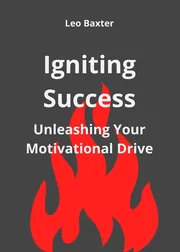
Igniting Success
by Leo Baxter · 2024
Suits adult readers and older teens interested in personal growth and career direction.
142 pages, about 2 to 3.5 hours.
A short, upbeat motivation primer built on exercises and famous examples. 31% taste match
What it covers
Igniting Success, with the subtitle Unleashing Your Motivational Drive, is a self-help book by Leo Baxter, first published in 2024. It belongs to the personal development and motivational psychology shelf, and it runs to about 142 pages. The book looks at how motivation works and how people can build a mindset aimed at success, drawing on motivational theory alongside real-life examples.
The chapters move through topics such as mindset and self-awareness, setting goals, and overcoming procrastination, with practical exercises included along the way. Readers are guided through identifying their core values, clarifying what they want, and drafting a roadmap for personal and professional growth. Figures such as Thomas Edison, J. K. Rowling, and Michael Jordan appear among the people discussed. Baxter writes as a motivational expert, speaking from years of work in personal development. The book suits readers interested in the psychology of success who want structured strategies for building drive and direction in their own lives.
Characters
Leo BaxterThomas EdisonJ. K. RowlingMichael Jordan
Themes
Motivation (Psychology)Motivational & InspirationalMotivationalSelf-help techniquesSelf-HelpSelf helpInspirationInspirational
Of 12 readers who put it on a shelf, 58% want to read it, 8% are reading it now, 33% have finished it and 0% stopped before the end.
By the numbers
- The median edition runs 142 pages. Counting about 275 words a page and an adult reading pace of 250 words a minute, that is about 2.6 hours of reading.
- On reader demand it ranks in the top 51% of the recent releases books in our catalog (1,627 of them).
 BookWard’s take
A short, upbeat motivation primer built on exercises and famous examples
Igniting Success is a 142-page self-help guide on how motivation works and how to build a mindset for success. It moves through mindset, self-awareness, goal-setting and procrastination, with exercises along the way. At that length it stays short and tight, which is a point in its favor. It opens with a quick promise of practical help rather than a story. It leans heavily on the genre's usual toolkit: core values, clarified goals, a roadmap, and examples from Thomas Edison, J. K. Rowling and Michael Jordan. Little here feels fresh or surprising. The outlook is hopeful and idea-led, with the author speaking directly as an expert. Readers who want structured prompts will get them; readers who want rigorous evidence should check how much each chapter leans on anecdote.
At 142 pages it is brief and focused, which suits BookWard's preference for tight books.
A short, exercise-driven guide moves briskly through each topic.
It covers well-trodden motivational ground, so it offers little BookWard would call new.
Practical self-help prose is plain and direct rather than ornate.
The whole book is pitched at lifting readers toward their goals, firmly hopeful.
A chapter-by-chapter guide with exercises is about as conventional as structure gets.
It is earnest and motivational, with little room for comedy.
The tone is encouraging, with overcoming adversity as a theme rather than dwelling on it.
It aims to inspire, producing moderate rather than intense feeling.
See all 50 dialsEvery position, side by side with this book
Where it lines up
- LengthBookWard 1 · book 2
- PaceBookWard 8 · book 7
- Sagging middleBookWard 8 · book 6
Where it pulls apart
- Familiar tropesBookWard 10 · book 2
- Internal logicBookWard 10 · book 5
- OriginalityBookWard 9 · book 2
At 142 pages it is brief and focused, which suits BookWard's preference for tight books.
A practical self-help pitch is a clear promise of help, but not a gripping way into a book.
Goal-setting, core values and success stories of famous figures are the genre's standard moves, far from BookWard's taste for fresh ground.
Self-help guides rarely build airtight arguments, and this one leans on advice and examples more than proof.
A short, exercise-driven guide moves briskly through each topic.
It covers well-trodden motivational ground, so it offers little BookWard would call new.
Motivational writing tends toward encouragement and uplift, more sentimental than the restraint BookWard prefers.
It blends motivational theory with real-life examples, but the pitch is practical inspiration rather than rigorous evidence.
Baxter writes as a motivational expert, a recognizable genre voice more than a singular one.
The book is built around concepts and strategies, not a story, which is more idea-led than BookWard's usual lean.
Advice is explained outright, with exercises telling the reader what to do, the opposite of BookWard's show-in-scene preference.
At this length the material stays compact, with little room to drag.
Practical self-help prose is plain and direct rather than ornate.
The whole book is pitched at lifting readers toward their goals, firmly hopeful.
A chapter-by-chapter guide with exercises is about as conventional as structure gets.
It is earnest and motivational, with little room for comedy.
Practical, accessible self-help asks little of the reader.
A single authorial voice addresses the reader throughout.
A how-to guide has no story to unfold, so there is no shifting timeline.
It is entirely grounded in everyday life and personal growth.
The focus stays on the individual reader's life and goals.
Mindset and self-awareness are central, so it leans toward inner work, with exercises turning that into action.
As a guide it is not built on conversation between characters.
Relationships come up as an area to improve, but romance is not a focus.
It deals in familiar personal and professional settings.
First published in 2024, it speaks to readers' present-day concerns.
The motivation genre revisits familiar ideas, though its basics do last.
The author speaks directly and plainly, with no unreliable framing.
Success and drive are presented as clearly good aims, with little ambiguity.
A how-to guide spends its words on advice rather than scene-setting.
It leans practical and instructional, though real-life examples add some narrative color.
Baxter speaks from years of experience and addresses the reader directly, a personal register.
It presents itself as a self-contained guide.
A guide to motivation has no plot, so surprises are few.
It encourages and reassures more than it unsettles.
The tone is encouraging, with overcoming adversity as a theme rather than dwelling on it.
It aims to inspire, producing moderate rather than intense feeling.
Nothing in a motivational guide calls for violence.
It is not a book that deals in sexual content.
It focuses on personal growth, not political argument.
Plain, accessible language throughout.
Baxter advises and persuades throughout, an opinionated stance by design.
It is oriented toward goals and future change in the reader's life.
The book promises fulfillment and the ability to reach your dreams, an idealistic worldview.
Review written by BookWard, dial version 1, November 2026.
Who is Igniting Success right for?
Suits adult readers and older teens interested in personal growth and career direction. Nothing sensitive is flagged, though readers in difficult circumstances may find advice on mindset only a partial answer.
Practical, accessible self-help asks little of the reader.
The tone is encouraging, with overcoming adversity as a theme rather than dwelling on it.
It aims to inspire, producing moderate rather than intense feeling.
Nothing in a motivational guide calls for violence.
Book CompanionIgniting Success: ideas, characters, themes
Motivation can be understood and cultivated through mindset, self-awareness and clear goals, leading to personal and professional growth.
- Mindset matters. The book covers mindset as part of building drive and pursuing success.
- Know yourself. Self-awareness and identifying your core values are part of finding direction.
- Set clear goals. Readers are guided to clarify what they want and set meaningful goals.
- Beat procrastination. One thread covers overcoming procrastination so that intentions turn into action.
- Build a roadmap. The book helps readers draft a roadmap for personal and professional growth, with exercises along the way.
Characters
Leo Baxter
Author and guide
Writes as a motivational expert drawing on years of work in personal development.
Thomas Edison
Example figure
Among the well-known people discussed in the book.
J. K. Rowling
Example figure
Another of the famous figures the book discusses.
Michael Jordan
Example figure
A third well-known person featured in the examples.
Themes
The inner drive that moves a person toward their goals.
The mental outlook that shapes how someone approaches obstacles and opportunity.
Understanding your own values, habits and motives.
Turning vague wishes into clear, meaningful targets.
Closing the gap between intending and doing.
Discussion questions
- Which exercise in the book would be easiest to try this week, and why?
- How do the examples of Edison, Rowling and Jordan shape your view of success?
- What are your core values, and do your current goals reflect them?
- Where does procrastination hold you back most, and what could change that?
- How much of motivation is mindset, and how much is circumstance?
Personalize your Book Companion
This is the general edition. In BookWard, the Companion is written for you: your reading profile, your notes, and spoiler-safe to the page you are on.
Buy, listen or borrow Igniting Success
Each link opens a search for this book on that store, in a new tab.
Read on a device
Borrow
Reviews and community
If you liked Igniting Success
A short, upbeat twelve-lesson manual that trades rigor for encouragement
The Compound EffectDarren HardySmall habits, big results: a short, forceful self-help pitch
No Excuses!Brian TracyA 21-chapter push to swap excuses for self-discipline
Emotional Intelligence 2.0Travis BradberryA short, practical workbook for raising your emotional intelligence
Sources: Open Library.
Track Igniting Success and find your next favorite
Add it to your shelf, rate what you have read, and BookWard will recommend what fits you.
Free to start. No credit card needed.