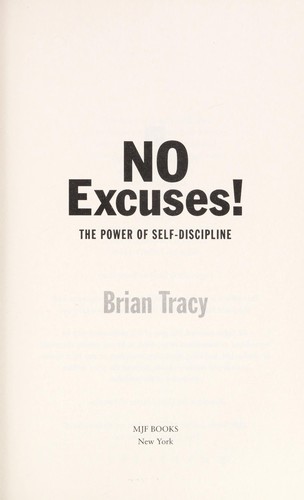
No Excuses!
by Brian Tracy
★ Top 25 book of 2010 · #14 on Best Books of 2010
Brian Tracy argues that success depends on self-discipline rather than luck, wealth or connections. Across 21 chapters with exercises, he shows how to build discipline in personal goals, business and money, and overall happiness.
Best for: Readers who want to stop making excuses and build self-discipline
No Excuses! is #14 on BookWard's Best Books of 2010, out of 43 2010 books that cleared our data bar.
What No Excuses! is about
Brian Tracy argues that self-discipline is what you need to succeed at any goal in life. You do not have to be born lucky, wealthy, well connected or specially skilled. He names two enemies of success: taking the path of least resistance, which is laziness, and wanting immediate gratification, which means ignoring the long-term consequences of what you do.
The book has 21 chapters covering personal goals, business and money goals, and overall happiness. Each chapter shows how to be more disciplined in one area of life and ends with exercises for putting the no-excuses approach into practice. It is practical and motivational, and it suits readers who want a structured, hands-on way to build discipline and take responsibility for their own progress.
No Excuses! on the Best Books of 2010
No Excuses! came out in 2010. Of the 43 books first published in 2010 that met BookWard's data bar, it ranks #14 on our Best Books of 2010 list.
Why it made the list: 522 readers have shelved it on Open Library; readers rate it 4 out of 5 (22 ratings); 57 are reading it right now. The list ranks each year’s books on how many readers have picked them up, how highly readers rate them, and how many are reading them right now.
Nearby on the 2010 list
- Attached Amir Levine, #12
- Full Dark, No Stars Stephen King, #13
- A Dog's Purpose W. Bruce Cameron, #15
- Rework Jason Fried, #16
See all Best Books of 2010 Best books by year
More years: Best Books of 2009 Best Books of 2011.
The numbers behind it
- Readers: 448 want to read it, 57 are reading it now and 17 have read it, according to Open Library.
- Ratings: 4 out of 5 from 22 Open Library ratings.
| Signal | This book (0 to 100) | Weight |
|---|---|---|
| Reach | 67 | 55% |
| Reader love | 51 | 25% |
| Being read right now | 84 | 20% |
Questions about No Excuses!
When was No Excuses! published?
No Excuses! by Brian Tracy was first published in 2010.
Was No Excuses! one of the best books of 2010?
No Excuses! is #14 on BookWard's Best Books of 2010, out of 43 2010 books that cleared our data bar. 522 readers have shelved it on Open Library; readers rate it 4 out of 5 (22 ratings); 57 are reading it right now.
Why is No Excuses! on the Best Books of 2010 list?
522 readers have shelved it on Open Library; readers rate it 4 out of 5 (22 ratings); 57 are reading it right now.
More of the best books of 2010
- The Lost Hero Rick Riordan, #1
- The Way of Kings Brandon Sanderson, #2
- Divergent Veronica Roth, #3
- The Personal MBA Josh Kaufman, #4
- It's Not Summer Without You Jenny Han, #5
- The Red Pyramid Rick Riordan, #6
See the full Best Books of 2010, the Top 100, or new books on Rising.
How we know
This page uses public data: Open Library reader counts and ratings, and Wikipedia page views for recent years. The description is paraphrased from real source text. Rankings reflect reading interest, not quality or sales, and can be affected by data gaps. Lists update monthly.
Suits adults and older teens interested in habits, careers and money.
Depends on the edition you pick.
A 21-chapter push to swap excuses for self-discipline. 35% taste match
 BookWard’s take
A 21-chapter push to swap excuses for self-discipline
No Excuses! is a self-help book built on one claim: success comes from self-discipline, not luck, money or connections. Its 21 chapters each take one area of life, and each ends with exercises, so it works as a workbook as much as a read. That structure is its strength. The premise lands at once, and every chapter does the same job, so there's no sagging middle. It is idea-led and plainly explained, which suits readers who want instruction rather than story. The weak spots are rigor and originality, since the book leans on motivational argument and a message most readers will already know. The clichés are where it strains hardest. The tone is earnest throughout, with little restraint.
The message is a familiar one in the self-help genre, so it falls short of BookWard's appetite for originality.
Plain, direct language fits a practical guide and sits near BookWard's less ornate end.
It insists anyone can succeed through discipline, a strongly hopeful outlook that matches BookWard's lean.
A conventional run of chapters with end exercises, more conventional than BookWard's middling taste.
The tone is earnest and instructional rather than comic.
The material is gentle and motivational.
Moderately stirring in its push to act, but not intense.
See all 50 dialsEvery position, side by side with this book
Where it lines up
- PaceBookWard 8 · book 7
- Sagging middleBookWard 8 · book 7
- OpeningBookWard 10 · book 8
Where it pulls apart
- Familiar tropesBookWard 10 · book 2
- ExpositionBookWard 2 · book 9
- Internal logicBookWard 10 · book 6
The premise of dropping excuses is stated immediately, so it grabs attention quickly, as BookWard likes.
Self-discipline and goal-setting advice is well-worn ground, which runs against BookWard's dislike of familiar tropes.
The argument is simple and consistent, but motivational reasoning is less airtight than BookWard prefers.
The message is a familiar one in the self-help genre, so it falls short of BookWard's appetite for originality.
Each chapter closes with exercises and a clear takeaway, giving the resolution BookWard enjoys.
The tone is earnest and encouraging, a little more sentimental than BookWard's restrained taste.
It is entirely driven by ideas and instruction, well beyond BookWard's story-leaning taste.
Advice is explained outright rather than dramatized, the opposite of BookWard's preference for showing.
The repeated chapter format keeps energy even, though sameness is a risk, which BookWard tolerates.
Plain, direct language fits a practical guide and sits near BookWard's less ornate end.
It insists anyone can succeed through discipline, a strongly hopeful outlook that matches BookWard's lean.
A conventional run of chapters with end exercises, more conventional than BookWard's middling taste.
The tone is earnest and instructional rather than comic.
Plain advice in short chapters is easy going, easier than BookWard's moderate preference.
A single authorial perspective speaks to the reader throughout.
The book proceeds in a straight line from chapter to chapter.
Entirely grounded in everyday goals and habits.
The focus is on one reader's personal habits, an intimate scale like BookWard's lean.
It balances mindset with concrete actions, landing near the middle of the scale.
As an advice book it has almost no dialogue, well under BookWard's taste.
The setting is the reader's own familiar working and personal life.
Written in 2010 for contemporary readers dealing with modern careers and money.
Discipline advice endures, though the packaging is of the self-help genre of its time.
The author speaks plainly and directly, with no unreliability.
It takes a clear line on what to do, far from the ambiguity BookWard tolerates.
Practical instruction with little scene-setting, sparse next to BookWard's middling taste.
It is organized around steps and exercises, leaning analytical over storytelling.
It addresses the reader directly but keeps a coaching distance, near the middle.
A standalone title.
A how-to book builds toward guidance rather than surprise.
It nudges readers to change their habits, mildly challenging but mostly encouraging.
The material is gentle and motivational.
Moderately stirring in its push to act, but not intense.
None appears on the page.
None appears on the page.
It stays focused on personal achievement rather than public issues.
Plain, accessible language throughout.
The author argues forcefully for a single approach, strongly opinionated.
It urges readers to act now for future payoff, pointing forward.
It holds that anyone can succeed through discipline, a notably idealistic worldview.
Review written by BookWard, dial version 1, November 2026.
Who is No Excuses! right for?
Suits adults and older teens interested in habits, careers and money. Nothing in it is graphic or disturbing.
Plain advice in short chapters is easy going, easier than BookWard's moderate preference.
The material is gentle and motivational.
Moderately stirring in its push to act, but not intense.
None appears on the page.
Book CompanionNo Excuses!: ideas, characters, themes
Self-discipline, not luck or connections, is what separates people who reach their goals from those who only envy others.
- Discipline over luck. Success does not require a lucky start, wealth or special skills, only self-discipline.
- Two enemies of success. Laziness and the craving for immediate gratification are the main obstacles to achievement.
- Think long term. Actions taken today carry consequences, so weigh them against future results.
- Three areas of life. The book covers personal goals, business and money goals, and overall happiness.
- Exercises at chapter end. Each of the 21 chapters closes with exercises for applying the approach to your own life.
Themes
Choosing consistent effort over comfort as the route to results.
Giving up short-term pleasure for long-term gain.
Owning your outcomes rather than blaming circumstances.
Defining what you want in personal, financial and emotional terms.
The idea that discipline serves both achievement and contentment.
Discussion questions
- Which excuse do you reach for most often, and what would drop it?
- Is self-discipline really enough, or do luck and background matter more than the book allows?
- Where do you see the pull of immediate gratification in your own routines?
- Which chapter area, personal, money or happiness, would you tackle first, and why?
- How would you measure whether the end-of-chapter exercises are working?
Personalize your Book Companion
This is the general edition. In BookWard, the Companion is written for you: your reading profile, your notes, and spoiler-safe to the page you are on.
Buy, listen or borrow No Excuses!
Each link opens a search for this book on that store, in a new tab.
Read on a device
Borrow
Reviews and community
If you liked No Excuses!
Small habits, big results: a short, forceful self-help pitch
Emotional Intelligence 2.0Travis BradberryA short, practical workbook for raising your emotional intelligence
Start with WhySimon SinekOne big idea, built on Apple, King and Kennedy
Igniting SuccessLeo BaxterA short, upbeat motivation primer built on exercises and famous examples
Find your own best books
Add what you have read, rate it, and BookWard will recommend what to read next.
Free to start. No credit card needed.