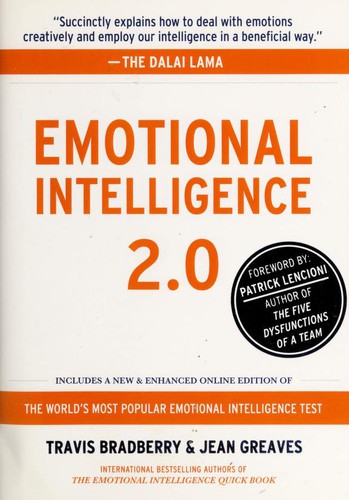
Emotional Intelligence 2.0
by Travis Bradberry
★ Top 25 book of 2009 · #12 on Best Books of 2009
This guide lays out a step-by-step program for raising your emotional intelligence through four core skills: self-awareness, self-management, social awareness and relationship management. Buyers also get online access to an appraisal test.
Best for: Professionals wanting practical steps to build emotional intelligence and get ahead at work
Emotional Intelligence 2.0 is #12 on BookWard's Best Books of 2009, out of 42 2009 books that cleared our data bar.
What Emotional Intelligence 2.0 is about
Emotional intelligence, the book argues, matters a great deal to your success, but knowing what it is and knowing how to use it are two very different things. It offers a step-by-step program for building your own, organised around four core skills: self-awareness, self-management, social awareness and relationship management.
The book is aimed at people in competitive workplaces and turbulent economic conditions who are searching for effective tools to manage, adapt, and get ahead, and it offers a step-by-step program for increasing EQ via four core skills. Buyers also get online access to the Emotional Intelligence Appraisal, taken through TalentSmart.com with a unique code, so readers can measure where they stand. It will help anyone who wants to handle stress, communicate better and work more smoothly with others.
Emotional Intelligence 2.0 on the Best Books of 2009
Emotional Intelligence 2.0 came out in 2009. Of the 42 books first published in 2009 that met BookWard's data bar, it ranks #12 on our Best Books of 2009 list.
Why it made the list: 561 readers have shelved it on Open Library; 29 are reading it right now. The list ranks each year’s books on how many readers have picked them up, how highly readers rate them, and how many are reading them right now.
Nearby on the 2009 list
- The Lost Symbol Dan Brown, #10
- Under the Dome Stephen King, #11
- The Forty Rules of Love Elif Şafak, #13
- Wolf Hall Hilary Mantel, #14
See all Best Books of 2009 Best books by year
More years: Best Books of 2008 Best Books of 2010.
The numbers behind it
- Readers: 514 want to read it, 29 are reading it now and 18 have read it, according to Open Library.
| Signal | This book (0 to 100) | Weight |
|---|---|---|
| Reach | 76 | 55% |
| Reader love | 38 | 25% |
| Being read right now | 79 | 20% |
Questions about Emotional Intelligence 2.0
When was Emotional Intelligence 2.0 published?
Emotional Intelligence 2.0 by Travis Bradberry was first published in 2009.
Was Emotional Intelligence 2.0 one of the best books of 2009?
Emotional Intelligence 2.0 is #12 on BookWard's Best Books of 2009, out of 42 2009 books that cleared our data bar. 561 readers have shelved it on Open Library; 29 are reading it right now.
Why is Emotional Intelligence 2.0 on the Best Books of 2009 list?
561 readers have shelved it on Open Library; 29 are reading it right now.
More of the best books of 2009
- The Last Olympian Rick Riordan, #1
- Catching Fire Suzanne Collins, #2
- The Maze Runner James Dashner, #3
- The Help Kathryn Stockett, #4
- Dork Diaries Rachel Renée Russell, #5
- I Will Teach You to Be Rich Ramit Sethi, #6
See the full Best Books of 2009, the Top 100, or new books on Rising.
How we know
This page uses public data: Open Library reader counts and ratings, and Wikipedia page views for recent years. The description is paraphrased from real source text. Rankings reflect reading interest, not quality or sales, and can be affected by data gaps. Lists update monthly.
Suits working adults and older teens who want practical help with people skills and emotions.
Depends on the edition you pick.
A short, practical workbook for raising your emotional intelligence. 33% taste match
 BookWard’s take
A short, practical workbook for raising your emotional intelligence
Emotional Intelligence 2.0 is a self-help manual built around four skills: self-awareness, self-management, social awareness and relationship management. It is organized as a program, with strategies you can try one at a time, and it comes with an online appraisal so you can measure where you start. The approach is thoroughly idea-led and explicit. Everything is laid out and explained rather than dramatized, and there is little in the way of scene or story, which is not where my own reading tastes lean. It also rests mostly on its own test and framework rather than on deep evidence, so it falls short of the rigor I value in a book like this. Its strength is clarity and usefulness. If you want a plain, usable toolkit rather than a literary experience, it delivers.
A compact program organized around four skills, closer to a workbook than a long treatise, which suits BookWard's liking for tight books.
Brisk, strategy-by-strategy delivery keeps it moving, in line with BookWard's taste for pace.
Emotional intelligence was already well known by this point, so the book packages familiar ideas into a usable program.
Plain, practical language aimed at ease of use, plainer even than BookWard's slightly plain leaning.
It is built on the premise that anyone can improve their EQ, which gives it a hopeful, optimistic outlook.
A conventional program layout of skills and strategies, with no formal experiments.
A serious, practical manual that is not aiming for laughs.
Gentle throughout, with no dark material.
Its subject is emotion, but the delivery is measured and instructional.
See all 50 dialsEvery position, side by side with this book
Where it lines up
- PaceBookWard 8 · book 7
- LengthBookWard 1 · book 3
- Sagging middleBookWard 8 · book 6
Where it pulls apart
- Familiar tropesBookWard 10 · book 3
- ExpositionBookWard 2 · book 9
- OpeningBookWard 10 · book 6
A compact program organized around four skills, closer to a workbook than a long treatise, which suits BookWard's liking for tight books.
It opens by promising practical tools for the workplace, a clear pitch but not a gripping opening.
It leans on familiar self-help framing and workplace success language, short of the fresh approach BookWard rewards.
The four-skill structure is orderly and easy to follow, though its claims are less tightly argued than BookWard prefers.
Brisk, strategy-by-strategy delivery keeps it moving, in line with BookWard's taste for pace.
Emotional intelligence was already well known by this point, so the book packages familiar ideas into a usable program.
Encouraging and motivational in tone, without being syrupy, sitting in the middle against BookWard's restraint.
It rests on a four-skill framework and a proprietary appraisal rather than extensive evidence, short of the rigor BookWard values.
A functional, instructional voice that serves the program more than it stamps a personality on the page.
This is a book of concepts and skills, far from the story-led pole BookWard prefers.
It explains its framework and strategies outright rather than dramatizing them, the reverse of BookWard's show-it-in-scene taste.
Skill-by-skill organization keeps each section purposeful, though manuals can feel repetitive across strategies.
Plain, practical language aimed at ease of use, plainer even than BookWard's slightly plain leaning.
It is built on the premise that anyone can improve their EQ, which gives it a hopeful, optimistic outlook.
A conventional program layout of skills and strategies, with no formal experiments.
A serious, practical manual that is not aiming for laughs.
Written to be easy to pick up and apply, with little reading effort required.
A single instructional voice speaks throughout.
It progresses linearly through the four skills.
Entirely grounded in everyday work and relationships.
A manual for the individual reader, with no cast to track.
Intimate in scope, focused on one person's habits and interactions.
It spans inner self-awareness and outward behavior, with a modest tilt toward the inner.
As a skills manual it is not built on dialogue.
Not a topic here; the focus is work and general relationships.
The familiar world of offices, colleagues and daily relationships.
Aimed at the competitive, uncertain workplace of its own day, so it speaks to the present.
The skills are lasting, but the workplace framing ties it somewhat to its time.
A straightforward instructor with nothing to hide.
It promotes clear, positive behaviors with little ambiguity.
Sparse in scenic detail; it describes skills rather than places or people.
Its framework-and-exercises approach is analytical rather than narrative.
It addresses the reader directly and personally, with a coaching feel.
Standalone as a program, though it draws on a wider EQ product line.
A practical manual has no plot surprises.
Mildly challenging in asking you to examine your habits, but largely comforting and encouraging.
Gentle throughout, with no dark material.
Its subject is emotion, but the delivery is measured and instructional.
None; this is a workplace skills book.
None; this is a workplace skills book.
Not political; it concerns personal and workplace effectiveness.
Plain, accessible language throughout.
It advocates a specific method and pushes it with conviction.
Aimed at improving your future performance and relationships.
Optimistic that skills can be learned and lives improved.
Review written by BookWard, dial version 1, November 2026.
Who is Emotional Intelligence 2.0 right for?
Suits working adults and older teens who want practical help with people skills and emotions. It contains no graphic or mature content.
Written to be easy to pick up and apply, with little reading effort required.
Gentle throughout, with no dark material.
Its subject is emotion, but the delivery is measured and instructional.
None; this is a workplace skills book.
Book CompanionEmotional Intelligence 2.0: ideas, characters, themes
Emotional intelligence is a set of four learnable skills, and deliberate practice can raise your EQ and help you succeed at work and in relationships.
- Four core skills. The program is organized around self-awareness, self-management, social awareness and relationship management.
- Knowing versus doing. Understanding what EQ is differs from knowing how to apply it, and the book focuses on application.
- A step-by-step approach. It offers a structured program rather than just a concept, so readers can work through it in order.
- Measuring your EQ. Purchase includes online access to an appraisal test, letting you assess where you stand.
- Aimed at the workplace. It pitches EQ as a tool for competitive, fast-moving work environments and uncertain economic times.
Themes
Recognizing your own emotions and tendencies as they happen.
Using that awareness to steer your behavior rather than react.
Reading the emotions and needs of the people around you.
Using your awareness of yourself and others to handle interactions well.
The idea that EQ is critical to getting ahead and adapting.
Discussion questions
- Which of the four skills do you think you are strongest in, and which weakest?
- Is emotional intelligence something that can really be trained, or is it mostly fixed?
- How useful is a self-assessment test for measuring something as personal as EQ?
- Why might knowing about EQ be so different from actually using it?
- How do these skills change how you would handle a difficult colleague or a stressful week?
Personalize your Book Companion
This is the general edition. In BookWard, the Companion is written for you: your reading profile, your notes, and spoiler-safe to the page you are on.
Buy, listen or borrow Emotional Intelligence 2.0
Each link opens a search for this book on that store, in a new tab.
Read on a device
Borrow
Reviews and community
If you liked Emotional Intelligence 2.0
A 21-chapter push to swap excuses for self-discipline
Igniting SuccessLeo BaxterA short, upbeat motivation primer built on exercises and famous examples
Why Has Nobody Told Me This Before?Julie SmithShort, practical mental health tools from a clinical psychologist, easy to dip into
Adult Children of Emotionally Immature ParentsLindsay C. GibsonA clear, practical guide for adults raised by emotionally unavailable parents
Find your own best books
Add what you have read, rate it, and BookWard will recommend what to read next.
Free to start. No credit card needed.