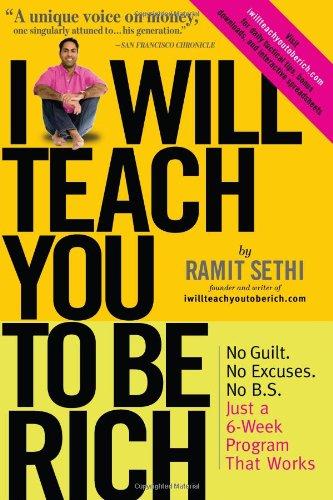
I Will Teach You to Be Rich
by Ramit Sethi
★ Top 10 book of 2009 · #6 on Best Books of 2009
Ramit Sethi offers a practical six-week personal finance program for young adults, built on banking, saving, budgeting, and investing. His nonjudgmental style and companion website help readers start building wealth with small steps.
Best for: Twenty-somethings and early-career readers who want a practical, approachable path to managing money
I Will Teach You to Be Rich is #6 on BookWard's Best Books of 2009, out of 42 2009 books that cleared our data bar.
What I Will Teach You to Be Rich is about
Ramit Sethi's guide to money is aimed at people between 20 and 35 who want to take control of their finances without feeling lectured. It lays out a 6-week program built on four pillars: banking, saving, budgeting and investing, with ideas from personal entrepreneurship about building wealth.
The style is practical, confident and nonjudgmental. Topics include credit cards, negotiation, taxes and how to begin with only $20. Sethi's first key lesson is that getting started matters more than being the smartest person in the room. The book connects to his website, which offers interactive charts, and it grew out of his blog of the same name. It will help young adults who feel behind on money and want clear steps rather than theory.
I Will Teach You to Be Rich on the Best Books of 2009
I Will Teach You to Be Rich came out in 2009. Of the 42 books first published in 2009 that met BookWard's data bar, it ranks #6 on our Best Books of 2009 list.
Why it made the list: 873 readers have shelved it on Open Library; readers rate it 4.3 out of 5 (15 ratings); 25 are reading it right now. The list ranks each year’s books on how many readers have picked them up, how highly readers rate them, and how many are reading them right now.
Nearby on the 2009 list
- The Help Kathryn Stockett, #4
- Dork Diaries Rachel Renée Russell, #5
- The 4-Hour Workweek Timothy Ferriss, #7
- Wintergirls Laurie Halse Anderson, #8
See all Best Books of 2009 Best books by year
More years: Best Books of 2008 Best Books of 2010.
The numbers behind it
- Readers: 828 want to read it, 25 are reading it now and 20 have read it, according to Open Library.
- Ratings: 4.3 out of 5 from 15 Open Library ratings.
| Signal | This book (0 to 100) | Weight |
|---|---|---|
| Reach | 83 | 55% |
| Reader love | 69 | 25% |
| Being read right now | 76 | 20% |
Questions about I Will Teach You to Be Rich
When was I Will Teach You to Be Rich published?
I Will Teach You to Be Rich by Ramit Sethi was first published in 2009.
Was I Will Teach You to Be Rich one of the best books of 2009?
I Will Teach You to Be Rich is #6 on BookWard's Best Books of 2009, out of 42 2009 books that cleared our data bar. 873 readers have shelved it on Open Library; readers rate it 4.3 out of 5 (15 ratings); 25 are reading it right now.
Why is I Will Teach You to Be Rich on the Best Books of 2009 list?
873 readers have shelved it on Open Library; readers rate it 4.3 out of 5 (15 ratings); 25 are reading it right now.
More of the best books of 2009
- The Last Olympian Rick Riordan, #1
- Catching Fire Suzanne Collins, #2
- The Maze Runner James Dashner, #3
- The Help Kathryn Stockett, #4
- Dork Diaries Rachel Renée Russell, #5
- The 4-Hour Workweek Timothy Ferriss, #7
See the full Best Books of 2009, the Top 100, or new books on Rising.
How we know
This page uses public data: Open Library reader counts and ratings, and Wikipedia page views for recent years. The description is paraphrased from real source text. Rankings reflect reading interest, not quality or sales, and can be affected by data gaps. Lists update monthly.
It suits young adults and early-career readers, especially anyone new to managing money.
Depends on the edition you pick.
A practical six-week money system with a bossy, friendly voice. 42% taste match
 BookWard’s take
A practical six-week money system with a bossy, friendly voice
Ramit Sethi's 2009 personal finance book is built as a six-week program for people in their twenties and early thirties, organized around four pillars: banking, saving, budgeting and investing. It is idea-led and openly instructional: the book explains outright what to do and why. Its strongest card is the voice, a direct, nonjudgmental tone that treats money as something you set up once and automate. It starts with a low barrier, getting going with as little as $20, which makes for a genuinely inviting opening for a how-to. A reader who prizes restraint and original ideas may find that the book trades subtlety for clear steps. It is an easy read, and the structure is deliberately conventional.
A six-week program in a single volume, long enough to cover four pillars but built to be worked through, not sprawled across.
The pillars are standard personal finance; the originality is in the tone and the automation-first, nonjudgmental pitch.
The writing is plain and conversational, built for clarity over style.
It is relentlessly encouraging, telling readers that getting started matters more than being the smartest person in the room.
A conventional self-help layout with a program, chapters and steps, nothing experimental.
The tone is cheeky and casual, with jokes and attitude, though the subject keeps it from being a comedy.
Content is gentle; the worst it gets is worry about debt.
It aims for motivation and confidence, not deep emotional intensity.
See all 50 dialsEvery position, side by side with this book
Where it lines up
- Authorial voiceBookWard 9 · book 9
- PaceBookWard 8 · book 7
- OpeningBookWard 10 · book 8
Where it pulls apart
- Familiar tropesBookWard 10 · book 5
- ExpositionBookWard 2 · book 9
- LengthBookWard 1 · book 5
A six-week program in a single volume, long enough to cover four pillars but built to be worked through, not sprawled across.
Budgeting and saving advice is familiar territory, though the friendly, anti-guilt framing freshens it a little.
The four pillars give a clear step-by-step sequence, though some claims rest on assertion more than proof.
The pillars are standard personal finance; the originality is in the tone and the automation-first, nonjudgmental pitch.
There is no cast to draw; the reader and the author's voice are the only personalities that matter.
Finishing the program gives a defined end state, a working system, which suits BookWard's liking for resolution.
It is pragmatic and motivational rather than weepy, with some pep-talk warmth that leans slightly sentimental.
It offers practical steps and rules of thumb rather than deep research, so it leans more advice than evidence.
Sethi's brash, confident, conversational voice is the book's signature and easy to recognize.
This is an idea-led how-to with no plot, built around a system for handling money.
It explains its ideas outright, step by step, the opposite of BookWard's show-in-scene preference, by design.
The writing is plain and conversational, built for clarity over style.
It is relentlessly encouraging, telling readers that getting started matters more than being the smartest person in the room.
A conventional self-help layout with a program, chapters and steps, nothing experimental.
The tone is cheeky and casual, with jokes and attitude, though the subject keeps it from being a comedy.
It is written for beginners and is easy to follow without prior financial knowledge.
Everything comes through one author's perspective speaking directly to the reader.
Its sequence is a straight six-week plan with no jumping around in time.
It is entirely practical and grounded in everyday money decisions.
The cast is essentially the author and you, the reader.
The scope is personal and household, one reader's finances rather than the wider economy.
It focuses on concrete actions like opening accounts and negotiating, more than on introspection.
As advice nonfiction it has little back-and-forth, mostly direct address and the occasional example.
Romance does not feature; the subject is money and career.
The world is everyday modern life, banks, credit cards and workplaces most readers already know.
Published in 2009 and aimed at young adults of that moment, it still reads as contemporary personal finance.
Core ideas like automating savings last, but specific products and tactics date quickly.
The author speaks plainly in his own voice with nothing hidden.
It takes clear stands on what to do with money and tells you directly.
Description is minimal; the book is instructions and examples, not scene-setting.
It mixes explanation and step-by-step instruction with some anecdote, landing between narrative and analytical.
Sethi writes in first person and addresses the reader directly, a personal and engaged stance.
It stands alone as a complete program.
As a how-to, it holds no plot surprises, only tips you may not have heard.
It nudges readers to change habits and talks frankly about money, but it is reassuring more than confronting.
Content is gentle; the worst it gets is worry about debt.
It aims for motivation and confidence, not deep emotional intensity.
The humor is bold and playful, with punchy asides closer to broad than dry.
There is no violence in a personal finance guide.
Sexual content is absent.
Politics sits in the background, with the focus on personal decisions rather than policy.
The language is plain and conversational with no dense jargon barrier.
It is strongly opinionated, telling readers exactly what to do and what to ignore.
The whole point is building future wealth, so it looks forward.
It is optimistic about what a simple system can do, though it frames the optimism practically.
Review written by BookWard, dial version 1, November 2026.
Who is I Will Teach You to Be Rich right for?
It suits young adults and early-career readers, especially anyone new to managing money. It discusses debt, credit cards and spending habits, which may feel uncomfortable if money is a source of stress.
It is written for beginners and is easy to follow without prior financial knowledge.
Content is gentle; the worst it gets is worry about debt.
It aims for motivation and confidence, not deep emotional intensity.
There is no violence in a personal finance guide.
Book CompanionI Will Teach You to Be Rich: ideas, characters, themes
Set up a simple, automated money system across banking, saving, budgeting and investing, and start now instead of waiting to be an expert.
- Four pillars. The program rests on banking, saving, budgeting and investing, tackled in a six-week sequence.
- Start small. Getting started matters more than being the smartest person in the room, even if you begin with $20.
- Budgeting without misery. The book argues budgeting does not have to suck and should fit your life instead of punishing you.
- Cheap versus frugal. It separates plain cheapness from deliberate frugality, spending on what you value and cutting what you do not.
- Negotiate and grow income. It covers negotiating and building relationships, with entrepreneurial wealth-building ideas alongside saving.
Themes
Letting systems handle money tasks so progress does not depend on willpower.
Taking imperfect action early beats waiting for perfect knowledge.
Spending on what matters is fine when the basics are handled.
Understanding your money reduces anxiety and builds a sense of control.
Increasing income through negotiation and entrepreneurship, not only cutting costs.
Discussion questions
- Which of the four pillars do you most need to fix, and what would your first week look like?
- Is starting with a small amount enough to change your habits, or does it risk feeling too minor?
- Where is the line between cheap and frugal in your own spending?
- Would automating your finances make you more engaged with money or less?
- How much does a confident, bossy tone help or hurt advice you plan to act on?
Personalize your Book Companion
This is the general edition. In BookWard, the Companion is written for you: your reading profile, your notes, and spoiler-safe to the page you are on.
Buy, listen or borrow I Will Teach You to Be Rich
Each link opens a search for this book on that store, in a new tab.
Read on a device
Borrow
Reviews and community
If you liked I Will Teach You to Be Rich
A self-taught learner's practical blueprint for mastering hard skills fast
The Lean StartupEric RiesA business method built on testing ideas against real customers early
Dotcom SecretsRussell BrunsonA funnel-building playbook that treats marketing as a system, not a trick
How to Talk to AnyoneLeil Lowndes92 named conversation techniques, built to be used at your next party
Find your own best books
Add what you have read, rate it, and BookWard will recommend what to read next.
Free to start. No credit card needed.