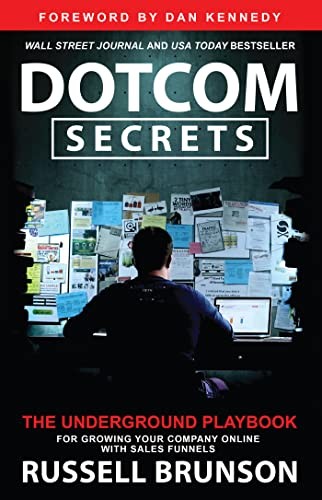
Dotcom Secrets
by Russell Brunson
★ Top 25 book of 2011 · #19 on Best Books of 2011
Russell Brunson argues that weak traffic and poor conversions point to a deeper problem: your sales funnel. This updated edition offers frameworks and scripts, drawn from thousands of split tests, to turn leads into customers.
Best for: Online business owners and marketers wanting to fix their sales funnel
Dotcom Secrets is #19 on BookWard's Best Books of 2011, out of 53 2011 books that cleared our data bar.
What Dotcom Secrets is about
An updated edition of Russell Brunson's guide to growing a business online through sales funnels. Brunson, co-founder and CEO of ClickFunnels, argues that low traffic or poor conversion rates are only symptoms of a larger problem that is easier to fix than it looks: most businesses really have a funnel problem. A funnel is the online process that carries potential customers toward becoming actual ones, and his point is that everyone has one, which either brings people in or pushes them away. The book sets out to teach how to build funnels well, and it positions itself as more than another internet marketing how-to. It will suit entrepreneurs and small business owners who want a clearer way to attract and keep customers.
Dotcom Secrets on the Best Books of 2011
Dotcom Secrets came out in 2011. Of the 53 books first published in 2011 that met BookWard's data bar, it ranks #19 on our Best Books of 2011 list.
Why it made the list: 577 readers have shelved it on Open Library; 38 are reading it right now. The list ranks each year’s books on how many readers have picked them up, how highly readers rate them, and how many are reading them right now.
Nearby on the 2011 list
- The Art of Thinking Clearly Rolf Dobelli, #17
- The Wise Man’s Fear Patrick Rothfuss, #18
- Insurgent Veronica Roth, #20
- Fifty Shades Darker E. L. James, #21
See all Best Books of 2011 Best books by year
More years: Best Books of 2010 Best Books of 2012.
The numbers behind it
- Readers: 527 want to read it, 38 are reading it now and 12 have read it, according to Open Library.
| Signal | This book (0 to 100) | Weight |
|---|---|---|
| Reach | 58 | 55% |
| Reader love | 68 | 25% |
| Being read right now | 62 | 20% |
Questions about Dotcom Secrets
When was Dotcom Secrets published?
Dotcom Secrets by Russell Brunson was first published in 2011.
Was Dotcom Secrets one of the best books of 2011?
Dotcom Secrets is #19 on BookWard's Best Books of 2011, out of 53 2011 books that cleared our data bar. 577 readers have shelved it on Open Library; 38 are reading it right now.
Why is Dotcom Secrets on the Best Books of 2011 list?
577 readers have shelved it on Open Library; 38 are reading it right now.
More of the best books of 2011
- Sapiens Yuval Noah Harari, #1
- The Song of Achilles Madeline Miller, #2
- Thinking, Fast and Slow Daniel Kahneman, #3
- Steve Jobs Walter Isaacson, #4
- The Son of Neptune Rick Riordan, #5
- Shatter Me Tahereh Mafi, #6
See the full Best Books of 2011, the Top 100, or new books on Rising.
How we know
This page uses public data: Open Library reader counts and ratings, and Wikipedia page views for recent years. The description is paraphrased from real source text. Rankings reflect reading interest, not quality or sales, and can be affected by data gaps. Lists update monthly.
Suits adults and older teens curious about online business and marketing.
Depends on the edition you pick.
A funnel-building playbook that treats marketing as a system, not a trick. 35% taste match
 BookWard’s take
A funnel-building playbook that treats marketing as a system, not a trick
Dotcom Secrets argues that low traffic and weak conversions are only symptoms, and that the real problem is the funnel: the online path that turns strangers into customers. Russell Brunson, co-founder of ClickFunnels, builds the book around frameworks, scripts and worked processes drawn from his own split tests. It is idea-led and explains things outright rather than dramatizing them in scene, which suits a manual. Where it strains is rigor: the evidence is one practitioner's experience, so it reads as anecdotal rather than measured. The voice is distinctive and salesy, and the opening is immediate, since the first pages promise a fix. Treat it as a practical toolkit with a strong point of view, not a neutral study.
A compact business manual built from short, modular chapters rather than a sprawling argument, which sits close to BookWard's taste for tight books.
Short sections move briskly from concept to tactic, close to BookWard's preference for momentum.
The funnel framing is the author's own angle, yet the wider genre of direct-response marketing advice is well worn.
Plain, conversational and functional, written to be understood quickly, not admired.
There is no plot or character arc; the book is driven by method, so it sits at the plot-driven end by default.
Relentlessly optimistic: every problem has a funnel-shaped fix, a brighter outlook than BookWard's average.
Conventional chapter-by-chapter instruction with no formal experimentation.
Mostly earnest and promotional, with light salesman's humor at most.
A gentle read with no dark material.
Motivational energy rather than deep emotion.
See all 50 dialsEvery position, side by side with this book
Where it lines up
- PaceBookWard 8 · book 7
- Authorial voiceBookWard 9 · book 8
- OpeningBookWard 10 · book 8
Where it pulls apart
- Familiar tropesBookWard 10 · book 3
- Shock for effectBookWard 9 · book 1
- ExpositionBookWard 2 · book 10
A compact business manual built from short, modular chapters rather than a sprawling argument, which sits close to BookWard's taste for tight books.
It opens by promising to fix the real problem behind low traffic and conversions, so the payoff is stated at once, though in sales language.
Self-help marketing conventions and promotional framing recur, so it sits on the familiar side of what BookWard likes to avoid.
The funnel framework is coherent and each step follows from the last, but claims rest on the author's results rather than airtight proof.
Short sections move briskly from concept to tactic, close to BookWard's preference for momentum.
The funnel framing is the author's own angle, yet the wider genre of direct-response marketing advice is well worn.
There is no cast to speak of; the book is about processes and the reader, so depth of character does not really apply.
Motivational and encouraging in tone, leaning warm and promotional rather than restrained.
Nothing here relies on shock; the stakes are business outcomes, so the book is simply gentle on this dial.
It draws on the author's own split tests, which is practical but anecdotal rather than rigorous, a gap for BookWard's standards.
Brunson's energetic, self-assured and salesy voice is unmistakable, which BookWard values even where the style is not its own.
This is an idea-led how-to, with concepts and scripts doing the work, which matches where BookWard's taste leans.
Frameworks and steps are explained outright, the opposite of BookWard's preference for showing, though that is what a manual does.
Plain, conversational and functional, written to be understood quickly, not admired.
There is no plot or character arc; the book is driven by method, so it sits at the plot-driven end by default.
Relentlessly optimistic: every problem has a funnel-shaped fix, a brighter outlook than BookWard's average.
Conventional chapter-by-chapter instruction with no formal experimentation.
Mostly earnest and promotional, with light salesman's humor at most.
Easy to follow and written for beginners, with no dense argument to wrestle with.
A single authorial perspective throughout, delivered directly to the reader.
Linear, moving step by step through building a funnel.
Entirely grounded in real online business practice.
There is no cast to speak of; the author and the reader are the only presences.
Focused on one business and its customer path, so intimate in scope.
About actions to take and systems to build rather than inner reflection.
Largely exposition and instruction, with scripts quoted rather than conversation.
No romance at all.
The online marketing world is familiar to anyone who has run or seen a website.
Written about the internet business landscape of the 2010s, so recent and present-oriented.
Platform tactics date quickly, though the core idea of guiding customers through a path may hold.
The author speaks plainly in his own name, so the narrator is reliable in a narrow sense.
Business advice with little moral ambiguity; the aim is clear.
Spare and functional, with description serving the examples rather than atmosphere.
Mixes personal story with frameworks, but leans toward instructional and analytical delivery.
The author inserts his own experience and results constantly, so it reads as personal.
Part of a broader family of the author's books and tools, which the text points toward.
A how-to manual with few surprises beyond the reframe that funnels, not traffic, are the problem.
Mostly comforting and encouraging, though it asks the reader to rethink their approach.
A gentle read with no dark material.
Motivational energy rather than deep emotion.
Salesman-style, broad and breezy rather than dry.
None.
None.
Absent; it is about marketing and sales.
Plain business English with some marketing jargon.
Strongly opinionated, presenting one approach as the answer.
Aimed at what the reader should build next, so forward-looking.
Optimistic and entrepreneurial, believing the right process unlocks growth.
Review written by BookWard, dial version 1, November 2026.
Who is Dotcom Secrets right for?
Suits adults and older teens curious about online business and marketing. There is no sensitive content, though the sales-driven tone is promotional.
Easy to follow and written for beginners, with no dense argument to wrestle with.
A gentle read with no dark material.
Motivational energy rather than deep emotion.
None.
Book CompanionDotcom Secrets: ideas, characters, themes
Low traffic and weak conversions are symptoms of a deeper funnel problem, and building the right online path for customers is the fix.
- Everyone has a funnel. Every business already leads customers through some process, and it either attracts or repels them.
- Symptoms versus cause. Traffic and conversion problems point to a larger underlying funnel problem.
- Frameworks over tweaks. Structured processes beat small headline or button adjustments.
- Testing drives learning. The author's methods come from running many split tests.
- Scripts and implementation. The book offers ready scripts and processes to put into action.
Themes
Treating marketing as a connected process rather than isolated tactics.
Belief that the right method produces growth.
Guiding people from stranger to buyer.
Learning from testing rather than guessing.
Discussion questions
- What is the difference between a traffic problem and a funnel problem?
- Which part of your own customer path would you map first?
- How much weight should one practitioner's results carry?
- Where does persuasion end and pressure begin?
- Which advice would date fastest as platforms change?
Personalize your Book Companion
This is the general edition. In BookWard, the Companion is written for you: your reading profile, your notes, and spoiler-safe to the page you are on.
Buy, listen or borrow Dotcom Secrets
Each link opens a search for this book on that store, in a new tab.
Read on a device
Borrow
Reviews and community
If you liked Dotcom Secrets
Maxwell's leadership framework: low road, middle road, high road
I Will Teach You to Be RichRamit SethiA practical six-week money system with a bossy, friendly voice
The Compound EffectDarren HardySmall habits, big results: a short, forceful self-help pitch
Rich Dad's Guide to InvestingRobert T. KiyosakiA cash-flow-first investing primer in Kiyosaki's loud, anecdotal style
Find your own best books
Add what you have read, rate it, and BookWard will recommend what to read next.
Free to start. No credit card needed.