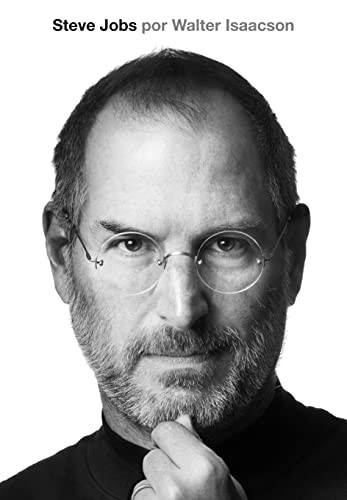
Steve Jobs
by Walter Isaacson
★ Top 5 book of 2011 · #4 on Best Books of 2011
Drawing on more than forty interviews with Jobs himself and over a hundred others, Isaacson portrays a perfectionist whose fierce drive reshaped six industries. Jobs gave no control over the text, so friends and rivals speak frankly about him.
Best for: Readers curious about innovation, creative leadership, and an intense, controlling personality
Steve Jobs is #4 on BookWard's Best Books of 2011, out of 53 2011 books that cleared our data bar.
What Steve Jobs is about
Walter Isaacson's biography of Steve Jobs rests on more than forty interviews with Jobs himself, held over two years, plus conversations with over a hundred relatives, friends, rivals, competitors and colleagues. Jobs agreed to take part but asked for no say over the contents and did not request a look at the manuscript. He also urged the people around him to speak frankly, and nothing was closed off.
The result is a portrait of an intense, perfectionist man whose life swung between highs and lows. His drive reshaped six industries: personal computers, animated films, music, phones, tablets and digital publishing. Isaacson also makes a wider argument, that in the twenty-first century the real value lies in joining creativity to technology. It is a good fit for readers interested in business, design or leadership, and for anyone who wants to understand the person behind the products.
Steve Jobs on the Best Books of 2011
Steve Jobs came out in 2011. Of the 53 books first published in 2011 that met BookWard's data bar, it ranks #4 on our Best Books of 2011 list.
Why it made the list: 2,177 readers have shelved it on Open Library; readers rate it 4.2 out of 5 (174 ratings); 130 are reading it right now. The list ranks each year’s books on how many readers have picked them up, how highly readers rate them, and how many are reading them right now.
It earns Being read right now.
Nearby on the 2011 list
- The Song of Achilles Madeline Miller, #2
- Thinking, Fast and Slow Daniel Kahneman, #3
- The Son of Neptune Rick Riordan, #5
- Shatter Me Tahereh Mafi, #6
See all Best Books of 2011 Best books by year
More years: Best Books of 2010 Best Books of 2012.
The numbers behind it
- Readers: 1,830 want to read it, 130 are reading it now and 216 have read it, according to Open Library.
- Ratings: 4.2 out of 5 from 174 Open Library ratings.
| Signal | This book (0 to 100) | Weight |
|---|---|---|
| Reach | 91 | 55% |
| Reader love | 74 | 25% |
| Being read right now | 91 | 20% |
Questions about Steve Jobs
When was Steve Jobs published?
Steve Jobs by Walter Isaacson was first published in 2011.
Was Steve Jobs one of the best books of 2011?
Steve Jobs is #4 on BookWard's Best Books of 2011, out of 53 2011 books that cleared our data bar. 2,177 readers have shelved it on Open Library; readers rate it 4.2 out of 5 (174 ratings); 130 are reading it right now.
Why is Steve Jobs on the Best Books of 2011 list?
2,177 readers have shelved it on Open Library; readers rate it 4.2 out of 5 (174 ratings); 130 are reading it right now.
More of the best books of 2011
- Sapiens Yuval Noah Harari, #1
- The Song of Achilles Madeline Miller, #2
- Thinking, Fast and Slow Daniel Kahneman, #3
- The Son of Neptune Rick Riordan, #5
- Shatter Me Tahereh Mafi, #6
- The Mark of Athena Rick Riordan, #7
See the full Best Books of 2011, the Top 100, or new books on Rising.
How we know
This page uses public data: Open Library reader counts and ratings, and Wikipedia page views for recent years. The description is paraphrased from real source text. Rankings reflect reading interest, not quality or sales, and can be affected by data gaps. Lists update monthly.
Suits adult and older teen readers curious about business, technology and creative work.
Depends on the edition you pick.
A candid, sprawling portrait of a brilliant, difficult man. 55% taste match
 BookWard’s take
A candid, sprawling portrait of a brilliant, difficult man
Isaacson's biography is long and sprawling, and it earns most of that length. Jobs cooperated but asked for no control over the book, so the result is candid rather than flattering. The reporting is rigorous, resting on more than forty interviews with Jobs and over a hundred others who knew him. It is also character-driven: Jobs's perfectionism and brutal honesty carry the story more than any single product launch does. I tend to favor tight, original books, and this one runs long and follows a familiar arc of rise, fall and return, so both the length and the well-worn shape work against my usual preferences. Still, the voice is plain, the pace steady, and the subject vivid enough to hold the middle.
A full-scale life biography that runs very long, which sits well above BookWard's preference for tight books.
It moves steadily through decades of a life, brisk in places and slower where business detail piles up.
The subject is distinctive, but the biographical form itself is conventional rather than new.
The writing is plain and functional, built to carry information rather than to ornament.
The book runs on Jobs's personality and drive more than on any plot machinery.
It balances triumph and cruelty, landing mildly hopeful about what vision and obsession can build.
It follows a conventional life-story shape from start to finish.
It is mostly serious, with occasional dry moments drawn from the people involved.
Harsh treatment of people and illness make parts heavy without being grim overall.
Moments of conflict and loss land, but the tone stays measured.
See all 50 dialsEvery position, side by side with this book
Where it lines up
- Character depthBookWard 8 · book 8
- EndingBookWard 8 · book 7
- Rigor (nonfiction)BookWard 9 · book 8
Where it pulls apart
- LengthBookWard 1 · book 9
- Familiar tropesBookWard 10 · book 4
- OpeningBookWard 10 · book 7
A full-scale life biography that runs very long, which sits well above BookWard's preference for tight books.
It opens on a compelling subject and cooperation story, though it builds more than it grabs outright.
The rise, fall and return arc is a familiar biography shape, so it leans on convention more than BookWard likes.
Events and decisions follow clearly from one another, and the account hangs together well.
It moves steadily through decades of a life, brisk in places and slower where business detail piles up.
The subject is distinctive, but the biographical form itself is conventional rather than new.
Jobs is drawn in unvarnished detail, with his obsessions, perfectionism and contradictions all on the page.
A life story reaches a settled close, resolving the arc more fully than most books do.
It stays fairly even-handed, though admiration for its subject warms parts of the telling.
The darker material, such as Jobs's harshness toward others, comes from the record, not from effect.
Built on over forty interviews with Jobs and over a hundred others, it is grounded and well sourced.
The prose is clear and professional, with a recognizable biographer's steadiness more than a striking style.
It is led by the story of a life, with ideas about creativity and technology woven through.
A good deal is explained outright, as biography tends to do, instead of dramatized in scene.
Long as it is, the strength of the subject keeps most stretches moving, with some business detail slowing it.
The writing is plain and functional, built to carry information rather than to ornament.
The book runs on Jobs's personality and drive more than on any plot machinery.
It balances triumph and cruelty, landing mildly hopeful about what vision and obsession can build.
It follows a conventional life-story shape from start to finish.
It is mostly serious, with occasional dry moments drawn from the people involved.
Accessible and clearly written, though its length asks for steady commitment.
Many voices, from family to rivals to colleagues, shape the portrait beyond Jobs himself.
It moves through a life in largely chronological order.
Entirely grounded in real events and real people.
A wide cast of colleagues, family, competitors and friends passes through.
It covers a whole career that touched six industries, which gives it real breadth.
It splits between Jobs's inner drives and the outer world of products and companies.
Quoted speech from interviews appears often, though narration carries most of the weight.
Personal relationships appear, but romance is not a central thread.
The business and technology world is familiar to many readers, with some insider detail.
Its decades-long story ends in the early 2010s, recent but no longer current.
Interest in Jobs persists, though the book's tech details date it.
The biographer narrates plainly, with no unreliable framing.
Jobs is shown as both brilliant and cruel, leaving his legacy open to judgment.
Moderate description, focused on people and products over setting.
It is told as narrative biography rather than analysis.
Isaacson stays mostly behind the subject, with limited presence of his own.
A standalone biography.
A life story has turning points but few real surprises for those who know the outline.
It invites you to weigh genius against behavior, which gives it some bite.
Harsh treatment of people and illness make parts heavy without being grim overall.
Moments of conflict and loss land, but the tone stays measured.
Humor is sparing and dry when it appears.
Essentially none on the page.
Little to none.
Business and culture dominate, with politics only at the edges.
Plain, accessible language throughout.
The author largely lets sources speak, with light evaluative framing.
It is mostly retrospective, though it frames Jobs's work as shaping the future.
It admires vision and craft while staying clear about its subject's flaws.
Review written by BookWard, dial version 1, November 2026.
Who is Steve Jobs right for?
Suits adult and older teen readers curious about business, technology and creative work. It includes harsh treatment of colleagues and serious illness, which some readers may find heavy.
Accessible and clearly written, though its length asks for steady commitment.
Harsh treatment of people and illness make parts heavy without being grim overall.
Moments of conflict and loss land, but the tone stays measured.
Essentially none on the page.
Book CompanionSteve Jobs: ideas, characters, themes
Jobs fused creativity and technology through perfectionism and control, and the book shows both the cost and the payoff of that drive.
- Cooperation without control. Jobs agreed to be interviewed but asked for no say over what was written, which lets the book speak frankly.
- Wide sourcing. More than forty interviews with Jobs and over a hundred with family, friends, rivals and colleagues shape the account.
- Six industries. The book traces his influence on personal computers, animated movies, music, phones, tablets and digital publishing.
- Perfectionism and obsession. Jobs's intensity and need for control drive both his products and his friction with people.
- Creativity meets engineering. A recurring thread is the pairing of imaginative leaps with remarkable feats of engineering.
Characters
Steve Jobs
Subject and creative entrepreneur
A perfectionist whose ferocious drive and abrasive personality shaped his company and its products.
Themes
The relentless pursuit of flawless products and its human cost.
How imagination combined with engineering creates lasting value.
Jobs's compulsion to shape every detail of products and people.
How a life's work and character are weighed after the fact.
Discussion questions
- Does Jobs's brilliance excuse how he treated people?
- What makes the pairing of creativity and technology so powerful here?
- How does it affect the book that Jobs gave no control over the text?
- Which of the six industries mentioned feels most changed by him?
- How would you weigh admiration against criticism in his story?
Personalize your Book Companion
This is the general edition. In BookWard, the Companion is written for you: your reading profile, your notes, and spoiler-safe to the page you are on.
Buy, listen or borrow Steve Jobs
Each link opens a search for this book on that store, in a new tab.
Read on a device
Borrow
Reviews and community
If you liked Steve Jobs
Kids in an evacuation camp start pulling at the official story
A Beautiful MindSylvia NasarA mathematician's genius and illness, told with a reporter's patience
PachinkoMin Jin LeeFour generations of a Korean family in Japan, told with patience
The Other Significant OthersRhaina CohenA reported case for making a friend your life partner
Find your own best books
Add what you have read, rate it, and BookWard will recommend what to read next.
Free to start. No credit card needed.