Updated November 2, 2026 · reading data through October 2026
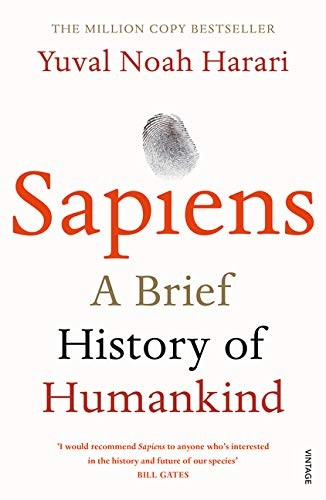
Sapiens
by Yuval Noah Harari
★ Most-read book of 2011 · #1 on Best Books of 2011
A sweeping history of humankind, from early hunter-gatherers to the modern day, built around the stories that let large groups cooperate. Big-picture and thought-provoking. Read the full description
Best for: Curious readers who enjoy big ideas
Sapiens is #34 on BookWard's Top 100 books for November 2026, with a BookWard Score of 71 out of 100. It climbed 3 places from #37 last month.
BookWard review of Sapiens
4 of 5 stars 4.1 out of 5, from 213 reader ratings
BookWard rates Sapiens 4.1 out of 5. That is the average of 213 reader ratings on Open Library (4.19), adjusted toward the typical book so that a small number of ratings cannot inflate it. Beyond the rating, it is #34 on BookWard's Top 100 books; 5,342 readers want to read it, 424 are reading it right now and 334 have finished it. Its adjusted rating is higher than 67% of the books on the Top 100.
How this rating works
BookWard’s rating is calculated, not hand-scored. We take the average rating readers have given the book on Open Library and adjust it toward the typical book: adjusted = (n × average + 25 × 3.8) ÷ (n + 25), where n is the number of ratings. A book needs at least 50 ratings to be rated. The rating reflects how readers received the book, not whether it is right for you. Your own ratings on your shelf are private and are not part of this number.
Sapiens: reading interest over the past 12 months
Sources: Open Library’s public reading-log and ratings data (dump of 2026-10-31), Wikipedia page views and Wikidata. Monthly counts are exact; they show relative interest among readers of these public sources, not total readership.
Ranked against the other books on this list, Sapiens’s reading interest has run from #41 to #72 over these 12 months. Interest rank blends shelf adds, Wikipedia page views and rating activity, each compared with the other 99 books that month.
Shelf adds by month
Sapiens was added to Open Library readers’ shelves 688 times in the past 12 months, peaking in October 2026 with 92 (60% above its monthly average of 57). Over the latest three months (Aug 2026 to Oct 2026) shelf adds were up 36% on the three months before. 88% of the adds were “want to read”, 6% “currently reading” and 6% “already read”.
Want to read Currently reading Already read
Wikipedia page views
Its Wikipedia article was viewed 312,473 times in the past 12 months, peaking in January 2026 with 32,994 views. The latest three months were down 3% on the three before.
Source: Wikimedia monthly page views for the article Sapiens: A Brief History of Humankind.
What the data says about Sapiens
- Moderate swings. Monthly shelf adds averaged 57 with some ups and downs.
- Busiest and quietest months. October 2026 was its busiest month (92 adds), about 2.4 times its quietest, August 2026 (38).
- Attention and shelf adds move independently. Its Wikipedia views and its shelf adds did not rise and fall together over these 12 months (correlation -0.25).
- Share of the list. It accounts for 0.7% of all shelf adds recorded for the Top 100 over these 12 months, #52 of 100.
- Its age. First published in 2011 (15 years ago), it is older than 39% of the books on the list.
Each finding is computed from the public data above and shown only when the numbers support it.
Sapiens on the Top 100: rank history
| Month | Rank | Score |
|---|---|---|
| November 2026 | #34 | 71 |
| October 2026 | #37 | 69 |
| September 2026 | #30 | 72 |
Is Sapiens rising or falling?
Cooling It ranks lower this week than over the past year, so interest is softening from its recent level.
On Open Library, Sapiens ranks #67 this week, #87 this month, and #62 over the past year. A longer bar means a higher position. Comparing the three windows shows whether readers are arriving faster than the book's long-term pace. Readings as of 2026-11-02.
Why Sapiens made the Top 100
Sapiens made the list mainly on momentum (+25.1 points) and being read right now (+20.7 points). Its smallest contribution is rising (+0). The BookWard Score blends five public signals, each scored from 0 to 100 and weighted as shown.
The reading-now, rating and rank signals come from Open Library’s public data, not from BookWard’s own readers. The score measures reading interest, not quality or sales. How the score works.
Open Library reader stats for Sapiens
Source: Open Library public reading logs, as of 2026-11-02. BookWard’s own monthly snapshots are added to the picture, and anonymous BookWard reader data will be layered in as the community grows.
More readers have Sapiens open right now than 70% of the other books on this list. These counts come from one public source, so they show relative interest rather than total readership.
Where it sits among History books
It is #1 of the 1 History books on this month’s list.
About Sapiens
What it’s about
Harari asks a deceptively simple question: how did one species of ape end up running the planet? His answer starts around 70,000 years ago, when modern ways of thinking appeared, at a time when several human species shared the Earth and ours was just one of them. He argues that what set us apart was the ability to cooperate flexibly in huge numbers, and that this rests on our knack for believing in things that exist only in the mind, such as gods, nations, money and human rights.
The story moves through four stages: a cognitive leap, the rise of farming, the gradual joining of the world's peoples, and the scientific era. Along the way he makes some deliberately uncomfortable claims, including that farming left most people, and most animals, worse off than foragers. Money, empires and universal religions, he says, did the most to knit humanity together. Based on a series of lectures he gave at the Hebrew University of Jerusalem, and citing Jared Diamond's Guns, Germs, and Steel as one of the greatest inspirations for the book, Harari surveys the history of humankind from the Stone Age to the 21st century, relying on a fusion of the natural sciences with the social sciences.
At a glance
- First published
- 2011
- Genre
- History
- Also described as
- popularisation of science, anthropology
- Length
- about 456 pages (the median across its editions)
- Original language
- Hebrew
- Languages
- editions in 13 languages listed on Open Library
- Editions
- 86 on Open Library
- Places covered
- America, Australia, India
From Open Library and Wikidata public records. Missing rows mean the records do not list that fact.
Themes
- How humans came to dominate
- Shared myths
- Agriculture, science and capitalism
What reading it is like
Sweeping, opinionated big-picture history that reads like a long essay.
At about 456 pages it is a longer read: roughly 9 hours at an average reading pace (about 250 words a minute, 300 words a page). Audiobook and edition lengths vary.
Good to know
Some of its claims are debated by specialists. First published in Hebrew.
The premise
Yuval Noah Harari traces the history of our species from small bands of hunter-gatherers to global empires, arguing that shared stories are what let humans cooperate at scale.
What you’ll get
- A sweeping, thought-provoking history
- Big ideas in plain language
- Plenty to argue with
You might skip it if you want detailed, scholarly history.
Pairs well with: Thinking, Fast and Slow · A Brief History of Time
Keep exploring the chart
Also on the chart at #33 and #35
Sapiens on the Best Books of 2011
Sapiens came out in 2011. Of the 53 books first published in 2011 that met BookWard's data bar, it ranks #1 on our Best Books of 2011 list.
Why it made the list: 6,091 readers have shelved it on Open Library; readers rate it 4.2 out of 5 (213 ratings); 424 are reading it right now. The list ranks each year’s books on how many readers have picked them up, how highly readers rate them, and how many are reading them right now.
It earns Most-read of 2011 and being read right now.
Nearby on the 2011 list
- The Song of Achilles Madeline Miller, #2
- Thinking, Fast and Slow Daniel Kahneman, #3
See all Best Books of 2011 Best books by year
More years: Best Books of 2010 Best Books of 2012.
Questions about Sapiens
What rank is Sapiens on the Top 100 books?
Sapiens is #34 on BookWard's Top 100 books for November 2026, with a BookWard Score of 71 out of 100. It climbed 3 places from #37 last month.
Is Sapiens rising or falling?
Cooling. It ranks lower this week than over the past year, so interest is softening from its recent level. On Open Library, Sapiens ranks #67 this week, #87 this month, and #62 over the past year.
Why is Sapiens on the Top 100?
Sapiens made the list mainly on momentum (+25.1 points) and being read right now (+20.7 points). Its smallest contribution is rising (+0).
How many people are reading Sapiens right now?
Open Library's reading logs show 424 readers currently reading Sapiens, 5,342 who want to read it and 334 who have logged it as read (as of 2026-11-02). These are counts from one public source, not all readers.
How much interest has Sapiens had over the past year?
688 Open Library shelf adds in the past 12 months (peak October 2026, 92); latest three months up 36% on the prior three; 312,473 Wikipedia views in the past 12 months (down 3% over the latest three months). Figures come from Open Library and Wikipedia public data.
Who is Sapiens best for?
Curious readers who enjoy big ideas.
Ask a question about Sapiens
Ask about this book's chart history, reading interest, or who it is for. Answers come from this page's data and can be wrong.
Answers are AI-written from BookWard’s own help content and can be wrong. Please do not share personal information: questions and answers may be saved and, if they are useful, shown on this site without your name.
How we know
This page is built from public data: Open Library’s dated reading-log and ratings dumps, Wikipedia page views, Wikidata, and BookWard’s own monthly Top 100 snapshots. The interest rank blends shelf adds (45%), Wikipedia page views (30%), rating activity (10%) and, for months where a snapshot exists, BookWard’s own score (15%), each as a percentile among the Top 100 books. Every month shown is real data; nothing is estimated. Rankings reflect reading interest, not quality or sales, and can be affected by data gaps. Last updated November 2026. Read the full methodology.
Suits curious teens and adults who enjoy big-picture history and science.
456 pages, about 7 to 10.5 hours.
A big-idea tour of humankind, bold and endlessly arguable. 55% taste match
 BookWard’s take
A big-idea tour of humankind, bold and endlessly arguable
Sapiens runs 456 pages from the Stone Age to the 21st century, and it is idea-led from the first chapter: biology, then history, then the question of where our species is heading. Its central claim, that humans dominate because they cooperate flexibly in large numbers through shared fictions like money, nations and human rights, gives the whole book a spine. That keeps the pace brisk and the opening strong. The voice is the signature, confident and opinionated, and I like it for how distinctive it is, though it sits uneasily with rigor, since sweeping claims invite pushback. The ideas are explained outright rather than dramatized, which is the opposite of what I tend to prefer, a book that works through scene. The originality is real in the framing, if not in every individual fact.
At 456 pages covering all of human history it is substantial but moves quickly; BookWard prefers tighter, though the scope earns most of it.
It covers tens of thousands of years in four parts, keeping a steady forward momentum that matches BookWard's appetite for speed.
Fusing natural and social science into one narrative of humankind is a distinctive framing, and BookWard prizes that.
The prose is clear and plain-spoken, built to carry ideas rather than to ornament them.
It is neither triumphant nor despairing, weighing human progress against its costs with an open question about our future.
It follows a conventional four-part chronological arc from the Stone Age to the present.
Dry asides and wry observations lighten the tone, though it remains an essentially serious survey.
It deals with extinctions, empires and exploitation without lingering luridly on any of it.
The tone is analytical and cool, aiming at thought rather than feeling.
See all 50 dialsEvery position, side by side with this book
Where it lines up
- SentimentBookWard 8 · book 8
- Authorial voiceBookWard 9 · book 9
- PaceBookWard 8 · book 7
Where it pulls apart
- LengthBookWard 1 · book 6
- Story or ideasBookWard 3 · book 10
- ExpositionBookWard 2 · book 9
At 456 pages covering all of human history it is substantial but moves quickly; BookWard prefers tighter, though the scope earns most of it.
It reframes familiar history through cooperation and shared fictions rather than retelling the standard narrative, which suits BookWard's dislike of the stock approach.
The argument builds step by step from one central claim, though some leaps across millennia are asserted more than proven.
It covers tens of thousands of years in four parts, keeping a steady forward momentum that matches BookWard's appetite for speed.
Fusing natural and social science into one narrative of humankind is a distinctive framing, and BookWard prizes that.
It closes by looking ahead at humans redesigning themselves, leaving big questions open rather than tying everything off.
It treats human achievements and failures with cool detachment rather than warmth, which fits BookWard's preference for restraint.
Its darker claims, such as human-driven extinctions, are argued as part of the thesis rather than used for effect.
It draws on science and history with real breadth, but its sweeping generalizations are more provocative than meticulously sourced.
Harari's confident, opinionated, wide-angle voice is unmistakable, and BookWard values that distinctiveness highly.
This is a book of ideas first, with arguments driving every chapter rather than any narrative of individuals.
Concepts are explained outright and at length, which is the reverse of BookWard's taste for showing in scene.
The four-part structure keeps new arguments arriving, so momentum holds across most of its length.
The prose is clear and plain-spoken, built to carry ideas rather than to ornament them.
It is neither triumphant nor despairing, weighing human progress against its costs with an open question about our future.
It follows a conventional four-part chronological arc from the Stone Age to the present.
Dry asides and wry observations lighten the tone, though it remains an essentially serious survey.
Ideas are big but explained accessibly, so it asks for attention more than expertise.
A single authorial perspective guides the whole account, with no competing narrators.
It moves in a clear chronological line from about 70,000 years ago to today.
It is firmly grounded in history, anthropology and science.
Its subject is the entire span of human history, about as epic as nonfiction scope gets.
As a work of nonfiction it contains essentially no dialogue.
Romance plays no part in this survey of human history.
It ranges across continents and ancient eras, familiar in outline but often unfamiliar in detail.
Most of the book covers the distant past, with the modern age arriving only toward the end.
Its questions about belief, cooperation and where humanity is headed should stay relevant for a long time.
The author states his claims directly, and the account is presented in a straightforward, reliable manner.
It tends to lay out judgments openly, though many of its conclusions on progress and ethics invite debate.
Description serves explanation, with enough detail to illustrate points but little scene-setting for its own sake.
It blends storytelling momentum with argument, sitting between narrative history and analysis.
Harari keeps his own life out of it, but his viewpoint is strongly felt in every judgment.
It stands as a complete work on its own.
Its surprises are intellectual reversals of familiar assumptions rather than plot twists.
It deliberately unsettles comfortable beliefs about progress, religion and human rights.
It deals with extinctions, empires and exploitation without lingering luridly on any of it.
The tone is analytical and cool, aiming at thought rather than feeling.
The humor is dry and understated rather than broad.
Violence appears as part of the historical record but is described briefly, not dwelt on.
Sex enters only as a topic in discussions of biology and social norms.
It discusses states, empires and ideologies as central themes, though it is not a partisan tract.
The language is clear and plain throughout.
Harari openly states strong opinions and bold conclusions rather than staying neutral.
It starts in deep history but ends by asking what humans may become.
It is skeptical about the stories humans tell themselves, leaning cynical over idealistic.
Review written by BookWard, dial version 1, November 2026.
Who is Sapiens right for?
Suits curious teens and adults who enjoy big-picture history and science. It discusses extinction, conquest and discrimination in an analytical rather than graphic way.
Ideas are big but explained accessibly, so it asks for attention more than expertise.
It deals with extinctions, empires and exploitation without lingering luridly on any of it.
The tone is analytical and cool, aiming at thought rather than feeling.
Violence appears as part of the historical record but is described briefly, not dwelt on.
Book CompanionSapiens: ideas, characters, themes
Homo sapiens came to dominate Earth because it alone can cooperate flexibly in huge numbers, through shared beliefs in things that exist only in the imagination.
- The Cognitive Revolution. Around 70,000 BCE, imagination emerged in Homo sapiens, marking the start of behavioral modernity.
- The Agricultural Revolution. Around 10,000 BCE, the development of agriculture reshaped how humans lived.
- The Unification of Humankind. Political organizations gradually consolidated toward globalization.
- The Scientific Revolution. From about 1543 CE, objective science emerged as a new force.
- Shared fictions. Gods, nations, money and human rights hold large-scale cooperation together, because enough people believe in them.
Themes
Collective beliefs in imagined things that make large-scale cooperation possible.
Flexible teamwork in large numbers as the key to human dominance.
Natural science sets the limits and culture shapes what happens within them.
The role of humans in extinctions and in reshaping the global ecosystem.
Humans acquiring the ability to design the world and themselves.
Discussion questions
- Is Harari right that shared fictions like money and nations are what let humans cooperate at scale?
- How convincing is the claim that Homo sapiens drove other human species and many large animals to extinction?
- Does fusing natural and social science give a fuller account of history, or oversimplify it?
- If humans can now design themselves, what should we want to become?
- Which of the four revolutions do you think changed human life most, and why?
Personalize your Book Companion
This is the general edition. In BookWard, the Companion is written for you: your reading profile, your notes, and spoiler-safe to the page you are on.
Buy, listen or borrow Sapiens
Each link opens a search for this book on that store, in a new tab.
Read on a device
Borrow
Reviews and community
If you liked Sapiens
Why some societies conquered others, argued from geography, not genes
NexusYuval Noah HarariA sweeping history of information, and why AI raises the stakes
The True Believer:Thoughts on the Nature of Mass MovementsEric HofferA short, sharp study of why people surrender to causes
Invisible WomenCaroline Criado PerezGender data gaps, argued with evidence and some real heat
Track Sapiens and find your next favorite
Add it to your shelf, rate what you have read, and BookWard will recommend what fits you.
Free to start. No credit card needed.