Updated November 2, 2026 · reading data through October 2026
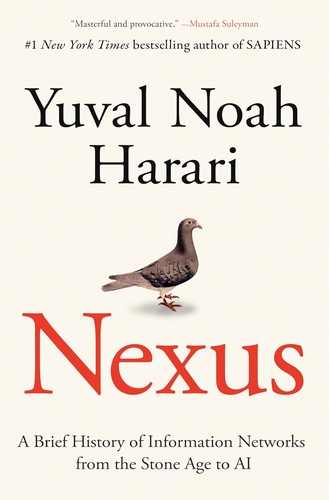
Nexus
by Yuval Noah Harari
From the author of Sapiens, a history of how information networks have shaped and reshaped our world. Harari asks what the power gathered over 100,000 years means for the age of new technology.
Best for: Readers who want a big-picture look at information, power and technology.
Nexus is #9 on BookWard's Rising chart for November 2026: the hottest new books published in the past two years.
What Nexus is about
Yuval Noah Harari, the author of Sapiens, turns here to a question that runs through all of human history: what happens when information moves from person to person, and who gains or loses by it? He follows that thread from the Stone Age to the present, stopping at the making of the Bible, the early modern witch-hunts, Stalinism, Nazism and the populism of today. Along the way he weighs how information relates to truth, how bureaucracy sits alongside myth, and how wisdom so often lags behind power.
His larger claim is that we are living through an existential crisis, shaped by ecological collapse, misinformation and the arrival of artificial intelligence. He treats AI as a new kind of information network and a serious threat, and he asks what choices we must make as non-human intelligence appears. The tone is analytical, sweeping and cautionary. Readers curious about technology, politics and where both are heading will find a lot to think about.
Why Nexus is on the Rising chart
Its Wikipedia page had 4,534 views last month; 314 readers have shelved it on Open Library since 2024. The Rising score blends six public signals, each scored from 0 to 100 against the other new books and weighted as shown.
| Signal | This book | Weight |
|---|---|---|
| Reader pace | 82 | 28% |
| Buzz | 48 | 24% |
| Growth | 14 | 18% |
| Being read right now | 82 | 12% |
| Reader love | 93 | 10% |
| Newness | 75 | 8% |
Holding strong Wikipedia attention is steady (within -20% to +25% of the two months before).
The numbers behind it
- Wikipedia: 4,534 page views last month, against an average of 4,868 in the two months before (down 7%). Read the article.
- Open Library readers: 287 want to read, 16 reading now, 11 have read it.
- Ratings: 5 out of 5 from 5 Open Library ratings.
Nexus on the Rising chart: history
| Month | Rank | Score |
|---|---|---|
| November 2026 | #9 | 62 |
| October 2026 | #14 | 59 |
Questions about Nexus
Is Nexus a new book?
Yes. Nexus by Yuval Noah Harari was first published in 2024, and BookWard's Rising chart only includes books published in the past two years.
Why is Nexus on the Rising chart?
Its Wikipedia page had 4,534 views last month; 314 readers have shelved it on Open Library since 2024.
More new books readers are finding
- Sunrise on the Reaping Suzanne Collins
- Onyx Storm Rebecca Yarros
- Dear Debbie Freida McFadden
- Diary of a Wimpy Kid Party Pooper Jeff Kinney
Prefer proven favorites? See the Top 100, or all Rising books.
How we know
This page uses public data: Open Library reader counts and ratings, and Wikipedia page views. The description is paraphrased from real source text (Open Library or Wikipedia). A book is on the Rising chart only if it was published in 2025 or 2026 and its readers are active and its interest is not falling. Rankings reflect reading interest, not quality or sales. Read the full methodology.
Best suited to adult readers and older teens who enjoy big-picture history and current affairs.
544 pages, about 8.5 to 12.5 hours.
A sweeping history of information, and why AI raises the stakes. 50% taste match
 BookWard’s take
A sweeping history of information, and why AI raises the stakes
Nexus asks how information networks have shaped human power, from the Stone Age through the canonization of the Bible, witch-hunts, Stalinism and Nazism to modern populism, and then turns to AI as a network that thinks for itself. It is idea-led rather than story-led, which sits far from BookWard's preference, and at 544 pages it is long where BookWard likes tight. Its rigor is the strongest match: the argument is built from historical cases and carried by a distinctive authorial voice, one that offers opinion openly rather than posing as neutral. Hope lands near BookWard's own, since the book looks for a middle ground rather than a verdict of doom. Expect explanation over scene.
At 544 pages, with a span from the Stone Age to AI, it is long, which is the opposite of BookWard's taste for tight.
Ideas arrive steadily, but the sweep across millennia asks for a measured pace rather than a quick one, a little under BookWard's.
Treating information networks as the engine of history, and AI as one of them, is a distinctive framing, if not wholly new ground.
The prose is plain and lucid, aimed at carrying ideas, which fits BookWard's mild lean toward the unadorned.
It looks for a hopeful middle ground between information as pure truth and as pure weapon, though the warnings are serious.
It moves through history and then into AI in a conventional argumentative arc, more traditional than BookWard's mild lean toward experiment.
The subject is grave, ecological collapse, misinformation and existential risk, and the tone stays serious, well short of BookWard's lean toward funny.
Witch-hunts, Stalinism and Nazism appear alongside existential risk, so the subject matter is heavy though treated analytically.
The tone is cool and analytical, with feeling kept in check.
See all 50 dialsEvery position, side by side with this book
Where it lines up
- SentimentBookWard 8 · book 8
- Authorial voiceBookWard 9 · book 9
- Shock for effectBookWard 9 · book 8
Where it pulls apart
- LengthBookWard 1 · book 8
- Story or ideasBookWard 3 · book 10
- ExpositionBookWard 2 · book 9
At 544 pages, with a span from the Stone Age to AI, it is long, which is the opposite of BookWard's taste for tight.
The big-picture history-of-humanity frame is familiar territory, but the focus on information as the organizing thread gives it a fresh angle.
The argument runs on a clear chain from stories to bureaucracy to AI, which suits BookWard's liking for airtight reasoning.
Ideas arrive steadily, but the sweep across millennia asks for a measured pace rather than a quick one, a little under BookWard's.
Treating information networks as the engine of history, and AI as one of them, is a distinctive framing, if not wholly new ground.
It handles heavy subjects like witch-hunts and Nazism in an analytical register, which matches BookWard's restraint.
Dark episodes serve the argument about information and power rather than existing for effect, which BookWard values.
It builds its case from named historical episodes, a strong fit, though broad synthesis leaves it a notch below BookWard's top mark.
Harari's clear, confident, opinionated voice is unmistakable, which BookWard rates highly.
This is an argument about information and power with history as evidence, far more idea-led than BookWard's story-leaning taste.
It explains its points outright, which is the nature of the form but pulls away from BookWard's preference for showing.
The case builds across themes from myth to bureaucracy to AI, though a long book of this kind can loosen in places.
The prose is plain and lucid, aimed at carrying ideas, which fits BookWard's mild lean toward the unadorned.
It looks for a hopeful middle ground between information as pure truth and as pure weapon, though the warnings are serious.
It moves through history and then into AI in a conventional argumentative arc, more traditional than BookWard's mild lean toward experiment.
The subject is grave, ecological collapse, misinformation and existential risk, and the tone stays serious, well short of BookWard's lean toward funny.
The prose is clear, but the scale of ideas and length ask for sustained attention, a touch above BookWard's comfort.
It follows one authorial argument while ranging across many societies and political systems, a middling spread of viewpoints.
Everything here is real history and current technology, firmly grounded.
It takes in 100,000 years of human history and the fate of the species, about as epic as nonfiction gets.
It is exposition and argument with almost no dialogue.
Romance has no place in a book about information networks and power.
The historical episodes range from witch-hunts to Stalinism, offering unfamiliar corners of the past, though the AI material is close to home.
The urgent subject is AI and populism today, so it is anchored in the present despite its long historical lens.
The history will last, but the AI-era urgency ties much of it to this moment.
The authorial voice argues openly and directly, which reads as reliable rather than slippery.
It presents real stakes and takes positions, yet also stresses the tangled relationship between truth, power and wisdom.
The book explains rather than paints scenes, so description stays lean.
It leans analytical, weighing systems and mechanisms, though historical episodes carry some narrative flavor.
Harari argues as an observer of whole societies rather than through personal experience, though the voice is clearly his own.
It is a standalone book, though it comes from the author of Sapiens.
An argument sets out its claims rather than springing surprises.
It confronts uncomfortable questions about AI, truth and power, which makes it more challenging than comforting.
Witch-hunts, Stalinism and Nazism appear alongside existential risk, so the subject matter is heavy though treated analytically.
The tone is cool and analytical, with feeling kept in check.
Humor is not central, and what there is stays dry.
Historical atrocities are discussed rather than dramatized, so violence stays mostly in the background.
Sexual content does not figure in this subject matter.
Populism, Stalinism, Nazism and the politics of AI put politics near the center.
The language is plain and accessible, with no dialect or dense phrasing.
The author argues a clear position rather than staying neutral, which matches BookWard's taste for narration with a view.
It reads history to prepare for what AI will do next, so it faces forward.
It refuses cynicism and looks for a hopeful middle ground, though it warns plainly about the risks.
Review written by BookWard, dial version 1, November 2026.
Who is Nexus right for?
Best suited to adult readers and older teens who enjoy big-picture history and current affairs. It discusses historical atrocities such as Stalinism and Nazism analytically, without graphic detail.
The prose is clear, but the scale of ideas and length ask for sustained attention, a touch above BookWard's comfort.
Witch-hunts, Stalinism and Nazism appear alongside existential risk, so the subject matter is heavy though treated analytically.
The tone is cool and analytical, with feeling kept in check.
Historical atrocities are discussed rather than dramatized, so violence stays mostly in the background.
Book CompanionNexus: ideas, characters, themes
Information is neither the raw material of truth nor merely a weapon, and how societies build their information networks decides whether those networks serve wisdom or power.
- Information is not simply truth. The book rejects the idea that more information automatically means more truth, and explores the tangled relationship between the two.
- Networks of stories and bureaucracy. It examines how myth and bureaucracy have served as tools for organizing large numbers of people.
- History as evidence. Episodes from the canonization of the Bible and early modern witch-hunts to Stalinism and Nazism show how information was wielded for good and ill.
- AI as a new kind of network. The book frames AI as a non-human intelligence and information network that raises new stakes for humanity.
- A hopeful middle ground. Rather than despair, it looks for a path between treating information as pure truth and as pure weapon.
Themes
The question of whether sharing more information brings people closer to truth or just to power.
How institutions and mythology organize societies and can be turned to harmful ends.
What happens when a non-human intelligence becomes part of the networks that run our world.
Why a species with great knowledge and power keeps risking its own undoing.
The hope that a better understanding of information can restore common ground.
Discussion questions
- Does more information make societies wiser, or only more powerful?
- Which historical case in the book most changes how you see misinformation today?
- Is AI different in kind from earlier information networks, or just faster?
- Where does the book find hope, and did it convince you?
- How should societies decide who controls the information networks they depend on?
Personalize your Book Companion
This is the general edition. In BookWard, the Companion is written for you: your reading profile, your notes, and spoiler-safe to the page you are on.
Buy, listen or borrow Nexus
Each link opens a search for this book on that store, in a new tab.
Read on a device
Borrow
Reviews and community
If you liked Nexus
Harari turns his lens from the past onto the present
Invisible WomenCaroline Criado PerezGender data gaps, argued with evidence and some real heat
CollapseJared DiamondDiamond's sweeping case for why societies fail, and how some survive
Guns, Germs, and SteelJared DiamondWhy some societies conquered others, argued from geography, not genes
Find new books before everyone else
Add what you have read, rate it, and BookWard will recommend what to read next.
Free to start. No credit card needed.