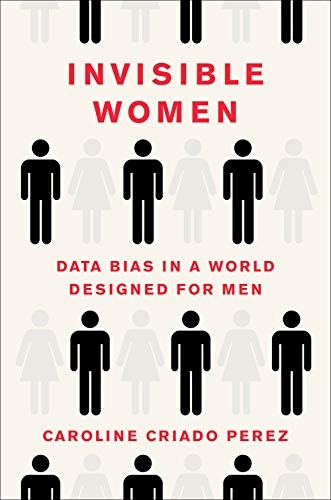
Invisible Women
by Caroline Criado Perez
★ Top 25 book of 2019 · #20 on Best Books of 2019
Caroline Criado Perez shows how data that treats men as the standard leaves women overlooked, with costs in time, money and sometimes lives. Drawing on hundreds of studies, she looks at product design, city planning and medical research to reveal built-in bias.
Best for: Readers curious about how data and design shape gender inequality
Invisible Women is #20 on BookWard's Best Books of 2019, out of 83 2019 books that cleared our data bar.
What Invisible Women is about
Criado Perez makes a clear, forceful argument: a great deal of the data used to design our world fails to account for gender. Men are treated as the default and women as the exception, and that bias gets built into systems, so women pay for it in time, money and often with their lives.
She takes the reader through the home, the workplace, the public square, the doctor's office and more. Pianos, cell phones and voice recognition software are made to fit men. Cities plan public transportation, roads and snow removal around men's needs, overlooking women's safety and the way they actually travel. The tone is analytical and pointed, with real anger behind it. It will help designers, policymakers and employers see what they have been missing, and any reader curious about why so much of the world seems to fit someone else.
Invisible Women on the Best Books of 2019
Invisible Women came out in 2019. Of the 83 books first published in 2019 that met BookWard's data bar, it ranks #20 on our Best Books of 2019 list.
Why it made the list: 360 readers have shelved it on Open Library; readers rate it 4.5 out of 5 (35 ratings). The list ranks each year’s books on how many readers have picked them up, how highly readers rate them, and how many are reading them right now.
It earns Reader favorite.
Nearby on the 2019 list
- The Tyrant's Tomb Rick Riordan, #18
- Everything Is F*cked Mark Manson, #19
- This Is How You Lose the Time War Amal El-Mohtar, #21
- Anxious People Fredrik Backman, #22
See all Best Books of 2019 Best books by year
More years: Best Books of 2018 Best Books of 2020.
The numbers behind it
- Readers: 309 want to read it, 10 are reading it now and 41 have read it, according to Open Library.
- Ratings: 4.5 out of 5 from 35 Open Library ratings.
| Signal | This book (0 to 100) | Weight |
|---|---|---|
| Reach | 66 | 55% |
| Reader love | 95 | 25% |
| Being read right now | 49 | 20% |
Questions about Invisible Women
When was Invisible Women published?
Invisible Women by Caroline Criado Perez was first published in 2019.
Was Invisible Women one of the best books of 2019?
Invisible Women is #20 on BookWard's Best Books of 2019, out of 83 2019 books that cleared our data bar. 360 readers have shelved it on Open Library; readers rate it 4.5 out of 5 (35 ratings).
Why is Invisible Women on the Best Books of 2019 list?
360 readers have shelved it on Open Library; readers rate it 4.5 out of 5 (35 ratings).
More of the best books of 2019
- Red, White & Royal Blue Casey McQuiston, #1
- A Good Girl's Guide to Murder Holly Jackson, #2
- Heartstopper, Volume 2 Alice Oseman, #3
- Guts Raina Telgemeier, #4
- The Silent Patient Alex Michaelides, #5
- Into the Pit (Five Nights at Freddy’s Scott Cawthon, #6
See the full Best Books of 2019, the Top 100, or new books on Rising.
How we know
This page uses public data: Open Library reader counts and ratings, and Wikipedia page views for recent years. The description is paraphrased from real source text. Rankings reflect reading interest, not quality or sales, and can be affected by data gaps. Lists update monthly.
Suited to mature teens and adults interested in social issues and policy.
Depends on the edition you pick.
Gender data gaps, argued with evidence and some real heat. 53% taste match
 BookWard’s take
Gender data gaps, argued with evidence and some real heat
Invisible Women builds one argument across its chapters: data that treats men as the default produces systems that quietly fail women, from product design to city planning to medicine. It is idea-led, not story-led, which fits BookWard's lean toward narrative, so the pull here is the strength of the case. On rigor it scores high, resting on hundreds of studies. Its authorial voice is distinctive, energetic and openly opinionated, and the originality of the framing is strong even where individual examples will be familiar to some readers. Expect a book that is challenging in what it asks you to notice, and one that explains its points outright rather than dramatizing them. It rewards readers who like evidence stacked patiently toward a single conclusion.
A substantial survey across many domains, long enough to feel thorough but not an endurance test. BookWard prefers tighter, so this sits mid-range.
Short case studies keep it moving, though the accumulation of examples slows it in places. Roughly in line with BookWard's preference.
Naming the gender data gap as a unifying lens is a distinctive and original organizing idea, which BookWard rewards.
Plain, clear prose built to carry evidence rather than ornament. That is a touch plainer than BookWard's middle ground.
It documents real harm at length but ends on the possibility of change, leaning somewhat bleak overall. BookWard prefers more hope.
A conventional chapter-by-domain structure, home, work, public space, medicine. BookWard is neutral on structure.
There is wit in the delivery, but the subject keeps the tone mostly serious. That sits below BookWard's lean toward humor.
The material includes real harm and mortality for women, but it is handled factually rather than luridly.
The evidence prompts anger and recognition, so the feeling is real but channeled through argument.
See all 50 dialsEvery position, side by side with this book
Where it lines up
- SentimentBookWard 8 · book 8
- OriginalityBookWard 9 · book 8
- Shock for effectBookWard 9 · book 8
Where it pulls apart
- LengthBookWard 1 · book 6
- ExpositionBookWard 2 · book 9
- Story or ideasBookWard 3 · book 9
A substantial survey across many domains, long enough to feel thorough but not an endurance test. BookWard prefers tighter, so this sits mid-range.
The central premise lands immediately and the framing grabs attention early. That matches BookWard's taste for openings that hook at once.
The core thesis and its data-driven approach feel fresh rather than recycled, which BookWard values.
Claims are tied to cited studies and build in a clear chain of reasoning, which suits BookWard's appetite for airtight argument.
Short case studies keep it moving, though the accumulation of examples slows it in places. Roughly in line with BookWard's preference.
Naming the gender data gap as a unifying lens is a distinctive and original organizing idea, which BookWard rewards.
It closes by pointing toward remedies and a clear call for better data, a reasonably resolved finish that BookWard likes.
The tone is pointed and evidence-driven rather than sentimental, which fits BookWard's preference for restraint.
The shock comes from the data itself rather than from manufactured drama, so its alarm is earned. BookWard approves.
Built on hundreds of studies from several countries, this leans firmly toward rigorous over anecdotal, as BookWard prefers.
The writing has a clear, energetic and witty personality that is recognizably the author's own, matching BookWard's taste.
This is an argument-first book where the thesis drives everything. That runs opposite to BookWard's story-led lean.
Ideas are explained outright and supported with data rather than dramatized, well away from BookWard's preference for showing.
The framework stays consistent through its sections, though the volume of examples can blur together toward the middle.
Plain, clear prose built to carry evidence rather than ornament. That is a touch plainer than BookWard's middle ground.
It documents real harm at length but ends on the possibility of change, leaning somewhat bleak overall. BookWard prefers more hope.
A conventional chapter-by-domain structure, home, work, public space, medicine. BookWard is neutral on structure.
There is wit in the delivery, but the subject keeps the tone mostly serious. That sits below BookWard's lean toward humor.
Accessible prose, though the sustained data and argument ask for real attention. About where BookWard sits.
Argued thematically in a straightforward way with no timeline play. This is more linear than BookWard's middle.
Entirely grounded in real-world data and lived conditions, well below BookWard's willingness for fantastical.
It spans workplaces, cities, hospitals and homes across countries, giving it broad, systemic reach rather than an intimate focus.
The focus is on external systems, design and policy, more than on private thought.
As an argument-driven nonfiction work it carries little dialogue, which is lighter than BookWard's liking.
Romance is not part of this book.
The settings are the everyday world of homes, offices and streets, so familiar rather than strange.
Rooted in contemporary data and current policy debates, so strongly present-day.
Tied to the data and debates of its moment, though the underlying problem it names will persist.
The author argues in a direct, forthright first-hand voice with nothing hidden, so reliable in the plainest sense.
The ethical stance is clear and openly stated, which is more direct than BookWard's taste for ambiguity.
Descriptions serve the argument and stay spare, below BookWard's preference for richer detail.
It mixes anecdote and case study with analysis, leaning toward the analytical, a bit more than BookWard's usual.
The author largely steps back to let the evidence speak, though she does write with evident conviction.
A standalone work with no series commitment.
The arguments build predictably, so there are few plot-style twists, though specific findings still land hard.
It asks readers to reexamine assumptions about everyday systems, a quite challenging experience that BookWard values.
The material includes real harm and mortality for women, but it is handled factually rather than luridly.
The evidence prompts anger and recognition, so the feeling is real but channeled through argument.
Where humor shows up it is dry and pointed rather than broad.
Some harms are discussed, but violence is not shown on the page in graphic detail.
Sexual content is not a feature of this book.
Gender and policy are the explicit subject, so politics is front and center.
The language is plain and clear, well within easy reach.
The author argues a position openly and forcefully, so the narration is far from neutral.
It diagnoses present problems in order to push toward better systems ahead, with a forward lean.
A firm belief that better data can fix these problems gives it a moderately idealistic edge.
Review written by BookWard, dial version 1, November 2026.
Who is Invisible Women right for?
Suited to mature teens and adults interested in social issues and policy. It discusses medical neglect, safety and harm to women, treated factually.
Accessible prose, though the sustained data and argument ask for real attention. About where BookWard sits.
The material includes real harm and mortality for women, but it is handled factually rather than luridly.
The evidence prompts anger and recognition, so the feeling is real but channeled through argument.
Some harms are discussed, but violence is not shown on the page in graphic detail.
Book CompanionInvisible Women: ideas, characters, themes
Systems built on data that treats men as the default end up failing women, and fixing this starts with counting women properly.
- The default male. Much data treats men as the standard person and women as a deviation, so systems quietly fit men best.
- Design that doesn't fit. Everyday products and tools are built around male bodies and needs, from phones to software.
- Cities and travel. Public transport and urban planning tend to reflect men's patterns, overlooking women's safety and routines.
- Medicine's blind spot. Women have been underrepresented in medical research, which leaves them misunderstood and misdiagnosed.
- Costs in time, money and lives. The bias carries real costs for women, from lost hours and income to health consequences.
Themes
Numbers that appear neutral can embed assumptions that favor men.
Women's needs go unseen when they are not measured or consulted.
Who builds a system shapes who it serves.
Overlooked data can translate directly into physical risk.
Rigorous research can be used to argue for change.
Discussion questions
- Where have you noticed something designed around a default user who was not you?
- How convincing is the claim that data itself, not just attitudes, drives inequality?
- Which domain, home, work, public space or medicine, felt most surprising?
- What would better data collection actually look like in practice?
- How does an openly opinionated voice affect how much you trust the evidence?
Personalize your Book Companion
This is the general edition. In BookWard, the Companion is written for you: your reading profile, your notes, and spoiler-safe to the page you are on.
Buy, listen or borrow Invisible Women
Each link opens a search for this book on that store, in a new tab.
Read on a device
Borrow
Reviews and community
If you liked Invisible Women
A witty, pointed takedown of AI hype and who profits
21 Lessons for the 21St CenturyYuval Noah HarariHarari turns his lens from the past onto the present
The Anxious GenerationJonathan HaidtA data-driven case against smartphone childhood, and what to do
NexusYuval Noah HarariA sweeping history of information, and why AI raises the stakes
Find your own best books
Add what you have read, rate it, and BookWard will recommend what to read next.
Free to start. No credit card needed.