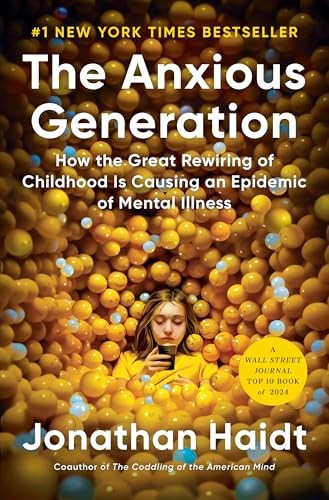
The Anxious Generation
by Jonathan Haidt
★ Top 25 book of 2024 · #16 on Best Books of 2024
Jonathan Haidt contends that smartphones, social media and overprotective parenting have reshaped childhood in damaging ways. He links this shift to a growing wave of mental illness among young people.
Best for: Parents, teachers and anyone worried about kids, screens and mental health
The Anxious Generation is #16 on BookWard's Best Books of 2024, out of 34 2024 books that cleared our data bar.
What The Anxious Generation is about
Jonathan Haidt argues that childhood changed sharply in the early 2010s, and that the change shows up in the numbers. Rates of anxiety, depression, self-harm and suicide among young people began to climb around 2010, just as smartphones became common. He points out that the rise appeared across developed countries, was far smaller for people over 30, and cannot be pinned on the 2008 financial crisis, since earlier downturns left no similar mark.
His explanation has two parts. Children need risk, challenge and unsupervised play to grow, and overprotective parenting and fewer chances to roam have taken those away. Meanwhile social media brings social deprivation, lost sleep, scattered attention and addiction, and Haidt says leaked Facebook documents show the company knew of harm to teenage girls. He calls for phone-free schools and simpler phones for kids. Parents, teachers and anyone who worries about young people's wellbeing will find a clear, data-driven case here.
The Anxious Generation on the Best Books of 2024
The Anxious Generation came out in 2024. Of the 34 books first published in 2024 that met BookWard's data bar, it ranks #16 on our Best Books of 2024 list.
Why it made the list: 300 readers have shelved it on Open Library; readers rate it 3.6 out of 5 (14 ratings); its Wikipedia page averaged 8,360 views a month recently. The list ranks each year’s books on how many readers have picked them up, how highly readers rate them, and how many are reading them right now.
Nearby on the 2024 list
- Absolution Jeff VanderMeer, #14
- The Great When Alan Moore, #15
- The Boyfriend Freida McFadden, #17
- Playground Richard Powers, #18
See all Best Books of 2024 Best books by year
More years: Best Books of 2023 Best Books of 2025.
The numbers behind it
- Readers: 233 want to read it, 6 are reading it now and 13 have read it, according to Open Library.
- Ratings: 3.6 out of 5 from 14 Open Library ratings.
- Wikipedia: its article averaged 8,360 views a month recently.
| Signal | This book (0 to 100) | Weight |
|---|---|---|
| Reach | 76 | 45% |
| Reader love | 18 | 20% |
| Being read right now | 74 | 15% |
| Attention | 79 | 20% |
Questions about The Anxious Generation
When was The Anxious Generation published?
The Anxious Generation by Jonathan Haidt was first published in 2024.
Was The Anxious Generation one of the best books of 2024?
The Anxious Generation is #16 on BookWard's Best Books of 2024, out of 34 2024 books that cleared our data bar. 300 readers have shelved it on Open Library; readers rate it 3.6 out of 5 (14 ratings); its Wikipedia page averaged 8,360 views a month recently.
Why is The Anxious Generation on the Best Books of 2024 list?
300 readers have shelved it on Open Library; readers rate it 3.6 out of 5 (14 ratings); its Wikipedia page averaged 8,360 views a month recently.
More of the best books of 2024
- Wind and Truth Brandon Sanderson, #1
- The Let Them Theory Mel Robbins, #2
- The Tainted Cup Robert Jackson Bennett, #3
- Lights Out Navessa Allen, #4
- The Women Kristin Hannah, #5
- Funny Story Emily Henry, #6
See the full Best Books of 2024, the Top 100, or new books on Rising.
How we know
This page uses public data: Open Library reader counts and ratings, and Wikipedia page views for recent years. The description is paraphrased from real source text. Rankings reflect reading interest, not quality or sales, and can be affected by data gaps. Lists update monthly.
Suited to parents, teachers and curious older teens interested in technology and mental health.
Depends on the edition you pick.
A data-driven case against smartphone childhood, and what to do. 45% taste match
 BookWard’s take
A data-driven case against smartphone childhood, and what to do
Haidt makes one argument and keeps pushing it: phone-based life and overprotective parenting have rewired childhood since around 2010. The opening hook is strong, because he starts with the sudden uptick in anxiety, depression and self-harm among the young. On rigor, he leans on statistics across developed countries and rules out the 2008 financial crisis as a cause, though the causal claim is the part readers will argue about. It is idea-led rather than story-led, with a clear authorial voice and plenty of exposition, which fits BookWard less than a scene-driven book would. It is also opinionated and political in its prescriptions, such as phone-free schools. Those who like a tight thesis and a concrete agenda will find plenty to chew on here.
It moves briskly through evidence toward its proposals, a reasonable match for BookWard's preference for momentum.
Haidt synthesizes existing research and his earlier work into a new framing, so it is distinctive but not wholly novel.
The writing is plain, clear and explanatory rather than ornate, close to BookWard's restrained taste.
There is no plot or cast to drive it; the argument itself is the engine.
It diagnoses a crisis but ends with actionable fixes, giving a cautiously hopeful tilt.
It is a serious subject treated seriously, with little room for humor.
It deals with anxiety, self-harm and suicide statistics, giving it a serious, somber subject.
The stakes for children give it feeling, though it stays mostly analytical.
See all 50 dialsEvery position, side by side with this book
Where it lines up
- EndingBookWard 8 · book 8
- Authorial voiceBookWard 9 · book 8
- OpeningBookWard 10 · book 8
Where it pulls apart
- ExpositionBookWard 2 · book 9
- LengthBookWard 1 · book 5
- Familiar tropesBookWard 10 · book 6
The safetyism and screen-time arguments echo familiar parenting debates, though the data framing is fresh, so it sits mid-high.
The argument is built stepwise from statistics and ruled-out alternatives, though the causal leap invites dispute against BookWard's airtight ideal.
It moves briskly through evidence toward its proposals, a reasonable match for BookWard's preference for momentum.
Haidt synthesizes existing research and his earlier work into a new framing, so it is distinctive but not wholly novel.
This is an argument about a generation, not individuals, so characters are largely absent against BookWard's liking for depth.
It argues with data and urgency, with some emotional appeal around children's wellbeing, so it is only moderately restrained.
The alarming statistics are the point and are earned by the evidence, which BookWard respects.
It rests on statistics across countries and rules out rival explanations, though critics may question causation.
Haidt's confident, opinionated authorial presence is clearly his own, which BookWard values.
It is wholly idea-led, built around a thesis rather than a narrative, the opposite of BookWard's story-led lean.
Ideas are explained outright instead of dramatized, far from BookWard's preference for showing in scene.
A thesis book can repeat its core claim, though the shift from diagnosis to prescription keeps it moving.
The writing is plain, clear and explanatory rather than ornate, close to BookWard's restrained taste.
There is no plot or cast to drive it; the argument itself is the engine.
It diagnoses a crisis but ends with actionable fixes, giving a cautiously hopeful tilt.
It is a serious subject treated seriously, with little room for humor.
Accessible popular nonfiction that asks little of the reader beyond attention to the data.
It speaks through one authorial perspective, building a single case.
Fully grounded in real statistics and real childhoods.
There are no characters to speak of, only populations and trends.
It takes in a whole generation and multiple countries, a wide societal canvas.
It weighs inner states like anxiety against outer behavior and design, landing in the middle.
As argument-driven nonfiction, it has essentially no dialogue.
Romance does not feature in a book about childhood and technology.
The setting is the ordinary family, school and screen life readers already know.
It addresses the smartphone era directly, about as present-day as a book gets.
Tied to a specific technological moment, so its relevance may shift as the debate does.
The author argues in his own voice and is straightforwardly reliable in manner.
Haidt takes a clear stance on what harms children and what to do about it.
It explains and reasons more than it paints scenes, so description is sparse.
It is analytical, built on data and argument rather than storytelling.
A standalone book, though it builds on his earlier work with The Coddling of the American Mind.
An argument-driven read, it offers few surprises beyond individual findings.
It asks parents and schools to change habits, which makes it a challenging read.
It deals with anxiety, self-harm and suicide statistics, giving it a serious, somber subject.
The stakes for children give it feeling, though it stays mostly analytical.
Humor is nearly absent, and what exists is dry.
Self-harm and suicide appear as statistics, not as depicted violence.
Sexual content is not a feature of the book.
It advocates policy such as school phone bans and age verification, so it engages politics directly.
The language is plain, mainstream and easy to follow.
Haidt argues forcefully for a position rather than staying neutral.
It looks back to diagnose the cause but aims forward with recommendations.
It holds that collective action can restore a healthier childhood, an idealistic bent.
Review written by BookWard, dial version 1, November 2026.
Who is The Anxious Generation right for?
Suited to parents, teachers and curious older teens interested in technology and mental health. It discusses self-harm and suicide in statistical terms.
Accessible popular nonfiction that asks little of the reader beyond attention to the data.
It deals with anxiety, self-harm and suicide statistics, giving it a serious, somber subject.
The stakes for children give it feeling, though it stays mostly analytical.
Self-harm and suicide appear as statistics, not as depicted violence.
Book CompanionThe Anxious Generation: ideas, characters, themes
Haidt argues that smartphones and social media, combined with overprotective parenting and less free play, rewired childhood and drove a rise in youth mental illness.
- The 2010 uptick. Rates of anxiety, depression, self-harm and suicide among the young rose sharply around 2010, when smartphones became widely available.
- Not the financial crisis. Haidt rules out the 2008 financial crisis by noting that past crises did not produce a similar jump.
- Antifragile children. Drawing on Antifragile, he argues children need some adversity and challenge early to cope as adults.
- Safetyism and lost play. Overprotective caregiving, reduced recess and less risky playground equipment have cut the free play that built resilience.
- What to do. He advocates keeping smartphones out of schools and using feature phones with limited functions instead.
Themes
How constant connection shapes mental health.
How shielding children from risk can weaken them.
Why unsupervised, risky play builds coping skills.
The idea that schools and parents must act together.
Whether the timing of the data proves the claim.
Discussion questions
- Does the timing of the 2010 uptick convince you that smartphones are the cause?
- How much of the problem is overprotective parenting versus screens?
- Is a phone ban in schools a realistic, fair fix?
- What risks should children be allowed to take that they often are not today?
- How should society weigh age verification against privacy and access?
Personalize your Book Companion
This is the general edition. In BookWard, the Companion is written for you: your reading profile, your notes, and spoiler-safe to the page you are on.
Buy, listen or borrow The Anxious Generation
Each link opens a search for this book on that store, in a new tab.
Read on a device
Borrow
Reviews and community
If you liked The Anxious Generation
Gender data gaps, argued with evidence and some real heat
21 Lessons for the 21St CenturyYuval Noah HarariHarari turns his lens from the past onto the present
The AI ConEmily M. BenderA witty, pointed takedown of AI hype and who profits
Not the End of the WorldHannah RitchieA data scientist's calm, evidence-first case that the planet is fixable
Find your own best books
Add what you have read, rate it, and BookWard will recommend what to read next.
Free to start. No credit card needed.