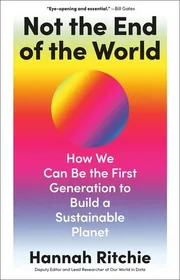
Not the End of the World
by Hannah Ritchie · 2024
Suits adults and older teens who are curious about climate and environmental issues, especially those feeling anxious about them.
352 pages, about 5.5 to 8 hours.
A data scientist's calm, evidence-first case that the planet is fixable. 55% taste match
What it covers
Not the End of the World is a 2024 book by Hannah Ritchie, a data scientist, that looks at the state of the planet through the lens of data. It sits in the history and politics category and draws on economic history, climate change, sustainability and environmental protection. At around 352 pages, it has appeared in six editions.
The book takes on the worry many people feel about the environment and the frequent warnings that climate change threatens the young. Ritchie steps back to look at long-term trends and argues that progress on several major environmental problems has been considerable, to the point where sustainability could be reached for the first time in human history. Along the way she examines everyday questions such as eating locally, living in the countryside, population growth, plastic straws and palm oil, and the text is accompanied by graphics and practical guidance on which lifestyle changes make a real difference. It suits readers who want a research-based account of environmental issues and of what individuals can do about them.
It has become common to tell kids that they're going to die from climate change.
Themes
Economic historyClimate changeSCIENCEsustainabilityEnvironmental protection
By the numbers
- The median edition runs 352 pages. Counting about 275 words a page and an adult reading pace of 250 words a minute, that is about 6.5 hours of reading.
- Open Library tracks 6 editions from 5 publishers.
- On reader demand it ranks in the top 28% of the recent releases books in our catalog (1,627 of them).
- Libraries shelve it under Library of Congress class HC-0079.00000000.E5.
 BookWard’s take
A data scientist's calm, evidence-first case that the planet is fixable
Hannah Ritchie takes the doomsday mood around climate and the environment and tests it against long-term data. The result is a rigorous, analytical book, with graphics doing real work alongside the argument. Its outlook is openly hopeful, and I land there too, though Ritchie pairs that hope with plain talk about what actually moves the needle. She goes after everyday assumptions about eating locally, plastic straws and palm oil, which gives the opening an easy hook for anyone who has felt anxious about the future. The pace stays brisk at 352 pages, and ideas are explained outright, which suits a book built on argument rather than story. Expect an authorial voice that is clear and personable rather than showy.
Chapters work through one issue at a time with graphics and guidance, keeping momentum steady rather than breathless.
The contrarian-but-evidence-based angle feels fresh, though it joins a growing line of data-driven optimism books.
The writing aims for clarity over ornament, which is a bit plainer than BookWard's middle-ground taste.
There is no plot or cast, so this dial does not apply to an argument-led nonfiction book.
The book is explicitly and radically hopeful, which is higher than BookWard's already optimistic outlook.
It follows a conventional issue-by-issue layout, more orderly than BookWard's openness to experiment.
The tone is earnest and informative rather than comic, a bit more serious than BookWard's fondness for wit.
It addresses grim headlines but is built to ease dread, so the content stays fairly gentle.
The tone is calm and reassuring rather than emotionally intense.
See all 50 dialsEvery position, side by side with this book
Where it lines up
- Shock for effectBookWard 9 · book 9
- Rigor (nonfiction)BookWard 9 · book 9
- Internal logicBookWard 10 · book 9
Where it pulls apart
- ExpositionBookWard 2 · book 9
- Story or ideasBookWard 3 · book 9
- LengthBookWard 1 · book 4
It deliberately overturns familiar environmental talking points, though the genre's framing of problems and solutions is recognizable.
The argument is built from data and moves step by step from evidence to conclusion, which BookWard values highly.
Chapters work through one issue at a time with graphics and guidance, keeping momentum steady rather than breathless.
The contrarian-but-evidence-based angle feels fresh, though it joins a growing line of data-driven optimism books.
This is an argument-driven book with no characters to draw, so the dial does not apply.
It builds toward a clear conclusion about what to focus on, giving readers a resolved takeaway rather than an open question.
It leans on figures and trends rather than tearful appeals, keeping a measured, restrained tone.
It takes the sting out of alarming headlines instead of using shock, and earns its optimism through data.
Its whole premise is that long-term data corrects scare headlines, which matches BookWard's demand for rigor.
Ritchie's plain, personable data-scientist voice is recognizable, if more steady than flashy.
This is an idea-led book from start to finish, which sits well beyond BookWard's story-leaning preference.
Ideas are explained outright with graphics and guidance, far from BookWard's lean toward showing in scene.
Each chapter tackles a distinct question, so interest holds up across the book.
The writing aims for clarity over ornament, which is a bit plainer than BookWard's middle-ground taste.
There is no plot or cast, so this dial does not apply to an argument-led nonfiction book.
The book is explicitly and radically hopeful, which is higher than BookWard's already optimistic outlook.
It follows a conventional issue-by-issue layout, more orderly than BookWard's openness to experiment.
The tone is earnest and informative rather than comic, a bit more serious than BookWard's fondness for wit.
Graphics and plain explanation keep it approachable, though the data requires some attention.
It is told through one author's analytical lens rather than a range of voices.
The data runs across history but the argument itself moves in a straightforward line.
It deals entirely with real-world environmental evidence, so it is fully grounded.
There is no cast of characters, so this dial does not apply.
It covers planet-wide problems and humanity's long-run trajectory, a far bigger canvas than BookWard's intimate lean.
The focus falls on external trends, data and actions rather than inner reflection.
As an argument-driven text it has essentially no dialogue, lighter than BookWard likes.
Romance has no place in a book about environmental data, so this dial does not apply.
Its subject is the familiar everyday world of food, travel and consumption, though the data may surprise.
It speaks directly to today's climate anxiety and current research, firmly in the present day.
Its data-heavy, current-affairs focus will date as figures and events move on.
The author speaks plainly in her own voice with no unreliable framing.
Prose is functional and graphics carry the load, so description stays light.
The book leans analytical, built around data, charts and reasoned argument rather than storytelling.
Ritchie keeps a professional, evidence-first distance while still offering some personal framing of why it matters.
It stands alone as a single complete argument.
Its surprises come from findings that challenge assumptions, a moderate number across the chapters.
It asks readers to rethink beliefs they may hold dear, which makes it more challenging than comforting.
It addresses grim headlines but is built to ease dread, so the content stays fairly gentle.
The tone is calm and reassuring rather than emotionally intense.
Humor is not a feature of this book, so this dial does not apply.
There is no violence on the page.
There is no sexual content.
Climate policy is central to the subject, so politics is present without being partisan sloganeering.
The language is plain and accessible throughout.
Ritchie states clear views and priorities, giving the narration a decidedly opinionated edge.
It looks ahead to a sustainable future built from current progress, tilting forward.
It argues we can build a better future for everyone, which is more idealistic than BookWard's baseline.
Review written by BookWard, dial version 1, November 2026.
Who is Not the End of the World right for?
Suits adults and older teens who are curious about climate and environmental issues, especially those feeling anxious about them. It discusses climate change and ecological threats, but its tone is reassuring and it contains no graphic content.
Graphics and plain explanation keep it approachable, though the data requires some attention.
It addresses grim headlines but is built to ease dread, so the content stays fairly gentle.
The tone is calm and reassuring rather than emotionally intense.
There is no violence on the page.
Book CompanionNot the End of the World: ideas, characters, themes
Looking at long-term data shows that major environmental problems are solvable and that sustainability is within reach for the first time in human history.
- Doom headlines miss the long view. Ritchie argues that zooming out on the data gives a very different picture from the alarming daily news.
- Progress is real. The book presents evidence that humanity has made considerable headway on several major environmental problems.
- Everyday myths get tested. Eating locally, living in the countryside, overpopulation, plastic straws and palm oil are all examined against the evidence.
- Not all actions matter equally. The book separates lifestyle changes that make a real difference from those that do not.
- Problems are big but solvable. The central message is that these challenges are serious yet tractable, and that a better future is possible.
Themes
Whether realistic optimism can replace despair as a response to environmental problems.
Using long-term evidence to judge claims rather than reacting to sensational news.
Which personal choices actually reduce environmental harm and which are mostly symbolic.
What it would take to meet human needs without wrecking the planet.
How the history of development shapes today's environmental problems and solutions.
Discussion questions
- Which environmental fear have you carried that the data in this book challenges?
- Is hope a good motivator for action, or does it risk complacency?
- Which everyday choices did the book convince you matter most, and which less?
- How much should long-term trends outweigh alarming short-term headlines?
- What would it take for your community to move toward real sustainability?
Personalize your Book Companion
This is the general edition. In BookWard, the Companion is written for you: your reading profile, your notes, and spoiler-safe to the page you are on.
Buy, listen or borrow Not the End of the World
Each link opens a search for this book on that store, in a new tab.
Read on a device
Borrow
Reviews and community
If you liked Not the End of the World
A cheerful, rigorous case that the world is better than you think
The AI ConEmily M. BenderA witty, pointed takedown of AI hype and who profits
The Anxious GenerationJonathan HaidtA data-driven case against smartphone childhood, and what to do
Moral AmbitionRutger BregmanA call to aim your career at the world's biggest problems
Sources: Open Library.
Track Not the End of the World and find your next favorite
Add it to your shelf, rate what you have read, and BookWard will recommend what fits you.
Free to start. No credit card needed.