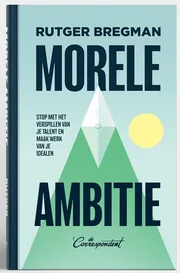
Moral Ambition
by Rutger Bregman · 2024
It suits older teens and adults thinking about work, purpose and where to direct their effort.
304 pages, about 5 to 7 hours.
A call to aim your career at the world's biggest problems. 48% taste match
What it covers
Moral Ambition is a 2024 book by Rutger Bregman, filed under self-help, personal growth, and social science, with additional threads of activism and social justice. It runs about 304 pages and has appeared in three editions.
The book takes up the question of how people spend their working lives and what they count as success. Bregman argues that titles, large salaries, and corner offices are poor yardsticks, and he proposes a different one: a career aimed at some of the world's biggest problems, such as climate change, pandemics, and the tobacco industry. He calls this outlook moral ambition, a drive to be among the best at something while measuring achievement by benefit to society rather than personal gain. Along the way he describes a growing movement of builders and problem-solvers who have already taken this route, and he lays out how readers might find a path of their own. It suits those weighing a career change, those who feel their present work lacks purpose, and anyone curious about how ambition can be pointed toward the common good.
Of all things wasted in our throwaway times, the greatest is wasted talent.
Themes
self-helppersonal growthsuccessself-managementsocial scienceactivismsocial justice
By the numbers
- The median edition runs 304 pages. Counting about 275 words a page and an adult reading pace of 250 words a minute, that is about 5.6 hours of reading.
- Open Library tracks 3 editions from 3 publishers, the earliest dated 2024 and the latest 2025, across 3 languages.
- On reader demand it ranks in the top 19% of the recent releases books in our catalog (1,627 of them).
 BookWard’s take
A call to aim your career at the world's biggest problems
Moral Ambition asks what you want from your 2,000 workweeks, and answers with a pointed argument: measure success by what you contribute, not by titles or salary. At 304 pages it is a fairly tight, short book, which suits a polemic that wants to move you rather than wear you out. The voice is distinctive and openly opinionated, closer to a persuasive essay than a neutral survey. The outlook is hopeful and idealistic, built on people already doing this work against problems like climate change, pandemics and the tobacco industry. It is driven by ideas more than by story, and it explains its case outright rather than showing it in scene. I tend to prize rigor and restraint, so the open exhortation is where I part ways with it.
At about 304 pages it stays compact for its argument, which sits well with BookWard's taste for the short and tight.
A short, argument-driven book moves briskly from point to point, close to BookWard's preference for momentum.
The framing of ambition aimed at society is fresh, though the genre around it is crowded, so it lands mid-high.
The writing is plain and accessible, in line with BookWard's slight lean toward unadorned prose.
There is no plot to drive it, so the book is neither plot-led nor strongly character-led, sitting just below the middle.
Its core message is that ambition can be pointed at the common good, a clearly hopeful outlook that BookWard enjoys.
The tone is earnest and purposeful, with little comedy, so it reads as serious next to BookWard's lighter lean.
Though it addresses serious problems, the tone stays constructive and gentle rather than dark.
It aims to inspire and stir a sense of purpose, with moderate emotional intensity.
See all 50 dialsEvery position, side by side with this book
Where it lines up
- LengthBookWard 1 · book 2
- PaceBookWard 8 · book 7
- EndingBookWard 8 · book 7
Where it pulls apart
- Familiar tropesBookWard 10 · book 5
- Story or ideasBookWard 3 · book 9
- ExpositionBookWard 2 · book 8
At about 304 pages it stays compact for its argument, which sits well with BookWard's taste for the short and tight.
Self-help carries a familiar shape of problem, argument and call to action, so it leans on convention more than BookWard would like.
The case runs in a clear line from the problem of wasted talent to a proposed alternative, which BookWard appreciates.
A short, argument-driven book moves briskly from point to point, close to BookWard's preference for momentum.
The framing of ambition aimed at society is fresh, though the genre around it is crowded, so it lands mid-high.
People appear as examples of the movement rather than as deeply drawn figures, so depth is limited here.
It appeals openly to meaning and legacy, which is warmer and more emotional than BookWard's restrained taste.
It argues rather than shocks, and nothing in it relies on darkness for effect, which BookWard appreciates.
It makes a reasoned case with real-world examples, though as a popular guidebook it is less rigorous than BookWard prefers.
Bregman's persuasive, personal voice is distinctive and carries the book, a quality BookWard values.
The book is built around an idea and its application, far from BookWard's story-led lean.
Arguments are stated outright rather than dramatized, which runs against BookWard's preference for showing.
A focused thesis keeps momentum fairly steady, though guidebooks can repeat their point, so it holds up well but not perfectly.
The writing is plain and accessible, in line with BookWard's slight lean toward unadorned prose.
There is no plot to drive it, so the book is neither plot-led nor strongly character-led, sitting just below the middle.
Its core message is that ambition can be pointed at the common good, a clearly hopeful outlook that BookWard enjoys.
The tone is earnest and purposeful, with little comedy, so it reads as serious next to BookWard's lighter lean.
Accessible prose and a clear argument make it an easy read, close to BookWard's low-effort preference.
It speaks mainly in the author's voice while citing a handful of people from the movement, so viewpoints stay modest.
The argument moves forward in a straightforward line, matching BookWard's lean toward linear structure.
This is entirely grounded in real careers and real problems, so it is as far from fantasy as it gets.
It draws on a range of pioneers as examples, giving a mid-sized cast of figures rather than a tiny one.
It takes on climate change, pandemics and Big Tobacco, so the stakes are large even though advice is personal.
The book is about action in the world and what to do with a career, more than inner reflection.
Romance plays no role in a book about careers and societal benefit.
The setting is the familiar working world of offices, careers and ordinary jobs, so it reads as quite known territory.
Published in 2024 and aimed at today's careers and crises, it is firmly rooted in the present day.
Its argument speaks to a lasting question about work, though its examples tie it to current concerns.
A nonfiction author arguing in his own voice is as reliable as a narrator gets.
The book takes a clear moral stance on what makes a career worthwhile, leaving little ambiguity.
The prose serves the argument rather than painting scenes, so description stays sparse.
It mixes argument with stories of people who have done this work, landing nearer to the narrative side than analytical.
It reads as a standalone work rather than part of a series.
An argumentative guidebook offers few surprises in the narrative sense.
It asks readers to question their definition of success, a real challenge, though framed encouragingly.
Though it addresses serious problems, the tone stays constructive and gentle rather than dark.
It aims to inspire and stir a sense of purpose, with moderate emotional intensity.
A book about careers and societal problems has essentially no violence on the page.
There is no sexual content in a book about work and purpose.
Questions of activism and social justice are central to the argument, though the focus is personal action.
The language is plain and accessible throughout.
Bregman argues openly for a point of view, making the narration strongly opinionated.
The book looks ahead, urging readers to build a legacy and tackle problems still to be solved.
Its belief that ambition can serve the common good is idealistic through and through.
Review written by BookWard, dial version 1, November 2026.
Who is Moral Ambition right for?
It suits older teens and adults thinking about work, purpose and where to direct their effort. The subject matter is serious, covering climate change, pandemics and harmful industries, but the tone is constructive and nothing in it is graphic.
Accessible prose and a clear argument make it an easy read, close to BookWard's low-effort preference.
Though it addresses serious problems, the tone stays constructive and gentle rather than dark.
It aims to inspire and stir a sense of purpose, with moderate emotional intensity.
A book about careers and societal problems has essentially no violence on the page.
Book CompanionMoral Ambition: ideas, characters, themes
Success should be measured by contribution to society rather than by title, salary or personal gain, and talented people should aim their careers at the world's biggest problems.
- The 2,000 workweeks. A career spans about 2,000 workweeks, so how you spend that time is one of the most important decisions of your life.
- Wasted talent. Many people are stuck in pointless or harmful jobs, which wastes talent that could be put to better use.
- A different yardstick. Moral ambition keeps the drive to be among the best but swaps fancy titles and big salaries for benefit to society.
- Real problems to solve. The book points to challenges like climate change, pandemics and Big Tobacco as places where focused effort can matter.
- A growing movement. Builders and problem-solvers are already living this ethos, offering examples and a path for readers to follow.
Themes
The will to excel while measuring success by contribution to others.
Treating a career as a finite resource worth spending on things that matter.
Replacing wealth and status with societal benefit as the mark of achievement.
Turning personal talent toward collective problems and fairer outcomes.
Building a body of work that lasts beyond personal accumulation.
Discussion questions
- How do you currently define success, and where did that definition come from?
- If your career is about 2,000 workweeks, how would you want to spend them?
- Which of the world's big problems would you most want to work on, and why?
- Is moral ambition realistic for most people, or does it depend on privilege and circumstance?
- What would it take to change your own work toward something more purposeful?
Personalize your Book Companion
This is the general edition. In BookWard, the Companion is written for you: your reading profile, your notes, and spoiler-safe to the page you are on.
Buy, listen or borrow Moral Ambition
Each link opens a search for this book on that store, in a new tab.
Read on a device
Borrow
Reviews and community
If you liked Moral Ambition
A cheerful, idea-led case for doubting yourself on purpose
FactfulnessHans RoslingA cheerful, rigorous case that the world is better than you think
Start with WhySimon SinekOne big idea, built on Apple, King and Kennedy
DriveDaniel H. PinkA lively case that autonomy, mastery and purpose beat carrots and sticks
Sources: Open Library.
Track Moral Ambition and find your next favorite
Add it to your shelf, rate what you have read, and BookWard will recommend what fits you.
Free to start. No credit card needed.