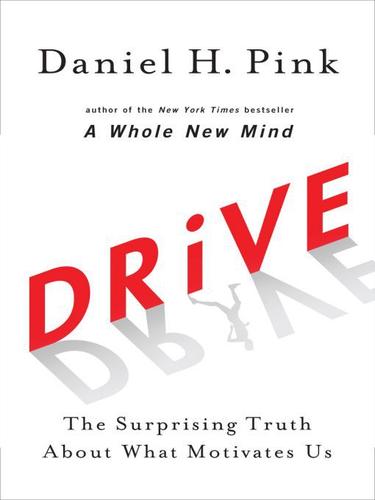
Drive
by Daniel H. Pink
★ Top 25 book of 2009 · #17 on Best Books of 2009
Daniel Pink challenges the idea that rewards like money are the best way to motivate people. Drawing on decades of research, he argues that internal drive leads to better performance, creativity and wellbeing.
Best for: Managers and curious readers interested in what really motivates people at work and home
Drive is #17 on BookWard's Best Books of 2009, out of 42 2009 books that cleared our data bar.
What Drive is about
Daniel H. Pink asks what actually motivates us, and his answer cuts against common workplace habits. He argues that the carrot-and-stick approach, where money and other outside rewards are used to drive performance, is a mistake. The real source of high performance and satisfaction, he says, is intrinsic motivation: the desire to follow your own interests.
He backs this with thirty years of scientific data, and he shows how both people and companies can put the idea to work, noting that some already do. The examples cover the job, the home and our own habits. Pink is also the author of A Whole New Mind, and the writing here is accessible and persuasive. It will help managers rethinking how they motivate a team, as well as anyone who wants more satisfaction from their own work.
Drive on the Best Books of 2009
Drive came out in 2009. Of the 42 books first published in 2009 that met BookWard's data bar, it ranks #17 on our Best Books of 2009 list.
Why it made the list: 383 readers have shelved it on Open Library; readers rate it 4 out of 5 (28 ratings). The list ranks each year’s books on how many readers have picked them up, how highly readers rate them, and how many are reading them right now.
Nearby on the 2009 list
- The Boy Who Harnessed the Wind William Kamkwamba, #15
- The 50Th Law Robert Greene, #16
- Fallen (Fallen #1) Lauren Kate, #18
- Where the Mountain Meets the Moon Grace Lin, #19
See all Best Books of 2009 Best books by year
More years: Best Books of 2008 Best Books of 2010.
The numbers behind it
- Readers: 333 want to read it, 11 are reading it now and 39 have read it, according to Open Library.
- Ratings: 4 out of 5 from 28 Open Library ratings.
| Signal | This book (0 to 100) | Weight |
|---|---|---|
| Reach | 64 | 55% |
| Reader love | 57 | 25% |
| Being read right now | 40 | 20% |
Questions about Drive
When was Drive published?
Drive by Daniel H. Pink was first published in 2009.
Was Drive one of the best books of 2009?
Drive is #17 on BookWard's Best Books of 2009, out of 42 2009 books that cleared our data bar. 383 readers have shelved it on Open Library; readers rate it 4 out of 5 (28 ratings).
Why is Drive on the Best Books of 2009 list?
383 readers have shelved it on Open Library; readers rate it 4 out of 5 (28 ratings).
More of the best books of 2009
- The Last Olympian Rick Riordan, #1
- Catching Fire Suzanne Collins, #2
- The Maze Runner James Dashner, #3
- The Help Kathryn Stockett, #4
- Dork Diaries Rachel Renée Russell, #5
- I Will Teach You to Be Rich Ramit Sethi, #6
See the full Best Books of 2009, the Top 100, or new books on Rising.
How we know
This page uses public data: Open Library reader counts and ratings, and Wikipedia page views for recent years. The description is paraphrased from real source text. Rankings reflect reading interest, not quality or sales, and can be affected by data gaps. Lists update monthly.
Suits adults and older teens interested in work, learning and leadership.
Depends on the edition you pick.
A lively case that autonomy, mastery and purpose beat carrots and sticks. 52% taste match
 BookWard’s take
A lively case that autonomy, mastery and purpose beat carrots and sticks
Drive argues that money and other external rewards are a poor way to motivate people doing creative or complex work, and that three things do the job better: autonomy, mastery and purpose. Pink is a clear, brisk writer, and his voice is a real asset here. The book moves quickly, with examples that arrive before the argument has time to stall. It is driven by ideas rather than by narrative, and it explains its points outright instead of letting them emerge. That suits a business book, though it may feel plain to readers who prefer to be shown rather than told. The argument leans on decades of motivation research, though this is a popular synthesis, not a lab report. It has also lasted, since the central argument still travels well.
A compact idea book that makes its case in a few hundred pages at most, which fits BookWard's love of tight reading.
Short sections and a steady stream of examples keep it moving without much padding.
The core finding was already in the research literature, but the framing for work and life felt fresh to many readers.
Plain, clear sentences that favor clarity over ornament, with little decoration.
Its message is that people can find more satisfaction in work and life, and it stays upbeat throughout.
A conventional run from problem to evidence to practice, with no formal experiments.
Light touches of wit appear, but the book stays mostly serious and practical.
Gentle subject matter with nothing grim or disturbing.
Engaging and encouraging, though not emotionally intense.
See all 50 dialsEvery position, side by side with this book
Where it lines up
- PaceBookWard 8 · book 7
- EndingBookWard 8 · book 7
- Authorial voiceBookWard 9 · book 8
Where it pulls apart
- Familiar tropesBookWard 10 · book 5
- ExpositionBookWard 2 · book 9
- Story or ideasBookWard 3 · book 9
A compact idea book that makes its case in a few hundred pages at most, which fits BookWard's love of tight reading.
It opens by challenging a common belief about rewards, which pulls you in, though not as hard as a gripping story would.
Business books lean on familiar formats and anecdotes, and this one follows many of them while overturning a popular assumption.
The argument builds step by step from research to practice, with each claim leading cleanly to the next.
Short sections and a steady stream of examples keep it moving without much padding.
The core finding was already in the research literature, but the framing for work and life felt fresh to many readers.
It closes by pulling its argument together and pointing to concrete next steps, which BookWard likes in a finished book.
Warm and encouraging in tone, with a clear wish for readers to feel better about their work.
It draws on decades of motivation research, but as a popular synthesis it trades some depth for readability.
Pink writes in a confident, conversational register that is easy to recognize and hard to confuse with a textbook.
The book is built around one big idea and its implications, with stories serving the argument.
Concepts are named and explained directly, which is the opposite of BookWard's preference for showing in scene.
Short chapters and recurring examples keep energy fairly even, with only mild repetition late on.
Plain, clear sentences that favor clarity over ornament, with little decoration.
Its message is that people can find more satisfaction in work and life, and it stays upbeat throughout.
A conventional run from problem to evidence to practice, with no formal experiments.
Light touches of wit appear, but the book stays mostly serious and practical.
Easy to read in a sitting or two, with no specialist knowledge required.
Told from a single authorial perspective guiding you through the evidence.
Moves in a straightforward order from the old model of motivation to the new one.
Entirely grounded in research, workplaces and everyday life.
It addresses workplaces and societies, but at the level of individual habits and management choices.
It dwells on what drives people from inside, even as it points to practical action.
This is an exposition-led book with almost no quoted conversation.
Not a topic here at all.
Offices, schools and homes are the settings, and they feel familiar.
Rooted in contemporary work culture, though its concerns have kept their relevance.
The core argument about motivation holds up well beyond its original moment.
The author speaks plainly in his own voice, with no tricks.
It pushes a clear view about how to treat people at work, without much room for shades of gray.
Settings and cases are sketched quickly, with little rich scene-painting.
Part story-driven examples, part analysis, so it lands near the middle of the two.
The author occasionally draws on his own experience, but mostly lets the research lead.
A standalone book, though it follows an earlier work by the same author.
Its few surprises are conceptual reversals of what you assumed about rewards, not plot turns.
It nudges you to rethink pay and incentives, a moderate challenge to common assumptions.
Gentle subject matter with nothing grim or disturbing.
Engaging and encouraging, though not emotionally intense.
Gentle, light humor rather than broad comedy.
No violence appears in a book about motivation.
No sexual content.
Touches on how organizations are run, but it is not a political book.
Written in standard, accessible language.
The author argues a case firmly and openly, taking a stand on how things should change.
It looks ahead to better ways of working and managing people.
It believes people want to do meaningful work and that workplaces can be built to support that.
Review written by BookWard, dial version 1, November 2026.
Who is Drive right for?
Suits adults and older teens interested in work, learning and leadership. There is no sensitive content.
Easy to read in a sitting or two, with no specialist knowledge required.
Gentle subject matter with nothing grim or disturbing.
Engaging and encouraging, though not emotionally intense.
No violence appears in a book about motivation.
Book CompanionDrive: ideas, characters, themes
People doing creative or complex work are driven far more by autonomy, mastery and purpose than by carrots and sticks.
- Rewards can backfire. For creative tasks, external rewards like money can dull interest and performance instead of lifting it.
- Intrinsic motivation. The strongest drive comes from following your own interests and seeing the benefit in the work itself.
- Autonomy. People do better when they have real say over what they do, when they do it and how.
- Mastery. Getting steadily better at something that matters is itself a powerful source of satisfaction.
- Purpose. Connecting work to something larger than yourself sustains effort in a way pay alone does not.
Themes
What actually makes people want to do good work.
Having genuine control over your own tasks and choices.
The satisfaction of improving at something over time.
Linking effort to something beyond personal gain.
How the way we work shapes our satisfaction and health.
Discussion questions
- Where in your own work have rewards or deadlines made you care less about the task?
- Which of autonomy, mastery or purpose matters most to you right now, and why?
- How could a team you belong to give people more genuine control?
- Is the argument stronger for creative work than for routine jobs?
- What would change in a school or home if this approach to motivation were applied?
Personalize your Book Companion
This is the general edition. In BookWard, the Companion is written for you: your reading profile, your notes, and spoiler-safe to the page you are on.
Buy, listen or borrow Drive
Each link opens a search for this book on that store, in a new tab.
Read on a device
Borrow
Reviews and community
If you liked Drive
A calm, idea-led case against busyness as proof of work
MindsetCarol S. DweckOne big idea, two mindsets, applied to work, love and parenting
Think AgainAdam GrantA cheerful, idea-led case for doubting yourself on purpose
Get Better at AnythingScott YoungA clear framework for why some learning sticks and some stalls
Find your own best books
Add what you have read, rate it, and BookWard will recommend what to read next.
Free to start. No credit card needed.