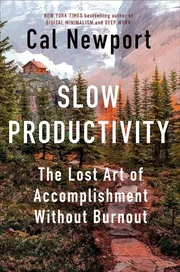
Slow Productivity
by Cal Newport · 2024
Suited to adult and older teen readers who work or expect to work with ideas.
256 pages, about 4 to 6 hours.
A calm, idea-led case against busyness as proof of work. 49% taste match
What it covers
Slow Productivity is a work of nonfiction by Cal Newport, first published in 2024 and running about 256 pages. It sits at the meeting point of self-help, time management, and economic history, taking up the question of how people in knowledge work decide what counts as useful effort and how much of it to take on.
Newport argues that the habit of equating busyness with accomplishment leaves workers with overloaded task lists and constant meetings, and he proposes an approach he calls slow productivity as a more sustainable path. To build the case, he looks back at the working lives of earlier thinkers, including Galileo, Isaac Newton, Jane Austen, and Georgia O'Keeffe, drawing on their habits and mindsets to outline a set of principles for modern jobs. The book blends cultural criticism with practical guidance for anyone who works with ideas and wants to produce lasting work without sliding into burnout or giving up on ambition.
Themes
ProductivityEconomic historyNew York Times bestseller
By the numbers
- The median edition runs 256 pages. Counting about 275 words a page and an adult reading pace of 250 words a minute, that is about 4.7 hours of reading.
- Open Library tracks 5 editions from 5 publishers, across 2 languages.
- On reader demand it ranks in the top 9% of the recent releases books in our catalog (1,627 of them).
- Libraries shelve it under Library of Congress class HD-0069.00000000.T54N4 2024.
 BookWard’s take
A calm, idea-led case against busyness as proof of work
Newport's argument is that busyness has become a poor stand-in for useful effort, and he builds the case by looking back at how Galileo, Isaac Newton, Jane Austen and Georgia O'Keeffe organised their working lives. This is a book driven by ideas rather than story, which is further from what I usually reach for, and it explains its points outright instead of dramatising them in scene, so that part didn't win me over. It does earn credit for originality, since the slow productivity framing is a fresh angle on a crowded shelf, and for a voice that is clear and unmistakably his. At 256 pages it stays tight, and its outlook is hopeful. A good fit if you want a practical, humane rethink of work rather than a hustle manual.
At about 256 pages it stays compact for its subject, close to BookWard's liking for tight books.
The slow productivity framing is a fresh take, though it builds on familiar ideas about focus and overload.
The writing is plain and direct, favouring clarity over ornament, and more spare than BookWard's middle setting.
It offers a more humane alternative to burnout and hustle culture, which is a hopeful outlook that fits BookWard.
It follows a conventional pattern of diagnosis, historical case studies and practical principles, close to BookWard's preference.
The tone is earnest and reasoned, with little comedy, sitting well on the serious side of BookWard's lean.
Its subject is overwork and burnout, handled in a measured tone with nothing disturbing.
It speaks to real stress but keeps a cool, reasoned register.
See all 50 dialsEvery position, side by side with this book
Where it lines up
- Shock for effectBookWard 9 · book 9
- EndingBookWard 8 · book 7
- SentimentBookWard 8 · book 7
Where it pulls apart
- ExpositionBookWard 2 · book 9
- OpeningBookWard 10 · book 6
- Familiar tropesBookWard 10 · book 6
At about 256 pages it stays compact for its subject, close to BookWard's liking for tight books.
It works in a well-worn self-help space, though its historical grounding keeps it from feeling formulaic.
The case runs from diagnosis to principles in a clear sequence that holds together, a little looser than BookWard's airtight ideal.
The slow productivity framing is a fresh take, though it builds on familiar ideas about focus and overload.
The principles resolve into a usable roadmap, giving a settled finish that suits BookWard's liking for resolution.
It speaks warmly about burnout and meaning but leans on argument rather than tugging at feelings.
It argues through evidence and example, with no cheap provocation, which BookWard values.
It draws on research into the habits of historical thinkers, though self-help guidance keeps it short of academic rigor.
Newport writes with a clear, recognisable, argumentative voice that makes the book stand out from generic advice.
The book is built around a thesis and its principles, so ideas lead and narrative supports, opposite to BookWard's lean.
Principles are explained outright and illustrated with examples, which runs against BookWard's preference for showing in scene.
Each principle gets its own section, so the argument stays focused rather than drifting in the middle.
The writing is plain and direct, favouring clarity over ornament, and more spare than BookWard's middle setting.
It offers a more humane alternative to burnout and hustle culture, which is a hopeful outlook that fits BookWard.
It follows a conventional pattern of diagnosis, historical case studies and practical principles, close to BookWard's preference.
The tone is earnest and reasoned, with little comedy, sitting well on the serious side of BookWard's lean.
The prose is accessible and the argument easy to follow, making it lighter reading than BookWard's middle ground.
It is argued from a single authorial perspective, with historical figures serving as examples rather than separate voices.
The argument moves between past figures and the present but follows a mostly straight line of reasoning.
It is wholly grounded in real history and real working conditions.
A varied roster of historical thinkers, from Galileo to Georgia O'Keeffe, adds up to a fairly sizeable cast of examples.
It stays focused on individual working lives and habits, making it intimate rather than epic.
It concerns how people think about and organise their work, so it leans toward inner mindset over outward action.
As an argument-led nonfiction book, it contains almost no dialogue.
Romance plays no part in this book.
The workplace setting is familiar to most readers, unlike BookWard's lean toward the unfamiliar.
It is aimed squarely at current working life, with overloaded inboxes and meetings, though history anchors it.
Its appeal to the working habits of past thinkers gives it some lasting value, though it speaks to today's concerns.
The author speaks plainly in his own voice, with nothing unreliable about it.
It takes a clear position on what real productivity means and what to avoid.
Descriptive passages serve the argument and are brief, so the book is on the sparse side.
It mixes historical stories with explicit principles, leaning slightly more analytical than narrative.
Newport writes as a guide with a stake in the problem, and the tone is conversational rather than detached.
It stands alone as a single book.
It is an argument rather than a story, so there are few surprises beyond its historical examples.
It questions how readers think about work, though it does so gently with practical steps.
Its subject is overwork and burnout, handled in a measured tone with nothing disturbing.
It speaks to real stress but keeps a cool, reasoned register.
Whatever wit appears is dry and incidental to the argument.
There is no violence in this book.
There is no sexual content in this book.
It critiques work culture and economics but stays with working life rather than party politics.
The language is plain and easy to follow throughout.
Newport argues his case openly, making the narration clearly opinionated.
It looks to history for lessons but aims them at how to work going forward.
It holds that a more humane way of working is attainable, which reads as idealistic yet practical.
Review written by BookWard, dial version 1, November 2026.
Who is Slow Productivity right for?
Suited to adult and older teen readers who work or expect to work with ideas. There is nothing sensitive beyond its discussion of overwork and burnout.
The prose is accessible and the argument easy to follow, making it lighter reading than BookWard's middle ground.
Its subject is overwork and burnout, handled in a measured tone with nothing disturbing.
It speaks to real stress but keeps a cool, reasoned register.
There is no violence in this book.
Book CompanionSlow Productivity: ideas, characters, themes
Real productivity means doing fewer things at a natural pace and focusing on quality, as history's most impactful thinkers did, rather than measuring worth by busyness.
- Busyness is a broken measure. Treating busyness as a proxy for useful effort leads to impossibly long task lists and constant meetings.
- History offers a better model. Figures such as Galileo, Isaac Newton, Jane Austen and Georgia O'Keeffe produced lasting work without modern overload.
- Rethink workload. Newport argues for managing workload more aggressively so effort goes to what matters.
- Vary the seasons. He proposes introducing seasonal variation into how intensely you work.
- Aim at long-term quality. Performance should be shifted toward work with staying power rather than short-term output.
Themes
The gap between looking busy and producing useful work.
The exhaustion that comes from overload and hustle culture.
Pursuing meaningful accomplishment without giving up on it.
Putting lasting work ahead of quick output.
Using the habits of past thinkers as a guide for modern jobs.
Discussion questions
- Where in your own work does busyness stand in for useful effort?
- Which historical example in the book would you most want to copy, and why?
- Can seasonal variation work in a job with fixed deadlines?
- Does slow productivity ask too much of people without control over their workload?
- How would you define useful work if no one were measuring your activity?
Personalize your Book Companion
This is the general edition. In BookWard, the Companion is written for you: your reading profile, your notes, and spoiler-safe to the page you are on.
Buy, listen or borrow Slow Productivity
Each link opens a search for this book on that store, in a new tab.
Read on a device
Borrow
Reviews and community
If you liked Slow Productivity
A lively case that autonomy, mastery and purpose beat carrots and sticks
MindsetCarol S. DweckOne big idea, two mindsets, applied to work, love and parenting
ContagiousJonah BergerA practical, story-rich guide to why ideas spread
Think AgainAdam GrantA cheerful, idea-led case for doubting yourself on purpose
Sources: Open Library.
Track Slow Productivity and find your next favorite
Add it to your shelf, rate what you have read, and BookWard will recommend what fits you.
Free to start. No credit card needed.