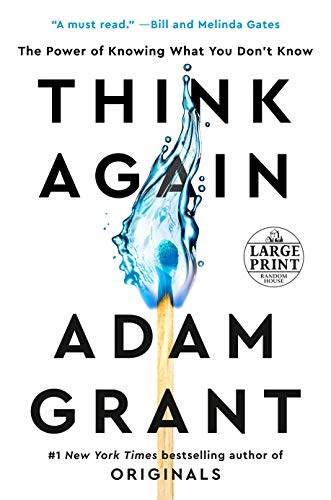
Think Again
by Adam Grant
★ Top 25 book of 2021 · #17 on Best Books of 2021
Adam Grant makes the case for doubt and the joy of being wrong, arguing that rethinking is a teachable skill. The book looks at how individuals, teachers, and organizations can build cultures that welcome changing your mind.
Best for: Leaders, teachers, and curious thinkers wanting to get better at changing their minds
Think Again is #17 on BookWard's Best Books of 2021, out of 60 2021 books that cleared our data bar.
What Think Again is about
Adam Grant makes the case that changing your mind is a strength, not a weakness. He argues that doubt has real benefits and that being wrong can be a source of joy. Creative thinkers, he says, do not cling to a single identity, and leaders who admit what they don't know and ask for tough feedback build more productive, inventive teams.
The book is organized in three parts. The first looks at why we resist rethinking and how individuals can learn to do it, including a warning that grit alone can backfire. The second turns to helping other people reconsider through what Grant calls argument literacy. The third examines how schools, businesses and governments fall short of building cultures that welcome rethinking. Throughout, he treats rethinking as both a mindset and a skillset that can be taught. It will help managers, teachers, and anyone who wants to argue better and hold opinions more lightly.
Think Again on the Best Books of 2021
Think Again came out in 2021. Of the 60 books first published in 2021 that met BookWard's data bar, it ranks #17 on our Best Books of 2021 list.
Why it made the list: 1,017 readers have shelved it on Open Library; readers rate it 3.7 out of 5 (35 ratings); 59 are reading it right now. The list ranks each year’s books on how many readers have picked them up, how highly readers rate them, and how many are reading them right now.
Nearby on the 2021 list
- Heartstopper, Volume 4 Alice Oseman, #15
- You'd Be Home Now Kathleen Glasgow, #16
- The Hawthorne Legacy Jennifer Lynn Barnes, #18
- The Hating Game Sally Thorne, #19
See all Best Books of 2021 Best books by year
More years: Best Books of 2020 Best Books of 2022.
The numbers behind it
- Readers: 911 want to read it, 59 are reading it now and 47 have read it, according to Open Library.
- Ratings: 3.7 out of 5 from 35 Open Library ratings.
| Signal | This book (0 to 100) | Weight |
|---|---|---|
| Reach | 78 | 55% |
| Reader love | 23 | 25% |
| Being read right now | 83 | 20% |
Questions about Think Again
When was Think Again published?
Think Again by Adam Grant was first published in 2021.
Was Think Again one of the best books of 2021?
Think Again is #17 on BookWard's Best Books of 2021, out of 60 2021 books that cleared our data bar. 1,017 readers have shelved it on Open Library; readers rate it 3.7 out of 5 (35 ratings); 59 are reading it right now.
Why is Think Again on the Best Books of 2021 list?
1,017 readers have shelved it on Open Library; readers rate it 3.7 out of 5 (35 ratings); 59 are reading it right now.
More of the best books of 2021
- The Love Hypothesis Ali Hazelwood, #1
- Twisted Games Ana Huang, #2
- Project Hail Mary Andy Weir, #3
- As Good as Dead Holly Jackson, #4
- You've Reached Sam Dustin Thao, #5
- Twisted Love Ana Huang, #6
See the full Best Books of 2021, the Top 100, or new books on Rising.
How we know
This page uses public data: Open Library reader counts and ratings, and Wikipedia page views for recent years. The description is paraphrased from real source text. Rankings reflect reading interest, not quality or sales, and can be affected by data gaps. Lists update monthly.
Suits adults and mature teens interested in psychology, work and decision-making.
Depends on the edition you pick.
A cheerful, idea-led case for doubting yourself on purpose. 47% taste match
 BookWard’s take
A cheerful, idea-led case for doubting yourself on purpose
Think Again argues that the most useful thinking skill is the willingness to revise what you believe, and it builds that case in three parts: rethinking as an individual, helping others rethink, and changing the cultures of schools, businesses and governments. It is idea-led rather than story-led, and the argument is the point. Grant's voice is distinctive and friendly, and the Opinionated narration keeps the pace brisk. On rigor it leans on research, though it also leans on anecdote to make each idea stick. Exposition is explained outright, which suits the form but sits far from BookWard's preference for showing in scene. The outlook is hopeful and the ending is resolved, since the book frames rethinking as a teachable skill. Readers who want a tight, original argument will find parts of it familiar.
Short, example-driven chapters move briskly, a touch slower than BookWard's taste for speed.
The core thesis about embracing being wrong is well argued but overlaps with a lot of popular psychology.
Plain, clear sentences built for explanation rather than ornament, a little plainer than BookWard likes.
The book argues that rethinking can be taught and pays off, an upbeat outlook that matches BookWard.
A conventional three-part self-help layout, close to BookWard's mild comfort with the familiar.
Light humor leavens the argument without turning it into a comedy.
Gentle throughout, with no grim material.
The tone is curious and encouraging rather than emotionally intense.
See all 50 dialsEvery position, side by side with this book
Where it lines up
- EndingBookWard 8 · book 8
- PaceBookWard 8 · book 7
- Authorial voiceBookWard 9 · book 8
Where it pulls apart
- Familiar tropesBookWard 10 · book 5
- ExpositionBookWard 2 · book 9
- LengthBookWard 1 · book 5
Self-improvement framing and familiar business-book moves keep it from avoiding tropes, short of BookWard's bar.
The three-part structure builds step by step from individual rethinking to group and institutional change, a clear and mostly sound argument.
Short, example-driven chapters move briskly, a touch slower than BookWard's taste for speed.
The core thesis about embracing being wrong is well argued but overlaps with a lot of popular psychology.
Warm and encouraging without being syrupy, a little more upbeat than BookWard's restrained preference.
Grant draws on research to back claims, though anecdote carries much of the persuasion, short of BookWard's rigor.
Grant's chatty, curious tone is recognizably his own, close to what BookWard prizes.
The argument is the book, with stories serving the ideas, far from BookWard's story-led lean.
Ideas are explained outright by design, the opposite of BookWard's preference for showing in scene.
Plain, clear sentences built for explanation rather than ornament, a little plainer than BookWard likes.
The book argues that rethinking can be taught and pays off, an upbeat outlook that matches BookWard.
A conventional three-part self-help layout, close to BookWard's mild comfort with the familiar.
Light humor leavens the argument without turning it into a comedy.
Accessible and easy to follow, a lighter lift than BookWard's middling tolerance for effort.
It speaks in Grant's single authorial voice, though it cites many people and studies.
The argument unfolds in order, section by section, with no time shifting.
Entirely grounded in research, organizations and everyday decisions.
It ranges from personal habits to schools, businesses and governments, wider than a purely intimate book.
Much of it concerns how we think and hold beliefs, inner life more than outer action.
Mostly explanation and argument, with little reliance on dialogue.
Romance plays no role in this argument about rethinking.
Everyday workplaces, classrooms and public life make for a familiar setting.
Published in 2021 and aimed at a fast-changing present.
The advice is durable, though its framing is tied to its moment.
Grant lays out his case in the open, a straightforward and reliable guide.
It takes clear sides on the value of humility and openness to being wrong.
Description serves explanation rather than atmosphere, so it stays on the sparse side.
It mixes stories and research, leaning a little toward narrative examples over dry analysis.
Grant speaks directly to the reader and uses personal framing, close to a personal perspective.
It stands alone as a single book.
It offers a few counterintuitive findings, not many surprises.
It nudges readers to question their own certainties, a moderate challenge delivered gently.
Gentle throughout, with no grim material.
The tone is curious and encouraging rather than emotionally intense.
Humor is mild and wry, closer to dry than broad.
Violence is essentially absent.
Sexual content does not figure in the book.
It touches on polarized debates as examples but is not a political book.
The language is plain and easy to read.
Grant argues a clear position and makes his stance plain throughout.
It points forward, urging readers to adapt to a fast-changing world.
It holds an optimistic belief that people and institutions can learn to rethink.
Review written by BookWard, dial version 1, November 2026.
Who is Think Again right for?
Suits adults and mature teens interested in psychology, work and decision-making. Nothing sensitive, though it touches on polarized debates.
Accessible and easy to follow, a lighter lift than BookWard's middling tolerance for effort.
Gentle throughout, with no grim material.
The tone is curious and encouraging rather than emotionally intense.
Violence is essentially absent.
Book CompanionThink Again: ideas, characters, themes
Being willing to doubt your own views and rethink them is a learnable skill that beats stubborn certainty.
- Doubt as a strength. The book argues that admitting you might be wrong is an advantage, not a weakness.
- Grit can backfire. Persistence alone can trap you in a bad path, so rethinking has to temper determination.
- Argument literacy. Helping others rethink depends on how you argue and listen, not just on how forcefully you speak.
- Seek critical feedback. Leaders who admit what they don't know and invite challenge tend to run more innovative teams.
- Cultures that reward rethinking. Schools, businesses and governments can build habits and structures that encourage people to revise their views.
Themes
Holding your beliefs loosely enough to update them.
Treating being wrong as a route to growth.
How to help others reconsider without triggering defensiveness.
How schools, workplaces and governments shape whether people rethink.
Adapting to a world that shifts faster than ever.
Discussion questions
- When did you last change your mind about something important, and what caused it?
- Is there a belief you hold that you would find hard to question, and why?
- How does the idea that grit can backfire fit your own experience?
- What makes someone better at helping others rethink than at winning an argument?
- Which institution you belong to rewards rethinking, and which punishes it?
Personalize your Book Companion
This is the general edition. In BookWard, the Companion is written for you: your reading profile, your notes, and spoiler-safe to the page you are on.
Buy, listen or borrow Think Again
Each link opens a search for this book on that store, in a new tab.
Read on a device
Borrow
Reviews and community
If you liked Think Again
A lively case that autonomy, mastery and purpose beat carrots and sticks
QuietSusan CainA well-researched case for the value of introverts
Slow ProductivityCal NewportA calm, idea-led case against busyness as proof of work
MindsetCarol S. DweckOne big idea, two mindsets, applied to work, love and parenting
Find your own best books
Add what you have read, rate it, and BookWard will recommend what to read next.
Free to start. No credit card needed.