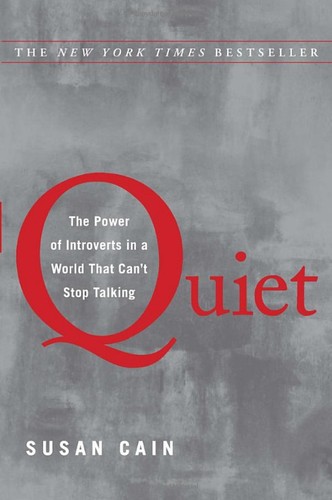
Quiet
by Susan Cain
★ Top 10 book of 2012 · #9 on Best Books of 2012
Cain argues that modern culture overvalues extroversion and overlooks what introverts offer. Drawing on research and real-life stories, she looks at business, schools, and relationships, and offers practical advice for introverts and those who live with them.
Best for: Introverts, and anyone who manages, teaches, or loves one, seeking research-based understanding
Quiet is #9 on BookWard's Best Books of 2012, out of 59 2012 books that cleared our data bar.
What Quiet is about
Susan Cain argues that we dramatically undervalue introverts and lose a great deal by doing so. She traces how the Extrovert Ideal rose to dominance in the twentieth century, then follows it through some surprising places: Dale Carnegie's birthplace, Harvard Business School, a Tony Robbins seminar and an evangelical megachurch. Along the way she listens to Asian-American students who feel out of step with the brash atmosphere of American schools, and she questions whether forced collaboration in business helps or blocks innovation. She also makes the case that the leadership potential of introverts is often overlooked.
The argument rests on psychology and neuroscience research into how introverts and extroverts differ, and it is brought to life through real people, such as a speaker who recharges in solitude and a record-breaking salesman who relies on the power of questions. It will reassure quiet readers, and it will help managers, teachers and parents who want to make room for them.
Quiet on the Best Books of 2012
Quiet came out in 2012. Of the 59 books first published in 2012 that met BookWard's data bar, it ranks #9 on our Best Books of 2012 list.
Why it made the list: 1,055 readers have shelved it on Open Library; readers rate it 4.1 out of 5 (99 ratings); 60 are reading it right now. The list ranks each year’s books on how many readers have picked them up, how highly readers rate them, and how many are reading them right now.
Nearby on the 2012 list
- Me Before You Jojo Moyes, #7
- Keeper of the Lost Cities Shannon Messenger, #8
- En Man Som Heter Ove Fredrik Backman, #10
- Breaking the Habit of Being Yourself Joe Dispenza, #11
See all Best Books of 2012 Best books by year
More years: Best Books of 2011 Best Books of 2013.
The numbers behind it
- Readers: 874 want to read it, 60 are reading it now and 120 have read it, according to Open Library.
- Ratings: 4.1 out of 5 from 99 Open Library ratings.
| Signal | This book (0 to 100) | Weight |
|---|---|---|
| Reach | 85 | 55% |
| Reader love | 66 | 25% |
| Being read right now | 90 | 20% |
Questions about Quiet
When was Quiet published?
Quiet by Susan Cain was first published in 2012.
Was Quiet one of the best books of 2012?
Quiet is #9 on BookWard's Best Books of 2012, out of 59 2012 books that cleared our data bar. 1,055 readers have shelved it on Open Library; readers rate it 4.1 out of 5 (99 ratings); 60 are reading it right now.
Why is Quiet on the Best Books of 2012 list?
1,055 readers have shelved it on Open Library; readers rate it 4.1 out of 5 (99 ratings); 60 are reading it right now.
More of the best books of 2012
- Wonder R. J. Palacio, #1
- The Fault in Our Stars John Green, #2
- The Selection (the Selection #1) Kiera Cass, #3
- Drama Raina Telgemeier, #4
- Throne of Glass Sarah J. Maas, #5
- The Power of Habit Charles Duhigg, #6
See the full Best Books of 2012, the Top 100, or new books on Rising.
How we know
This page uses public data: Open Library reader counts and ratings, and Wikipedia page views for recent years. The description is paraphrased from real source text. Rankings reflect reading interest, not quality or sales, and can be affected by data gaps. Lists update monthly.
It suits adult and older teen readers, including parents, teachers and managers.
Depends on the edition you pick.
A well-researched case for the value of introverts. 53% taste match
 BookWard’s take
A well-researched case for the value of introverts
Quiet argues that Western culture, especially American business and schooling, has built itself around an Extrovert Ideal and undervalues the people who think best alone. Susan Cain builds the case with psychology and neuroscience research alongside stories of real people, which gives it real rigor, and her voice is warm and distinctive rather than generic. This is a book of ideas far more than a story, and the argument is explained outright rather than dramatized. The pace is steady rather than fast, and it's an easy read. For nonfiction, it leans toward the narrative rather than the analytical, since the research is carried by profiles and scenes. I like the rigor and the voice, and I'm less taken with the habit of explaining everything outright.
It is a full-length trade nonfiction book with wide scope, longer than BookWard's taste for tight reads.
It moves at a measured, explanatory pace, slower than BookWard's preferred drive.
Reframing introversion as an undervalued strength was a fresh angle, which BookWard rewards.
The prose is clear and plain, serving the argument rather than showing off, close to BookWard's taste.
It is driven by an argument, not by plot or character, landing in the middle of this scale.
It offers an encouraging message that introverts have real strengths worth embracing.
It follows a conventional thematic sequence of argument, evidence and advice.
The tone is earnest and serious, with only light touches of humor.
The material is gentle and affirming with nothing dark in it.
It touches on feelings of alienation and belonging but stays measured.
See all 50 dialsEvery position, side by side with this book
Where it lines up
- EndingBookWard 8 · book 8
- Shock for effectBookWard 9 · book 9
- Rigor (nonfiction)BookWard 9 · book 8
Where it pulls apart
- ExpositionBookWard 2 · book 9
- LengthBookWard 1 · book 5
- Familiar tropesBookWard 10 · book 6
It is a full-length trade nonfiction book with wide scope, longer than BookWard's taste for tight reads.
It opens with a personal story and a clear premise that draws readers in, though without urgency.
Its theme is fresh to many readers, but it uses familiar self-help and pop-science book conventions.
The argument builds step by step from research to conclusions, matching BookWard's liking for sound reasoning.
It moves at a measured, explanatory pace, slower than BookWard's preferred drive.
Reframing introversion as an undervalued strength was a fresh angle, which BookWard rewards.
Real people are profiled with some depth, though they serve the argument more than they stand alone.
It is warm and affirming, with some emotional appeal, a little more sentimental than BookWard prefers.
It argues its case with research and stories, never leaning on shock for effect.
It draws on psychology and neuroscience research, which BookWard values highly in nonfiction.
Cain writes with a personal, engaged tone that feels distinctly hers.
The book exists to carry an argument, so it sits far on the ideas side, opposite BookWard's story lean.
Findings and arguments are explained outright, which is the opposite of BookWard's show-in-scene preference.
The middle holds up through varied settings and people, though some chapters feel more routine.
The prose is clear and plain, serving the argument rather than showing off, close to BookWard's taste.
It is driven by an argument, not by plot or character, landing in the middle of this scale.
It offers an encouraging message that introverts have real strengths worth embracing.
It follows a conventional thematic sequence of argument, evidence and advice.
The tone is earnest and serious, with only light touches of humor.
It is written for general readers and is easy to follow, a little easier than BookWard's usual level.
It draws on many different people and settings, though the narration stays in Cain's voice.
It moves in a mostly linear way through its argument, with some historical detours.
It is entirely grounded in real research and real people.
It brings in many real figures, from researchers to business leaders and students, across its chapters.
It starts from personal experience but ranges across culture, schools and workplaces, giving a mid-to-broad scale.
A book about inner temperament, its focus stays on thought and experience over action.
It is mostly narration and explanation, with only occasional quoted speech.
Romance is not part of this book's subject.
It covers familiar settings such as offices, classrooms and homes.
It looks at contemporary culture and the modern workplace and was published in 2012.
Temperament is a lasting subject, though the book's examples are tied to its moment.
The author speaks directly and openly, with no unreliability to speak of.
It takes a clear stance in favor of introverts, with only some nuance about when to act otherwise.
It describes scenes and people with moderate detail, enough to keep the stories vivid.
Research is woven through profiles and scenes, which makes it lean toward narrative over analysis.
Cain brings in personal perspective and an engaged stance, not a detached one.
It is a standalone book with no series ties.
It is argument-led, with few surprises beyond a few counterintuitive findings.
It gently challenges readers to rethink a common cultural bias without being confrontational.
The material is gentle and affirming with nothing dark in it.
It touches on feelings of alienation and belonging but stays measured.
Any humor is mild and understated.
There is no violence in it.
There is no sexual content in it.
It critiques culture and institutions but is not overtly political.
The language is plain and accessible throughout.
Cain argues a clear position and says so openly, which BookWard finds a touch more opinionated than neutral.
It looks back at the history of the Extrovert Ideal and forward to more balanced workplaces.
It argues hopefully that culture can change to value quiet strengths.
Review written by BookWard, dial version 1, November 2026.
Who is Quiet right for?
It suits adult and older teen readers, including parents, teachers and managers. Nothing in it is sensitive beyond discussion of social anxiety and feeling out of place.
It is written for general readers and is easy to follow, a little easier than BookWard's usual level.
The material is gentle and affirming with nothing dark in it.
It touches on feelings of alienation and belonging but stays measured.
There is no violence in it.
Book CompanionQuiet: ideas, characters, themes
Western culture has built an Extrovert Ideal that undervalues introverts, and recognizing their strengths benefits everyone.
- The Extrovert Ideal. Cain traces how twentieth-century culture came to prize outgoing, assertive personalities.
- Workplace and schools. She questions forced collaboration in business and the brash atmosphere of many classrooms.
- The science. She draws on psychology and neuroscience to describe real differences between introverts and extroverts.
- Stories of introverts. Profiles of successful introverts show how quiet strengths work in practice.
- Practical advice. The book covers relationships, raising introverted children and when it makes sense to be a pretend extrovert.
Themes
How inborn differences shape the way people work, relate and recharge.
How a society's preferences can quietly undervalue some kinds of people.
The role of time alone in thinking, innovation and recovery.
Whether quieter people are overlooked as leaders and what they offer.
How people who feel out of step with their surroundings find their place.
Discussion questions
- Where have you seen the Extrovert Ideal at work in your own school or workplace?
- Does forced collaboration help or hurt good ideas in your experience?
- When is it worth acting like an extrovert, and what does it cost?
- How could schools better support introverted children?
- Which profile in the book changed your view most, and why?
Personalize your Book Companion
This is the general edition. In BookWard, the Companion is written for you: your reading profile, your notes, and spoiler-safe to the page you are on.
Buy, listen or borrow Quiet
Each link opens a search for this book on that store, in a new tab.
Read on a device
Borrow
Reviews and community
If you liked Quiet
A cheerful, idea-led case for doubting yourself on purpose
The Happiness HypothesisJonathan HaidtAncient wisdom on happiness, tested against modern psychology, by Jonathan Haidt
DriveDaniel H. PinkA lively case that autonomy, mastery and purpose beat carrots and sticks
Slow ProductivityCal NewportA calm, idea-led case against busyness as proof of work
Find your own best books
Add what you have read, rate it, and BookWard will recommend what to read next.
Free to start. No credit card needed.