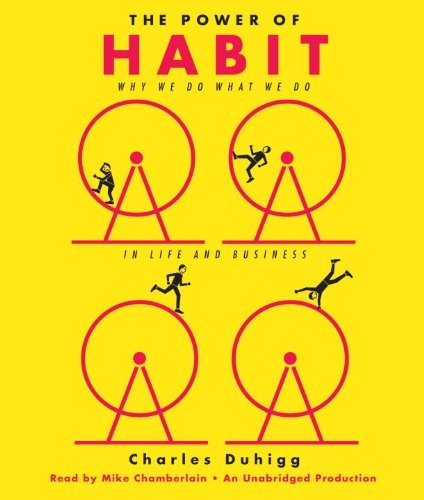
The Power of Habit
by Charles Duhigg
★ Top 10 book of 2012 · #6 on Best Books of 2012
Duhigg explores the science of why habits form and how they can be changed, using stories from a lab, a marketing campaign for Febreze, and a company overhaul at Alcoa to show transformation in action.
Best for: Curious readers who want science-backed, story-driven insight into changing habits at work and home
The Power of Habit is #6 on BookWard's Best Books of 2012, out of 59 2012 books that cleared our data bar.
What The Power of Habit is about
Charles Duhigg, an award-winning New York Times business reporter, explores scientific discoveries that explain why habits exist and how they can be changed, showing that people achieved success by focusing on the patterns that shape their lives and transforming habits. He opens with a young woman who quit smoking, ran a marathon, and earned a promotion at work within two years, while neurologists found that the patterns inside her brain had fundamentally changed.
From there he moves to business stories. Procter & Gamble marketers studied videos of people making their beds while trying to sell Febreze, a product headed for one of the company's biggest flops; after a slight shift in advertising, it earned a billion dollars a year. A new CEO at Alcoa attacked one pattern, how employees approached worker safety, and the company became the top performer in the Dow Jones. Told through anecdotes and written in an accessible style, it will help anyone who wants to break a habit, build a better one, or understand how organizations change.
The Power of Habit on the Best Books of 2012
The Power of Habit came out in 2012. Of the 59 books first published in 2012 that met BookWard's data bar, it ranks #6 on our Best Books of 2012 list.
Why it made the list: 2,533 readers have shelved it on Open Library; readers rate it 4 out of 5 (149 ratings); 144 are reading it right now. The list ranks each year’s books on how many readers have picked them up, how highly readers rate them, and how many are reading them right now.
It earns Being read right now.
Nearby on the 2012 list
- Drama Raina Telgemeier, #4
- Throne of Glass Sarah J. Maas, #5
- Me Before You Jojo Moyes, #7
- Keeper of the Lost Cities Shannon Messenger, #8
See all Best Books of 2012 Best books by year
More years: Best Books of 2011 Best Books of 2013.
The numbers behind it
- Readers: 2,226 want to read it, 144 are reading it now and 161 have read it, according to Open Library.
- Ratings: 4 out of 5 from 149 Open Library ratings.
| Signal | This book (0 to 100) | Weight |
|---|---|---|
| Reach | 97 | 55% |
| Reader love | 53 | 25% |
| Being read right now | 95 | 20% |
Questions about The Power of Habit
When was The Power of Habit published?
The Power of Habit by Charles Duhigg was first published in 2012.
Was The Power of Habit one of the best books of 2012?
The Power of Habit is #6 on BookWard's Best Books of 2012, out of 59 2012 books that cleared our data bar. 2,533 readers have shelved it on Open Library; readers rate it 4 out of 5 (149 ratings); 144 are reading it right now.
Why is The Power of Habit on the Best Books of 2012 list?
2,533 readers have shelved it on Open Library; readers rate it 4 out of 5 (149 ratings); 144 are reading it right now.
More of the best books of 2012
- Wonder R. J. Palacio, #1
- The Fault in Our Stars John Green, #2
- The Selection (the Selection #1) Kiera Cass, #3
- Drama Raina Telgemeier, #4
- Throne of Glass Sarah J. Maas, #5
- Me Before You Jojo Moyes, #7
See the full Best Books of 2012, the Top 100, or new books on Rising.
How we know
This page uses public data: Open Library reader counts and ratings, and Wikipedia page views for recent years. The description is paraphrased from real source text. Rankings reflect reading interest, not quality or sales, and can be affected by data gaps. Lists update monthly.
Suitable for teens and adults, especially anyone interested in psychology, business or self-improvement.
Depends on the edition you pick.
Habit science told through stories, with a framework you can use. 52% taste match
 BookWard’s take
Habit science told through stories, with a framework you can use
Duhigg builds the book around narrative case studies, the Febreze launch and the Alcoa safety turnaround among them, and uses each to explain how habits form and change. That story-first approach makes the opening strong: it starts with a woman in a laboratory and keeps pulling you in. The pace is brisk, and the prose stays plain and clear. Rigor is where it falls short for me. The science is real but compressed into tidy loops, and some of the anecdotes smooth over complexity. It leans on familiar tropes in its self-help framing, though the cue, routine and reward model is a genuinely useful organizing idea. The ending resolves cleanly, with an appendix that turns the ideas into practice.
Short chapters and a steady run of case studies keep it moving at roughly the speed BookWard likes.
Popularizing the habit loop as a practical tool was fresh, though much of the underlying research was already known.
The writing is plain, journalistic and transparent, built to carry ideas rather than draw attention to itself.
There is no plot to speak of, and the focus is on ideas and patterns more than on individual characters.
The core message is that habits can be changed, which gives the book a clearly optimistic outlook.
Three parts moving from individual to company to society give it a clear, conventional shape.
The tone is earnest and informative, with only light touches of wit.
Mostly everyday subjects, with a few sobering examples of addiction and failure.
It is more informative than moving, with only occasional emotional notes in personal stories.
See all 50 dialsEvery position, side by side with this book
Where it lines up
- PaceBookWard 8 · book 8
- EndingBookWard 8 · book 8
- OpeningBookWard 10 · book 9
Where it pulls apart
- Familiar tropesBookWard 10 · book 5
- ExpositionBookWard 2 · book 7
- LengthBookWard 1 · book 4
It opens on a woman in a laboratory whose brain has changed, a scene that pulls you in immediately, matching BookWard's taste.
The self-help frame and neat before-and-after arcs lean on familiar genre moves, though the habit loop itself is a fresh organizing device.
The cue, routine, reward framework holds together and each case study supports it, though it sometimes simplifies to fit.
Short chapters and a steady run of case studies keep it moving at roughly the speed BookWard likes.
Popularizing the habit loop as a practical tool was fresh, though much of the underlying research was already known.
People appear as vehicles for ideas, such as the lab patient and the Alcoa CEO, so they are sketched rather than deeply drawn.
It closes by resolving its argument and offering concrete steps, which suits BookWard's taste for full resolution.
Stories of personal transformation carry some uplift, but the tone stays mostly measured rather than syrupy.
It uses surprising reversals like the Febreze flop-to-hit story, but they illustrate the science rather than shock for effect.
Duhigg draws on real studies and interviews, but compresses them into anecdotes, so it falls short of BookWard's high bar.
The reporter's clear, confident narration is recognizable but polished in a way typical of popular business writing.
Ideas drive the book, though it delivers them through stories, so it sits toward the idea-led side with narrative help.
Concepts are often stated outright after a story sets them up, leaning on explanation more than BookWard likes.
Self-contained case-study chapters keep energy up throughout, with little drag in the middle.
The writing is plain, journalistic and transparent, built to carry ideas rather than draw attention to itself.
There is no plot to speak of, and the focus is on ideas and patterns more than on individual characters.
The core message is that habits can be changed, which gives the book a clearly optimistic outlook.
Three parts moving from individual to company to society give it a clear, conventional shape.
The tone is earnest and informative, with only light touches of wit.
Accessible language and clear explanations make it an easy read even when the science gets technical.
It moves among many people and organizations, from lab patients to executives to community figures, across its case studies.
Each case study is told in a mostly chronological way, though chapters hop between unrelated stories.
Entirely grounded in real people, companies and research.
A long procession of individuals and organizations appears across the chapters, though each is brief.
It ranges from personal routines to corporations and social movements, giving it broad reach.
It balances what happens in the brain with observable behavior and organizational action.
Quoted speech appears in anecdotes, but the book is mostly narration and explanation.
Romance is not a concern of this book.
The settings are familiar: offices, homes, stores and everyday routines.
Written in 2012 about contemporary life, it feels recent though some references have aged.
The habit loop is a durable idea, but the corporate examples date it somewhat.
A reporter narrates plainly and in good faith, with no sign of unreliability.
The advice is mostly clear, though a few cases, like manipulative marketing, raise murkier questions.
Scenes get enough detail to set up an anecdote, but description serves the argument and stays economical.
It is built on narrative reportage, with ideas wrapped inside stories rather than presented as dry analysis.
Duhigg stays mostly in the background as a reporter, with limited personal presence.
A self-contained book with no sequels required.
Case studies often turn on a surprising finding, so there are regular small reversals.
It mostly affirms that change is possible and offers tools, rather than unsettling the reader.
Mostly everyday subjects, with a few sobering examples of addiction and failure.
It is more informative than moving, with only occasional emotional notes in personal stories.
Humor is mild and occasional, closer to dry than broad.
Little physical violence appears, only passing mentions in a few cases.
Sexual content is essentially absent.
Some chapters touch on social movements and institutions, but politics is not the focus.
Plain, standard prose with minimal jargon, and technical terms get explained.
Duhigg frames the evidence toward a clear thesis, though he stays measured rather than polemical.
It aims at improving your future habits and behavior, looking ahead more than back.
It believes people and organizations can change for the better, which gives it an idealistic streak.
Review written by BookWard, dial version 1, November 2026.
Who is The Power of Habit right for?
Suitable for teens and adults, especially anyone interested in psychology, business or self-improvement. Some examples touch on addiction and personal struggle, handled in an informational way.
Accessible language and clear explanations make it an easy read even when the science gets technical.
Mostly everyday subjects, with a few sobering examples of addiction and failure.
It is more informative than moving, with only occasional emotional notes in personal stories.
Little physical violence appears, only passing mentions in a few cases.
Book CompanionThe Power of Habit: ideas, characters, themes
Habits follow a loop of cue, routine and reward, and understanding that loop lets individuals and organizations change them.
- The habit loop. Habits run on a cue that triggers a routine, which delivers a reward, and spotting these parts is the first step to change.
- Cravings drive habits. A habit becomes automatic when the brain starts craving the reward, as the Febreze story shows.
- Keystone habits. Some habits set off wider changes, as the focus on worker safety did at Alcoa.
- Replace, don't erase. Old routines are best changed by keeping the cue and reward while swapping in a new routine.
- Habits scale up. The same dynamics shape organizations and communities, not just individuals.
Themes
People and organizations can reshape ingrained behavior.
Much of what we do is automatic and driven by cues we rarely notice.
Habit dynamics work at personal, corporate and social levels.
Research becomes persuasive when told through human examples.
Discussion questions
- Which of your own routines can you break into cue, routine and reward?
- Does the book's focus on case studies make its argument stronger or more selective?
- Why might a company's habits matter as much as an individual's?
- What are the ethical limits of using habit science in marketing?
- Is changing a habit as simple as the book's framework suggests?
Personalize your Book Companion
This is the general edition. In BookWard, the Companion is written for you: your reading profile, your notes, and spoiler-safe to the page you are on.
Buy, listen or borrow The Power of Habit
Each link opens a search for this book on that store, in a new tab.
Read on a device
Borrow
Reviews and community
If you liked The Power of Habit
Success has a postcode and a birthday, not just talent
Think AgainAdam GrantA cheerful, idea-led case for doubting yourself on purpose
BlinkMalcolm GladwellGladwell on snap judgments: brisk, vivid, and sometimes too neat
QuietSusan CainA well-researched case for the value of introverts
Find your own best books
Add what you have read, rate it, and BookWard will recommend what to read next.
Free to start. No credit card needed.