Suits students, working professionals and hobbyists, and is readable for teens and adults alike.
Depends on the edition you pick.
A clear framework for why some learning sticks and some stalls. 47% taste match
What it covers
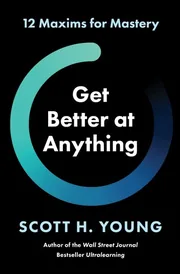
Get Better at Anything is a 2024 self-help book by Scott Young, the author of Ultralearning. It sits in the self-improvement and psychology space and focuses on how people learn new skills, whether at school, at work, or in pastimes they pursue for enjoyment.
Young looks at why learning can feel easy in some situations and frustrating in others, and why years of repeating an activity, such as driving, typing, or hitting a tennis ball, do not reliably lead to improvement. He proposes that three factors must be present for progress to happen. The first is seeing, which concerns how much of what we know comes from other people and how easily we can learn from them. The second is doing, since mastery depends on practice. The book also sets out twelve maxims intended to help readers change how they approach learning. It suits anyone who wants to build new abilities or move into a different field, and it speaks to students, working professionals, and hobbyists alike.
Themes
LearningSelf-help techniquesSelf-Improvement
By the numbers
- Open Library tracks 4 editions from 2 publishers.
- On reader demand it ranks in the top 14% of the recent releases books in our catalog (1,627 of them).
- Libraries shelve it under Library of Congress class LB-1060.00000000.Y6 2024.
 BookWard’s take
A clear framework for why some learning sticks and some stalls
Scott Young, author of Ultralearning, builds this book on three factors he says must be present for progress: see, do and feedback. The idea is that most of what we know comes from other people, that mastery needs practice that is not just repetition, and that improvement depends on constant adjustment. Twelve maxims turn the framework into advice. This is a book of ideas rather than story, and it stays on the idea side throughout. It is built on research and real-life examples, which gives it a solid footing, though the pitch is practical rather than academic. Expect the ideas to be explained outright rather than dramatized. The stakes are low-key, and the outlook is hopeful by design: anyone can improve if the right conditions are met.
Learning advice is a crowded field, but organizing it around see, do and feedback offers a fresh lens on familiar ground.
Practical nonfiction favors clear, plain sentences over ornament, which fits BookWard's slightly plain lean.
The central promise is that anyone can improve when the right conditions are in place, an optimistic stance.
The material is earnest and instructional, with little humor driving it.
The subject matter is gentle and constructive.
The emphasis is on method over feeling, so emotional intensity is low.
See all 50 dialsEvery position, side by side with this book
Where it lines up
- Shock for effectBookWard 9 · book 9
- SentimentBookWard 8 · book 7
- Internal logicBookWard 10 · book 8
Where it pulls apart
- Character depthBookWard 8 · book 1
- ExpositionBookWard 2 · book 9
- Familiar tropesBookWard 10 · book 6
Self-help carries familiar habits of the genre, but the see, do, feedback framework gives it a shape of its own.
The argument rests on three named factors and twelve maxims that map onto them, giving it a clear, structured line of reasoning.
Learning advice is a crowded field, but organizing it around see, do and feedback offers a fresh lens on familiar ground.
This is a how-to book with no characters to draw, so the dial does not reward it.
A maxim-based book closes by consolidating its advice, so the ending is resolved rather than left open.
The tone is practical and improvement-focused, with an encouraging streak that stops short of sentimentality.
There is nothing dark or sensational here; the book earns its points through argument and example.
The book draws on research and real-life examples, which gives it solid footing, though it is a popular rather than academic treatment.
Young writes in an accessible, personal register carried over from Ultralearning, with a recognizable author presence.
The whole book is about concepts and techniques, so it sits at the idea-led end, opposite BookWard's story-led preference.
Ideas are explained directly and organized into maxims, which is the opposite of BookWard's show-it-in-scene taste.
With discrete maxims as its building blocks, the book can keep a steady rhythm instead of relying on a single sustained plot.
Practical nonfiction favors clear, plain sentences over ornament, which fits BookWard's slightly plain lean.
The central promise is that anyone can improve when the right conditions are in place, an optimistic stance.
The material is earnest and instructional, with little humor driving it.
Accessible advice aimed at students, professionals and hobbyists keeps the reading effort light.
Young speaks as the single guiding author, drawing in research and examples but not multiple narrators.
A topic-by-topic argument moves forward in order rather than shifting through time.
This is entirely grounded in real skills like driving, typing and tennis.
The scope is personal skill-building, an intimate frame rather than an epic one.
Learning involves both the mind and hands-on practice, so the focus splits between inner process and outward action.
Instructional nonfiction is built from explanation, not conversation.
Romance has no place in a book about learning skills.
The settings are everyday life, school and work, which are familiar to most readers.
Published in 2024 and aimed at current readers, it is firmly of the present day.
Learning is a perennial concern, but self-help advice tends to date, so staying power is moderate.
Advice here is clear and prescriptive, with little moral ambiguity.
Practical explanation outweighs scene-setting, so description stays sparse.
It leans analytical, breaking learning into factors and maxims, while still using real-life examples.
Written for the reader's own practice, it has a personal, directly engaged angle.
Though it follows Ultralearning, it is presented as its own book.
A framework-driven argument offers few surprises beyond reframing familiar problems.
The ideas ask readers to rethink how they practice, a mild challenge to habit, though mostly comforting in tone.
The subject matter is gentle and constructive.
The emphasis is on method over feeling, so emotional intensity is low.
Humor is not a feature; what lightness exists is mild and dry.
No violence appears in a book about learning skills.
There is no sexual content.
The subject is learning, with little political content.
The language is plain and accessible throughout.
As an advice book, it argues a position and tells readers what to do, so the narration is opinionated.
Aimed at improving future ability, it looks forward more than back.
It believes progress is achievable when the right conditions are met, which reads as idealistic.
Review written by BookWard, dial version 1, November 2026.
Who is Get Better at Anything right for?
Suits students, working professionals and hobbyists, and is readable for teens and adults alike. It contains no sensitive content.
Accessible advice aimed at students, professionals and hobbyists keeps the reading effort light.
The subject matter is gentle and constructive.
The emphasis is on method over feeling, so emotional intensity is low.
No violence appears in a book about learning skills.
Book CompanionGet Better at Anything: ideas, characters, themes
Learning progresses when you can see others do it, practice effectively yourself, and get reliable feedback.
- Most knowledge is borrowed. Much of what we know comes from other people, so how easily we can learn from them largely sets how fast we improve.
- Practice has to be the right kind. Mastery requires practice, but not just any practice will do, because our brains are effort-saving machines.
- Feedback drives adjustment. Progress needs constant correction, from a teacher's marks to the results of hands-on experience.
- Years of repetition can stall. Decades of driving, typing or hitting a tennis ball do not reliably make us better at them.
- Twelve maxims make it usable. The three factors are broken into twelve maxims meant to change how you approach learning.
Themes
Getting better takes the right kind of effort, not just time spent.
Observing and absorbing other people's skill speeds progress.
Reliable information about results lets you adjust and improve.
When seeing, doing or feedback is missing, improvement can become impossible.
Discussion questions
- Which of the three factors (see, do, feedback) is weakest in a skill you are trying to improve?
- Why can years of repeating an activity fail to make us better at it?
- How easy is it to learn from the people around you in your work or studies?
- What counts as reliable feedback when no teacher is marking your work?
- Which of the twelve maxims would you test first, and how?
Personalize your Book Companion
This is the general edition. In BookWard, the Companion is written for you: your reading profile, your notes, and spoiler-safe to the page you are on.
Buy, listen or borrow Get Better at Anything
Each link opens a search for this book on that store, in a new tab.
Read on a device
Borrow
Reviews and community
If you liked Get Better at Anything
One big idea, two mindsets, applied to work, love and parenting
ContagiousJonah BergerA practical, story-rich guide to why ideas spread
UltralearningScott YoungA self-taught learner's practical blueprint for mastering hard skills fast
DriveDaniel H. PinkA lively case that autonomy, mastery and purpose beat carrots and sticks
Sources: Open Library.
Track Get Better at Anything and find your next favorite
Add it to your shelf, rate what you have read, and BookWard will recommend what fits you.
Free to start. No credit card needed.