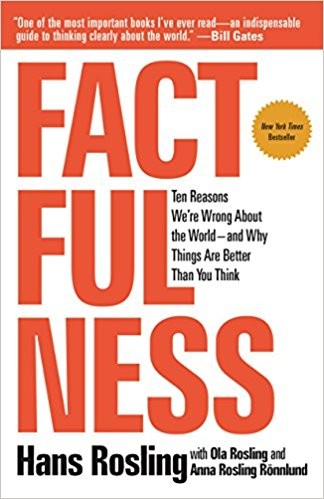
Factfulness
by Hans Rosling
★ Top 25 book of 2018 · #13 on Best Books of 2018
People consistently misjudge global trends like poverty, population and education, often worse than random guesses. The authors name ten instincts that distort our view and argue the world is better than we think.
Best for: Curious readers who want a fact-based, less fearful view of the world
Factfulness is #13 on BookWard's Best Books of 2018, out of 60 2018 books that cleared our data bar.
What Factfulness is about
Hans Rosling, a Professor of International Health, wrote this with his long-time collaborators Anna and Ola. Their argument is that most of us hold a distorted picture of the world. Ask people simple questions about global trends, such as how many people live in poverty or how many girls finish school, and they get them wrong so often that a chimpanzee guessing at random would beat teachers, journalists, and Nobel laureates.
The book names ten instincts behind this, including the habit of splitting the world into us and them, taking in media where fear rules, and assuming that things are only getting worse. Against these, the authors offer factfulness: holding only those opinions you have strong facts to support. Their conclusion is hopeful, that the world, for all its flaws, is in better shape than we think. It suits anyone who feels worn down by the news and wants a clearer, calmer way to read it.
Factfulness on the Best Books of 2018
Factfulness came out in 2018. Of the 60 books first published in 2018 that met BookWard's data bar, it ranks #13 on our Best Books of 2018 list.
Why it made the list: 424 readers have shelved it on Open Library; readers rate it 4.3 out of 5 (78 ratings). The list ranks each year’s books on how many readers have picked them up, how highly readers rate them, and how many are reading them right now.
It earns Reader favorite.
Nearby on the 2018 list
- Educated Tara Westover, #11
- All Your Perfects Colleen Hoover, #12
- My Year of Rest and Relaxation Ottessa Moshfegh, #14
- The Burning Maze Rick Riordan, #15
See all Best Books of 2018 Best books by year
More years: Best Books of 2017 Best Books of 2019.
The numbers behind it
- Readers: 312 want to read it, 11 are reading it now and 101 have read it, according to Open Library.
- Ratings: 4.3 out of 5 from 78 Open Library ratings.
| Signal | This book (0 to 100) | Weight |
|---|---|---|
| Reach | 63 | 55% |
| Reader love | 93 | 25% |
| Being read right now | 52 | 20% |
Questions about Factfulness
When was Factfulness published?
Factfulness by Hans Rosling was first published in 2018.
Was Factfulness one of the best books of 2018?
Factfulness is #13 on BookWard's Best Books of 2018, out of 60 2018 books that cleared our data bar. 424 readers have shelved it on Open Library; readers rate it 4.3 out of 5 (78 ratings).
Why is Factfulness on the Best Books of 2018 list?
424 readers have shelved it on Open Library; readers rate it 4.3 out of 5 (78 ratings).
More of the best books of 2018
- Heartstopper, Volume 1 Alice Oseman, #1
- Where the Crawdads Sing Delia Owens, #2
- The Laws of Human Nature Robert Greene, #3
- Atomic Habits James Clear, #4
- Five Feet Apart Rachael Lippincott, #5
- Verity Colleen Hoover, #6
See the full Best Books of 2018, the Top 100, or new books on Rising.
How we know
This page uses public data: Open Library reader counts and ratings, and Wikipedia page views for recent years. The description is paraphrased from real source text. Rankings reflect reading interest, not quality or sales, and can be affected by data gaps. Lists update monthly.
Suits curious teenagers and adults who want a clear, accessible look at global trends.
Depends on the edition you pick.
A cheerful, rigorous case that the world is better than you think. 57% taste match
 BookWard’s take
A cheerful, rigorous case that the world is better than you think
Factfulness opens with a quiz and then spends its pages explaining why nearly everyone fails it. Rosling builds the book around ten instincts that distort how we see the world, and each gets its own chapter with stories to hold it in place. The opening hooks at once, since the questions land before you have settled into the chair. The book leans on data while keeping the argument plain, which is exactly how this kind of subject is best served. Rosling's warmth and showmanship are unmistakable in every chapter. It is driven by ideas rather than plot, but the anecdotes keep it moving. And it is more hopeful than most nonfiction, without turning sentimental. It is a book you can finish quickly and then argue from for years.
Short chapters and a steady stream of examples keep it brisk without feeling rushed.
Framing global trends as predictable mental habits is a fresh angle, even where the underlying data is familiar.
Plain, conversational sentences chosen for clarity, a little plainer than BookWard's middle-leaning taste.
No plot to speak of; the book is driven by its argument and by the author's presence.
Its central message is that the world is improving, which makes it markedly more hopeful than BookWard's baseline.
A conventional run of chapters, one instinct each, with no formal experiments.
Rosling's humor shows up in the telling, but the book stays mostly earnest.
Though it covers poverty and hard topics, the tone remains gentle and constructive.
Warm and sometimes moving, but not intense.
See all 50 dialsEvery position, side by side with this book
Where it lines up
- EndingBookWard 8 · book 8
- Authorial voiceBookWard 9 · book 9
- Sagging middleBookWard 8 · book 8
Where it pulls apart
- Story or ideasBookWard 3 · book 9
- ExpositionBookWard 2 · book 8
- Character depthBookWard 8 · book 3
The opening quiz puts you in the argument immediately, which is exactly the kind of start BookWard rewards.
It takes the familiar gloomy view of the world head on, though the self-help-style framing is a known format.
Each instinct is introduced, illustrated and answered in a clear chain, so the case holds together as you read.
Short chapters and a steady stream of examples keep it brisk without feeling rushed.
Framing global trends as predictable mental habits is a fresh angle, even where the underlying data is familiar.
It is an argument rather than a character study, so people appear mainly as illustrations and the book makes no attempt at depth.
It is openly warm and affectionate toward its subject, a touch less restrained than BookWard prefers.
Its surprises come from numbers that overturn assumptions, and they earn their effect rather than being staged.
Claims are anchored to data and trends, in line with BookWard's appetite for evidence-led nonfiction.
Rosling's energetic, teacherly personality comes through on every page, which BookWard values highly.
The ideas drive everything and the anecdotes serve them, which sits further toward ideas than BookWard usually goes.
It explains its points outright, more than BookWard likes, though here clarity is the whole point.
Ten parallel chapters keep the energy even, so there is no slack stretch in the middle.
Plain, conversational sentences chosen for clarity, a little plainer than BookWard's middle-leaning taste.
No plot to speak of; the book is driven by its argument and by the author's presence.
Its central message is that the world is improving, which makes it markedly more hopeful than BookWard's baseline.
A conventional run of chapters, one instinct each, with no formal experiments.
Rosling's humor shows up in the telling, but the book stays mostly earnest.
Easy to read, with no specialist background needed, a little easier than BookWard's usual middle.
A single authorial perspective guides the whole book.
Told straightforwardly, with trends traced from past to present.
Entirely grounded in real-world data and events.
A handful of recurring figures and anecdotes, nothing like a large cast.
It deals with the whole world and its long-term trends, which is as broad as scope gets.
It looks outward at the world and its trends, while also naming the habits of mind behind how we see them.
Little in the way of conversation, with the author explaining directly.
Romance does not figure in this book.
The subject is the global picture, mostly familiar territory with unfamiliar facts.
Written in the late 2010s about the present state of the world.
The specific figures will date, but the instincts it describes will not.
The author speaks for himself and is plainly upfront about his aims.
The book takes a clear and direct stance rather than leaving things murky.
It describes only enough to make a point, not to paint scenes.
It sits between narrative and analysis, using stories to carry data-based claims.
Rosling's own experiences and presence are central to how the argument is told.
A standalone book.
The quiz and the data reversals supply some real surprises, but it isn't plot-twist driven.
It asks you to revise your picture of the world, which is gently challenging.
Though it covers poverty and hard topics, the tone remains gentle and constructive.
Warm and sometimes moving, but not intense.
Violence is mentioned as a subject, not depicted on the page.
Nothing sexual in the content.
It engages with global development and public debate, but not as a partisan tract.
Plain, accessible language throughout.
Rosling argues a case and says so plainly.
It starts from the past record but keeps its eyes on where progress can go.
Its core stance is optimistic about human progress, while insisting on the facts.
Review written by BookWard, dial version 1, November 2026.
Who is Factfulness right for?
Suits curious teenagers and adults who want a clear, accessible look at global trends. It discusses poverty and other hard realities but in a measured, non-graphic way.
Easy to read, with no specialist background needed, a little easier than BookWard's usual middle.
Though it covers poverty and hard topics, the tone remains gentle and constructive.
Warm and sometimes moving, but not intense.
Violence is mentioned as a subject, not depicted on the page.
Book CompanionFactfulness: ideas, characters, themes
We hold a distorted, overly negative view of the world because of predictable instincts, and replacing them with fact-based habits makes us calmer and more accurate.
- We get the basics wrong. The book opens with simple questions about global trends and shows that most people, however educated, do worse than random guessing.
- Ten instincts distort our view. Rosling names ten habits of thinking, such as dividing the world into two camps, that push us toward a skewed picture.
- Media tilts toward fear. The way news is consumed rewards dramatic stories, which makes the world feel worse than the trends suggest.
- Progress is easy to miss. Because gradual improvement rarely makes headlines, many people assume that most things are getting worse.
- Facts calm us down. Carrying only opinions we can support is presented as a stress-reducing habit that also helps us focus on real threats.
Themes
How ordinary minds reliably misjudge the state of the world.
The long, uneven improvement in global living conditions.
Gut reactions pulling against what the data actually shows.
The pull to split the world into opposing camps.
How attention-grabbing coverage shapes what we believe.
Admitting what we don't know and updating our views.
Discussion questions
- Which of the opening quiz questions would you have gotten wrong, and why?
- Which of the ten instincts do you recognize most in yourself?
- How much does the news you consume shape your sense of the world?
- Is it possible to be hopeful about progress without ignoring real problems?
- How would you test your own opinions against solid facts in daily life?
Personalize your Book Companion
This is the general edition. In BookWard, the Companion is written for you: your reading profile, your notes, and spoiler-safe to the page you are on.
Buy, listen or borrow Factfulness
Each link opens a search for this book on that store, in a new tab.
Read on a device
Borrow
Reviews and community
If you liked Factfulness
A data scientist's calm, evidence-first case that the planet is fixable
Moral AmbitionRutger BregmanA call to aim your career at the world's biggest problems
The AI ConEmily M. BenderA witty, pointed takedown of AI hype and who profits
Think AgainAdam GrantA cheerful, idea-led case for doubting yourself on purpose
Find your own best books
Add what you have read, rate it, and BookWard will recommend what to read next.
Free to start. No credit card needed.