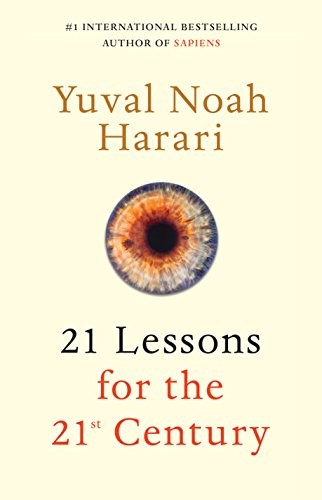
21 Lessons for the 21St Century
by Yuval Noah Harari
★ Top 25 book of 2018 · #21 on Best Books of 2018
Harari takes on urgent questions of today, from the state of liberal democracy and fake news to nationalism, immigration and what children should learn. He argues that busy people still need clarity, since the future of humanity will be decided with or without them.
Best for: Busy readers who want clear thinking on today's biggest global issues
21 Lessons for the 21St Century is #21 on BookWard's Best Books of 2018, out of 60 2018 books that cleared our data bar.
What 21 Lessons for the 21St Century is about
Harari takes on the questions that crowd the news and asks what they mean for ordinary lives. His central claim is that clarity is power in a world swamped with irrelevant information. He also argues that modern censorship rarely blocks information. Instead, it buries people under disinformation and distraction.
From there he asks why liberal democracy is in crisis, whether God is back, whether a new world war is coming, and what the rise of Donald Trump signifies. He looks at fake news, terrorism and immigration into Europe, wonders whether the West, China or Islam dominates the world, and asks whether nationalism can solve inequality and climate change. He even asks what we should teach our kids. His warning is that busy people cannot afford to look away, because the future of humanity may be decided in their absence. It suits curious readers who want a thoughtful, accessible guide through the present moment.
21 Lessons for the 21St Century on the Best Books of 2018
21 Lessons for the 21St Century came out in 2018. Of the 60 books first published in 2018 that met BookWard's data bar, it ranks #21 on our Best Books of 2018 list.
Why it made the list: 466 readers have shelved it on Open Library; readers rate it 4 out of 5 (46 ratings). The list ranks each year’s books on how many readers have picked them up, how highly readers rate them, and how many are reading them right now.
Nearby on the 2018 list
- Everything I Know About Love Dolly Alderton, #19
- The Priory of the Orange Tree Samantha Shannon, #20
- The Poppy War R. F. Kuang, #22
- Legendary Stephanie Garber, #23
See all Best Books of 2018 Best books by year
More years: Best Books of 2017 Best Books of 2019.
The numbers behind it
- Readers: 386 want to read it, 14 are reading it now and 66 have read it, according to Open Library.
- Ratings: 4 out of 5 from 46 Open Library ratings.
| Signal | This book (0 to 100) | Weight |
|---|---|---|
| Reach | 67 | 55% |
| Reader love | 50 | 25% |
| Being read right now | 63 | 20% |
Questions about 21 Lessons for the 21St Century
When was 21 Lessons for the 21St Century published?
21 Lessons for the 21St Century by Yuval Noah Harari was first published in 2018.
Was 21 Lessons for the 21St Century one of the best books of 2018?
21 Lessons for the 21St Century is #21 on BookWard's Best Books of 2018, out of 60 2018 books that cleared our data bar. 466 readers have shelved it on Open Library; readers rate it 4 out of 5 (46 ratings).
Why is 21 Lessons for the 21St Century on the Best Books of 2018 list?
466 readers have shelved it on Open Library; readers rate it 4 out of 5 (46 ratings).
More of the best books of 2018
- Heartstopper, Volume 1 Alice Oseman, #1
- Where the Crawdads Sing Delia Owens, #2
- The Laws of Human Nature Robert Greene, #3
- Atomic Habits James Clear, #4
- Five Feet Apart Rachael Lippincott, #5
- Verity Colleen Hoover, #6
See the full Best Books of 2018, the Top 100, or new books on Rising.
How we know
This page uses public data: Open Library reader counts and ratings, and Wikipedia page views for recent years. The description is paraphrased from real source text. Rankings reflect reading interest, not quality or sales, and can be affected by data gaps. Lists update monthly.
Suited to teens and adults curious about current affairs and big-picture thinking.
Depends on the edition you pick.
Harari turns his lens from the past onto the present. 51% taste match
 BookWard’s take
Harari turns his lens from the past onto the present
Harari moves from the sweep of history to the questions of today: democracy in crisis, fake news, immigration, nationalism, terrorism, what to teach our kids. It is an idea-led book, built as a run of short essays, and it never pretends to be story. The voice is distinctive and confident, and the opinions are plainly stated, which keeps things brisk and stops the middle from sagging. Where it falls short is in rigor and restraint: this is a synthesis of big claims rather than a heavily evidenced argument, and it tends to explain outright when a reader might prefer to be shown. The scale is global, the tone is calm and often dry, and the outlook is cautious rather than bleak. If you want clarity on messy headlines, it delivers.
A set of short essays gives it a moderate length; it never sprawls, though it is not especially tight either.
Short chapters keep it moving briskly, which sits well with BookWard's taste for momentum.
The synthesis is distinctive, but many of its themes were already widely discussed by the time it appeared.
The prose is plain and clear, built to explain, not to dazzle.
There is no plot or character arc to drive it, so this dial does not apply.
It is sober about the risks ahead but offers practical clarity, landing in the middle between bleak and hopeful.
A conventional run of themed chapters, with no formal experiments.
Dry asides surface now and then, but the tone stays serious overall.
It discusses war, terrorism and upheaval, but in a measured, analytical tone.
The register is cool and intellectual, with little emotional heat.
See all 50 dialsEvery position, side by side with this book
Where it lines up
- SentimentBookWard 8 · book 8
- Authorial voiceBookWard 9 · book 9
- PaceBookWard 8 · book 7
Where it pulls apart
- Story or ideasBookWard 3 · book 10
- ExpositionBookWard 2 · book 9
- LengthBookWard 1 · book 5
A set of short essays gives it a moderate length; it never sprawls, though it is not especially tight either.
It leans on some familiar big-picture framings of technology and politics, though the topics themselves are fresh.
Arguments build step by step with a clear through line, though some leaps are asserted more than proven.
Short chapters keep it moving briskly, which sits well with BookWard's taste for momentum.
The synthesis is distinctive, but many of its themes were already widely discussed by the time it appeared.
There is no cast to draw, so this dial does not apply.
The tone is cool and analytical, with little emotional appeal, which suits BookWard's taste for restraint.
It does not lean on shock; it unsettles through argument, not gratuitous grimness.
Claims are sweeping and argued with confidence, but they are broad synthesis, short of the rigor BookWard prizes.
Harari's calm, wry, assured voice is unmistakable, which BookWard rewards.
This is a book of ideas, with essays standing in for any plot; that is more idea-led than BookWard's taste.
It explains its points outright, far from BookWard's preference for showing in scene.
Short, self-contained chapters keep energy steady from start to finish.
The prose is plain and clear, built to explain, not to dazzle.
There is no plot or character arc to drive it, so this dial does not apply.
It is sober about the risks ahead but offers practical clarity, landing in the middle between bleak and hopeful.
A conventional run of themed chapters, with no formal experiments.
Dry asides surface now and then, but the tone stays serious overall.
The language is accessible, though the range of topics asks for steady attention.
It surveys many cultures, nations and schools of thought, though one author's voice frames them all.
It moves forward through contemporary issues, with only brief glances back for context.
It deals with real-world matters and plausible futures, not the fantastical.
Without characters, this dial does not apply.
It tackles humanity as a whole and the planet's future, which is as wide as scale gets.
It looks mainly at forces in the world, with a closing turn toward the self and mind.
There is essentially no dialogue; it is all exposition and argument.
Romance plays no part in it.
It ranges over the whole world but stays rooted in today's familiar headlines.
It is about the present moment, squarely contemporary.
Tied closely to the news of the late 2010s, so parts will date, though the questions endure.
The author speaks plainly in his own voice, with nothing unreliable in the telling.
It weighs trade-offs and rarely hands down a simple verdict, leaving much open to judgment.
Description is sparse, with ideas taking priority over scenery or imagery.
It is analytical and argumentative rather than a told story, with some illustrative anecdote.
The author mostly stays behind the argument, though a personal note surfaces now and then.
It stands on its own as a book, though it follows Harari's earlier works.
There are few surprises in structure; the surprises are in the claims, not the plot.
It pushes readers to rethink comfortable assumptions about politics and technology.
It discusses war, terrorism and upheaval, but in a measured, analytical tone.
The register is cool and intellectual, with little emotional heat.
Where humor appears it is dry, not broad.
Violence is discussed in the abstract, with almost nothing depicted on the page.
Sexual content is essentially absent.
Politics is at its heart, from democracy to nationalism to immigration.
The language is plain and easy to follow, with no dialect or dense jargon.
The author states his views openly and freely, never hiding behind neutrality.
It looks forward, asking what the coming decades demand of us, while drawing on the past.
It is clear-eyed and wary of easy hopes, yet it believes better understanding can help.
Review written by BookWard, dial version 1, November 2026.
Who is 21 Lessons for the 21St Century right for?
Suited to teens and adults curious about current affairs and big-picture thinking. It discusses terrorism, war and political conflict in general terms, without graphic detail.
The language is accessible, though the range of topics asks for steady attention.
It discusses war, terrorism and upheaval, but in a measured, analytical tone.
The register is cool and intellectual, with little emotional heat.
Violence is discussed in the abstract, with almost nothing depicted on the page.
Book Companion21 Lessons for the 21St Century: ideas, characters, themes
To face the future, we need clarity about the biggest challenges now confronting humanity, from technology and politics to meaning and education.
- Clarity is power. In a flood of information and distraction, the scarce resource is understanding, and the book sets out to supply some.
- Democracy under strain. It asks why liberal democracy is in crisis and what that means for ordinary citizens.
- Fake news and distraction. It argues that flooding people with disinformation can work as censorship does.
- Nations, religion and civilisation. It questions whether God is back and which civilisation, if any, dominates the world.
- What to teach our kids. It treats education as a central problem for a world changing faster than schools do.
Themes
Too much data can weaken understanding rather than strengthen it.
The pressures on open, representative government today.
Whether loyalty to nation can answer global problems.
How automation and new tools reshape jobs and power.
How to live and teach in a fast-changing world.
Discussion questions
- Which of the book's questions feels most urgent to you, and why?
- Is clarity enough to help ordinary people join debates about the future?
- How should a society weigh openness to immigrants against other concerns?
- Can nationalism solve problems like inequality and climate change?
- What would you want children to learn to prepare for the coming decades?
Personalize your Book Companion
This is the general edition. In BookWard, the Companion is written for you: your reading profile, your notes, and spoiler-safe to the page you are on.
Buy, listen or borrow 21 Lessons for the 21St Century
Each link opens a search for this book on that store, in a new tab.
Read on a device
Borrow
Reviews and community
If you liked 21 Lessons for the 21St Century
A sweeping history of information, and why AI raises the stakes
Invisible WomenCaroline Criado PerezGender data gaps, argued with evidence and some real heat
The AI ConEmily M. BenderA witty, pointed takedown of AI hype and who profits
The Anxious GenerationJonathan HaidtA data-driven case against smartphone childhood, and what to do
Find your own best books
Add what you have read, rate it, and BookWard will recommend what to read next.
Free to start. No credit card needed.