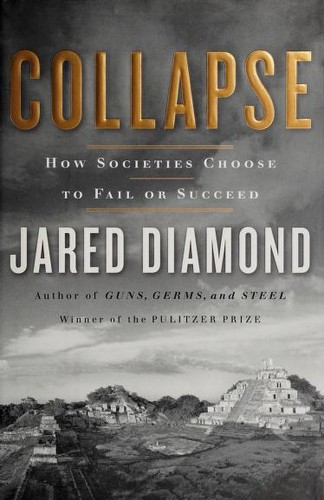
Collapse
by Jared Diamond
★ Top 25 book of 2004 · #19 on Best Books of 2004
Jared Diamond investigates why great societies of the past, from Easter Island to the Maya and Greenland's Vikings, fell into ruin. He examines how resource misuse and environmental signals shaped their fates, and what we might learn.
Best for: Readers interested in environmental lessons from past civilizations and what they mean today
Collapse is #19 on BookWard's Best Books of 2004, out of 48 2004 books that cleared our data bar.
What Collapse is about
Jared Diamond, author of the Pulitzer Prize-winning Guns, Germs, and Steel, turns here to a different question: why did some great civilizations collapse, and what can we learn from their fates? He builds a global argument out of a series of historical case studies, including Easter Island, the Anasazi, the Maya, the medieval Viking colony on Greenland, and the modern world.
Diamond traces a recurring pattern of catastrophe linked to squandered resources and ignored environmental warnings. Other pressures play a part too, among them climate change, rapid population growth, unstable trade partners and hostile neighbours. He also points out that some societies found ways through the very same problems, which keeps the book from being a simple tale of doom. The tone is analytical and sobering, and it will suit readers interested in history, sustainability and how communities make decisions under pressure.
Collapse on the Best Books of 2004
Collapse came out in 2004. Of the 48 books first published in 2004 that met BookWard's data bar, it ranks #19 on our Best Books of 2004 list.
Why it made the list: 302 readers have shelved it on Open Library; readers rate it 3.7 out of 5 (36 ratings). The list ranks each year’s books on how many readers have picked them up, how highly readers rate them, and how many are reading them right now.
Nearby on the 2004 list
- The Spook's Apprentice Joseph Delaney, #17
- The Walking Dead, Vol. 1 Robert Kirkman, #18
- Going Postal Terry Pratchett, #20
- Knuffle Bunny Mo Willems, #21
See all Best Books of 2004 Best books by year
More years: Best Books of 2003 Best Books of 2005.
The numbers behind it
- Readers: 246 want to read it, 11 are reading it now and 45 have read it, according to Open Library.
- Ratings: 3.7 out of 5 from 36 Open Library ratings.
| Signal | This book (0 to 100) | Weight |
|---|---|---|
| Reach | 71 | 55% |
| Reader love | 21 | 25% |
| Being read right now | 52 | 20% |
Questions about Collapse
When was Collapse published?
Collapse by Jared Diamond was first published in 2004.
Was Collapse one of the best books of 2004?
Collapse is #19 on BookWard's Best Books of 2004, out of 48 2004 books that cleared our data bar. 302 readers have shelved it on Open Library; readers rate it 3.7 out of 5 (36 ratings).
Why is Collapse on the Best Books of 2004 list?
302 readers have shelved it on Open Library; readers rate it 3.7 out of 5 (36 ratings).
More of the best books of 2004
- Darkly Dreaming Dexter Jeffry P. Lindsay, #1
- Rich Dad, Poor Dad for Teens Robert T. Kiyosaki, #2
- The Ruins of Gorlan John Flanagan, #3
- Blink Malcolm Gladwell, #4
- Alexander Hamilton Ron Chernow, #5
- She Comes First Ian Kerner, #6
See the full Best Books of 2004, the Top 100, or new books on Rising.
How we know
This page uses public data: Open Library reader counts and ratings, and Wikipedia page views for recent years. The description is paraphrased from real source text. Rankings reflect reading interest, not quality or sales, and can be affected by data gaps. Lists update monthly.
Suits adults and mature teens who enjoy serious popular history and science.
Depends on the edition you pick.
Diamond's sweeping case for why societies fail, and how some survive. 46% taste match
 BookWard’s take
Diamond's sweeping case for why societies fail, and how some survive
Collapse is a big, idea-led work of popular history. Diamond moves from Easter Island to the Anasazi, the Maya, and the Norse in Greenland, then to the modern world, tracing one pattern of environmental damage, climate shift, hostile neighbors and unreliable trade. He argues from a wide base of evidence, though the central thesis gets stretched across very different cases. It also sprawls well past what a tighter book would allow, and the opening builds slowly rather than hooking you at once. What redeems it is the originality of its framing question, why some societies persisted while others failed, and the strength of Diamond's plainspoken, opinionated narration, which keeps the pages moving. It leans analytical, built on argument and case studies rather than character, which suits readers who want ideas over story.
Diamond spends chapter after chapter on separate societies before reaching the modern world, which makes it a long, sprawling read against BookWard's preference for tight books.
Each case study moves steadily but densely, so the pace is measured rather than brisk.
Asking why some societies persisted while others failed gives the book a distinctive angle that BookWard values.
The writing is clear and functional, built to carry an argument rather than to ornament it.
There is no plot to speak of; the drive comes from the argument and the societies it examines.
It is sobering about failure but insists some societies found solutions, which leaves a measured note of hope.
A run of case studies building toward a modern conclusion is a conventional shape for popular history.
This is a serious subject treated seriously, with little room for humor.
The subject is societal ruin and its causes, which is grim but handled analytically.
The tone is analytical and measured, so emotional intensity stays low.
See all 50 dialsEvery position, side by side with this book
Where it lines up
- OriginalityBookWard 9 · book 8
- SentimentBookWard 8 · book 9
- Shock for effectBookWard 9 · book 8
Where it pulls apart
- LengthBookWard 1 · book 9
- OpeningBookWard 10 · book 4
- ExpositionBookWard 2 · book 9
Diamond spends chapter after chapter on separate societies before reaching the modern world, which makes it a long, sprawling read against BookWard's preference for tight books.
Its central argument avoids stock framing, though environmental-doom narratives are a familiar genre, so it sits just above the middle.
The argument follows a clear structure of contributing factors, though fitting such varied cases to one pattern leaves some strain.
Each case study moves steadily but densely, so the pace is measured rather than brisk.
Asking why some societies persisted while others failed gives the book a distinctive angle that BookWard values.
It is about societies and systems, not individuals, so people are largely sketched rather than deeply drawn.
It closes on what the modern world can learn, giving a reasoned resolution rather than leaving the question open.
It treats societal ruin with analysis rather than sentiment, which fits BookWard's taste for restraint.
The grim fates it describes serve the argument rather than being used for effect, so the darkness is earned.
Its claims rest on historical and environmental evidence across many cases, though the grand synthesis simplifies some of it.
Diamond's plainspoken, argumentative voice is recognisably his own and carries the long case studies.
The book exists to advance a thesis, with historical narratives serving the argument rather than the other way round.
Diamond explains his reasoning outright rather than dramatizing it, which cuts against BookWard's preference for showing in scene.
The writing is clear and functional, built to carry an argument rather than to ornament it.
There is no plot to speak of; the drive comes from the argument and the societies it examines.
It is sobering about failure but insists some societies found solutions, which leaves a measured note of hope.
A run of case studies building toward a modern conclusion is a conventional shape for popular history.
This is a serious subject treated seriously, with little room for humor.
The ideas are accessible but the sheer density of detail across many societies takes sustained attention.
It ranges across several societies and eras, but a single authorial perspective frames them all.
It moves from case to case across different eras, though each society is mostly told in order.
Everything in it is real history and environmental science, firmly grounded.
Many societies and peoples pass through the book, giving it a wide cast of civilizations.
It takes in entire civilizations and the fate of the modern world, which makes it epic in scope.
It concerns environments, resources, trade and conflict rather than anyone's inner life.
As expository nonfiction it contains next to no dialogue.
Romance has no place in a book about societal collapse.
Most cases come from the past, with the modern world arriving as the final turn.
Its questions about resources and environment keep their relevance, though the details date from 2004.
Diamond lays out his own argument openly and can be taken at face value.
The book draws fairly clear lessons about what societies should and should not do.
Descriptions of landscapes and environments are central, and the book gives them plenty of room.
It leans analytical, using historical narratives mainly to build and support an argument.
Diamond keeps a scholarly distance, though he does speak in his own voice.
It stands alone, though it follows his earlier Guns, Germs, and Steel in theme.
It follows a stated thesis, so there are few surprises in structure, only in the cases themselves.
It asks readers to face uncomfortable questions about their own society's future.
The subject is societal ruin and its causes, which is grim but handled analytically.
The tone is analytical and measured, so emotional intensity stays low.
Humor is largely absent; any lightness is dry at most.
Conflict with enemies figures as one factor in collapse but is discussed rather than dwelt on.
There is no sexual content.
Environmental policy and resource use are close to its core, so the politics are never far away.
The language is plain and clear, though the subject matter is dense.
Diamond argues a clear case and draws conclusions, so the narration is firmly opinionated.
It reads the past in order to warn about the future, so its gaze is forward.
It assumes societies can choose better, which gives it a quietly idealistic streak.
Review written by BookWard, dial version 1, November 2026.
Who is Collapse right for?
Suits adults and mature teens who enjoy serious popular history and science. It discusses societal ruin and conflict in an analytical way, with little graphic content.
The ideas are accessible but the sheer density of detail across many societies takes sustained attention.
The subject is societal ruin and its causes, which is grim but handled analytically.
The tone is analytical and measured, so emotional intensity stays low.
Conflict with enemies figures as one factor in collapse but is discussed rather than dwelt on.
Book CompanionCollapse: ideas, characters, themes
Societies collapse when they ignore environmental limits and warning signs, but some survived the same pressures by changing course.
- A pattern of catastrophe. Diamond traces a recurring pattern of failure across very different societies, from Easter Island to the Maya.
- Environmental damage. Squandering resources and cutting down too many trees feature among the central causes.
- More than one cause. Climate change, population growth, unstable trade partners and pressure from enemies all play a part.
- Warning signs ignored. Societies that failed did not heed the signals their environment gave them.
- Some societies endured. Other societies faced the same problems and found solutions, which makes collapse avoidable.
Themes
Societies depend on resources that can be overused and exhausted.
Collapse is shaped by decisions, not only by fate or circumstance.
Historical failures offer lessons for the modern world.
Several factors combine, so no single cause explains ruin.
Discussion questions
- Which of the societies Diamond examines surprised you most, and why?
- Does a single pattern really explain such different civilizations?
- Which factors does Diamond treat as most decisive, and do you agree?
- What separates societies that failed from those that persisted?
- What do the book's lessons mean for how we treat resources today?
Personalize your Book Companion
This is the general edition. In BookWard, the Companion is written for you: your reading profile, your notes, and spoiler-safe to the page you are on.
Buy, listen or borrow Collapse
Each link opens a search for this book on that store, in a new tab.
Read on a device
Borrow
Reviews and community
If you liked Collapse
A sweeping history of information, and why AI raises the stakes
Guns, Germs, and SteelJared DiamondWhy some societies conquered others, argued from geography, not genes
Fast Food NationEric SchlosserA muckraking tour of fast food, from drive-ins to slaughterhouse floors
The Code BookSimon SinghA history of secret writing that makes the mathematics approachable
Find your own best books
Add what you have read, rate it, and BookWard will recommend what to read next.
Free to start. No credit card needed.