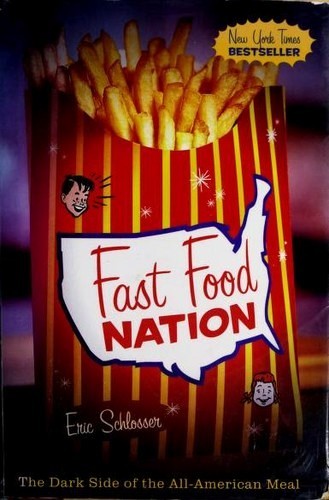
Fast Food Nation
by Eric Schlosser
★ Top 25 book of 2008 · #20 on Best Books of 2008
This investigative account traces how the fast food industry reshaped postwar America, from its California origins to meatpacking plants and overseas expansion. It examines the effects on society, health, work and culture, with sharp reporting and wit.
Best for: Readers curious about food, business and culture who like critical, myth-busting reportage
Fast Food Nation is #20 on BookWard's Best Books of 2008, out of 46 2008 books that cleared our data bar.
What Fast Food Nation is about
Eric Schlosser follows the American fast food industry from its beginnings after the Second World War to its place in the wider world today. The first half is a history of the people who built it, among them Carl Karcher, the McDonald brothers, Ray Kroc and Walt Disney. It also looks at who does the work: in Colorado Springs, Schlosser finds that fast-food restaurants pay the minimum wage to a larger share of their staff than any other American industry.
The second half moves to the food itself. It looks at the chemistry behind fast food flavor, at ranchers, and at the meatpacking industry, which Schlosser calls the most dangerous job in America. He argues that centralized production created the conditions for E. coli to spread. The book closes with fast food as an American export. It began as a magazine series in Rolling Stone and has drawn comparisons to Upton Sinclair's The Jungle. Readers curious about where their meals come from, and what that costs workers and public health, will find a clear, critical guide.
Fast Food Nation on the Best Books of 2008
Fast Food Nation came out in 2008. Of the 46 books first published in 2008 that met BookWard's data bar, it ranks #20 on our Best Books of 2008 list.
Why it made the list: 239 readers have shelved it on Open Library; readers rate it 4.2 out of 5 (28 ratings). The list ranks each year’s books on how many readers have picked them up, how highly readers rate them, and how many are reading them right now.
Nearby on the 2008 list
- Anathem Neal Stephenson, #18
- I Love My New Toy! (Elephant and Piggie) Mo Willems, #19
- The Last Lecture Randy Pausch, #21
- Firefly Lane Kristin Hannah, #22
See all Best Books of 2008 Best books by year
More years: Best Books of 2007 Best Books of 2009.
The numbers behind it
- Readers: 186 want to read it, 15 are reading it now and 38 have read it, according to Open Library.
- Ratings: 4.2 out of 5 from 28 Open Library ratings.
| Signal | This book (0 to 100) | Weight |
|---|---|---|
| Reach | 48 | 55% |
| Reader love | 72 | 25% |
| Being read right now | 65 | 20% |
Questions about Fast Food Nation
When was Fast Food Nation published?
Fast Food Nation by Eric Schlosser was first published in 2008.
Was Fast Food Nation one of the best books of 2008?
Fast Food Nation is #20 on BookWard's Best Books of 2008, out of 46 2008 books that cleared our data bar. 239 readers have shelved it on Open Library; readers rate it 4.2 out of 5 (28 ratings).
Why is Fast Food Nation on the Best Books of 2008 list?
239 readers have shelved it on Open Library; readers rate it 4.2 out of 5 (28 ratings).
More of the best books of 2008
- The Hunger Games Suzanne Collins, #1
- End of Days Sylvia Browne, #2
- The Last Straw Jeff Kinney, #3
- Amulet Kazu Kibuishi, #4
- Outliers Malcolm Gladwell, #5
- Michelle Obama in Her Own Words Michelle Obama, #6
See the full Best Books of 2008, the Top 100, or new books on Rising.
How we know
This page uses public data: Open Library reader counts and ratings, and Wikipedia page views for recent years. The description is paraphrased from real source text. Rankings reflect reading interest, not quality or sales, and can be affected by data gaps. Lists update monthly.
It suits older teens and adults curious about food, business and labor.
Depends on the edition you pick.
A muckraking tour of fast food, from drive-ins to slaughterhouse floors. 52% taste match
 BookWard’s take
A muckraking tour of fast food, from drive-ins to slaughterhouse floors
Eric Schlosser traces fast food from its postwar California beginnings through the meatpacking plants that feed it, and the case he builds is hard to wave away. It is rigorous work, well beyond the anecdotal, with real legwork behind every argument. This is a book driven by ideas rather than story, which may be a harder sell for readers who prefer narrative. The pace is steady rather than urgent, and the hook is gentle, though the chapters on teenage workers and the most dangerous job in America pull you along. The voice is a strength: wry, alert, and clearly Schlosser's own. The central questions about what we eat and who pays for it feel timeless, even where the details have aged. The book earns its darkness by reporting rather than shouting.
A two-part survey that covers a lot of ground without padding, longer than BookWard's taste for tight books.
Chapters move briskly between locations and subjects, though the detail slows it somewhat, a little below BookWard's quick pace.
Its blend of business history, labor reporting and food science felt fresh in 2001, near BookWard's preference for original angles.
The writing is clear and journalistic rather than ornate, close to BookWard's plain-leaning middle.
There is no plot to speak of; the book is organized by subject, so it sits well on the plot side of the dial.
The picture is largely critical, with little offered as consolation, so it leans bleak against BookWard's modest hopefulness.
A conventional two-part layout, history first and industry mechanics second, with nothing experimental.
Dry wit appears occasionally, but the tone stays serious, a bit below BookWard's lean toward humor.
Worker injuries, contaminated meat and exploitation make for dark, if reported, material.
The anger is controlled and the tone measured, so intensity builds quietly.
See all 50 dialsEvery position, side by side with this book
Where it lines up
- SentimentBookWard 8 · book 8
- Shock for effectBookWard 9 · book 8
- Rigor (nonfiction)BookWard 9 · book 8
Where it pulls apart
- LengthBookWard 1 · book 5
- OpeningBookWard 10 · book 6
- Story or ideasBookWard 3 · book 9
A two-part survey that covers a lot of ground without padding, longer than BookWard's taste for tight books.
It opens with fast food's pioneers in southern California, engaging but not a jolt, short of BookWard's love of an instant hook.
The exposé genre has familiar beats, but Schlosser's reporting keeps it from reading as formula, close to BookWard's taste.
Each chapter builds a clear chain from history to industry mechanics to consequences, which suits BookWard's appetite for airtight argument.
Chapters move briskly between locations and subjects, though the detail slows it somewhat, a little below BookWard's quick pace.
Its blend of business history, labor reporting and food science felt fresh in 2001, near BookWard's preference for original angles.
This is reportage, so people serve the argument rather than being drawn in depth, below BookWard's interest in character.
The closing chapter looks at fast food as an American export, wrapping up the argument without tidy solutions, a fair match.
Schlosser reports plainly and avoids tugging at feelings, in line with BookWard's preference for restraint.
The shocking material, from workplace danger to E. coli, comes from documented reporting, which is exactly how BookWard likes darkness earned.
The book is built on on-site reporting and detailed investigation of industry practice, matching BookWard's high regard for rigor.
Schlosser's wry, confident narration is distinctive and unmistakably his, fitting BookWard's liking for a strong voice.
The book is built on a thesis about fast food and American society, not a narrative, so it leans toward ideas.
Explaining how the industry works is the point, so exposition dominates, far from BookWard's love of showing in scene.
The two-part structure keeps new subjects arriving, from advertising to slaughterhouses, so the middle holds up well.
The writing is clear and journalistic rather than ornate, close to BookWard's plain-leaning middle.
There is no plot to speak of; the book is organized by subject, so it sits well on the plot side of the dial.
The picture is largely critical, with little offered as consolation, so it leans bleak against BookWard's modest hopefulness.
A conventional two-part layout, history first and industry mechanics second, with nothing experimental.
Dry wit appears occasionally, but the tone stays serious, a bit below BookWard's lean toward humor.
The prose is accessible, yet the volume of industry detail asks for steady attention, near BookWard's middle.
Schlosser moves among ranchers, teenage workers, meatpackers and franchisers, giving many vantage points, close to BookWard's taste.
It runs from the postwar beginnings of fast food toward the present in a mostly linear sweep.
It is entirely grounded in real businesses, places and people.
Pioneers, workers, ranchers and executives make for a large cast of real figures, bigger than BookWard's usual.
The book connects local restaurants to national industry and global cultural export, a broad canvas.
The focus is on industries, workplaces and external conditions rather than inner life.
Quoted voices appear, but the book is driven by narration and reporting, not conversation.
Romance has no place in an investigation of the food industry.
Slaughterhouses and flavor labs are unfamiliar territory to most readers, which suits BookWard's taste for new settings.
It documents fast food from its postwar origins to the turn of the millennium, so it reads as recent history rather than present day.
The questions about food, labor and corporate power persist, so it holds up beyond its moment.
Schlosser reports on what he witnessed and researched, a reliable guide rather than a slippery one.
The book clearly argues that something is wrong, though it leaves room for readers to weigh the trade-offs.
Scenes in plants, restaurants and ranch country are vividly rendered, richer than sparse reportage.
It blends narrative profiles with analysis, sitting near the middle with a slight analytical edge.
Schlosser appears as an observer who visits places, but the book stays focused on its subject, not himself.
It stands alone as a single book.
Revelations about the industry arrive regularly, though not as plot twists, so it surprises moderately.
It asks readers to rethink everyday habits and the systems behind them, which is a real challenge.
Worker injuries, contaminated meat and exploitation make for dark, if reported, material.
The anger is controlled and the tone measured, so intensity builds quietly.
What humor exists is wry and understated rather than broad.
Descriptions of dangerous slaughterhouse work and injury are frank but not gratuitous.
The book is not concerned with sexual content.
Labor, regulation and corporate power are central, so politics sits front and center.
The language is plain and journalistic, with no dialect to decode.
Schlosser's critical stance comes through clearly, so the narration is far from neutral.
It mostly traces how we got here and what that history has produced, leaning backward, with a nod to fast food's global spread.
The book shows skepticism about corporate promises more than faith, yet it implicitly believes reform is worth demanding.
Review written by BookWard, dial version 1, November 2026.
Who is Fast Food Nation right for?
It suits older teens and adults curious about food, business and labor. It includes frank descriptions of workplace injury and unsanitary meat processing that may unsettle some readers.
The prose is accessible, yet the volume of industry detail asks for steady attention, near BookWard's middle.
Worker injuries, contaminated meat and exploitation make for dark, if reported, material.
The anger is controlled and the tone measured, so intensity builds quietly.
Descriptions of dangerous slaughterhouse work and injury are frank but not gratuitous.
Book CompanionFast Food Nation: ideas, characters, themes
Fast food is the story of postwar America, and its rise has remade food production, labor, landscape and culture at real human cost.
- Pioneers of the business. The first section opens with Carl Karcher and the McDonald brothers in southern California, then turns to Ray Kroc and Walt Disney.
- Marketing to children. Schlosser examines the intricate, profitable methods the industry uses to advertise to young consumers.
- Work in Colorado Springs. His visit shows fast-food workers' lives and that the industry pays minimum wage to a higher share of its employees than any other American industry.
- The science of flavor. The second part begins with the chemical components that make fast food taste so good.
- Meatpacking and risk. He argues that meatpacking is the most dangerous job in America and that centralization created conditions where E. coli can spread.
Characters
Ray Kroc
Fast-food pioneer
Discussed in the opening section alongside Walt Disney, in a relationship Schlosser calls complicated.
Carl N. Karcher
Fast-food pioneer
One of the early California figures whose roles open the book's history.
The McDonald brothers
Fast-food pioneers
Early innovators in southern California whose model the book places at the industry's start.
Walt Disney
Entertainment figure
Examined alongside Ray Kroc as part of fast food's early story.
Themes
How a few firms shaped what and how a nation eats.
The low wages and physical danger faced by those who make the food.
The malling and sameness of American places and tastes.
Winning consumers young and building lifelong habits.
How American food habits spread to other countries.
Discussion questions
- Which part of Schlosser's case changed how you think about a fast-food meal?
- How much responsibility belongs to companies and how much to consumers?
- Why might the book be compared to Upton Sinclair's The Jungle?
- What does the treatment of workers say about the real price of cheap food?
- Have the issues Schlosser describes changed since he wrote, or only their details?
Personalize your Book Companion
This is the general edition. In BookWard, the Companion is written for you: your reading profile, your notes, and spoiler-safe to the page you are on.
Buy, listen or borrow Fast Food Nation
Each link opens a search for this book on that store, in a new tab.
Read on a device
Borrow
Reviews and community
If you liked Fast Food Nation
A sweeping, art-filled history of African Americans from Africa to hip-hop
1491Charles C. MannA rigorous, idea-rich rewrite of the Americas before Columbus
The Shock DoctrineNaomi KleinA sweeping, argumentative history of crisis as an economic opening
The Code BookSimon SinghA history of secret writing that makes the mathematics approachable
Find your own best books
Add what you have read, rate it, and BookWard will recommend what to read next.
Free to start. No credit card needed.