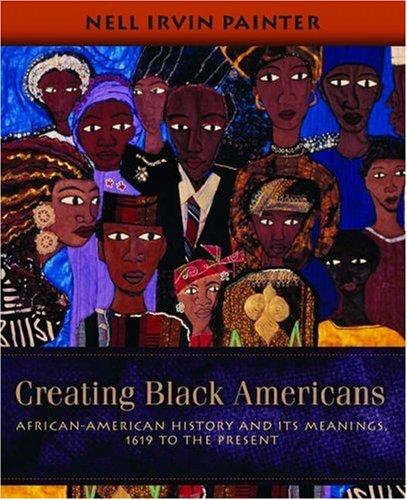
Creating Black Americans
by Nell Irvin Painter
★ Top 25 book of 2005 · #21 on Best Books of 2005
Nell Irvin Painter traces African American history from life in Africa before slavery through to hip-hop. Her narrative draws on recent research and is enriched by artwork from black artists, covering slavery, Reconstruction, Jim Crow, the Harlem Renaissance and Civil Rights.
Best for: Readers wanting a sweeping, art-illustrated history of African Americans, from Africa to hip-hop
Creating Black Americans is #21 on BookWard's Best Books of 2005, out of 52 2005 books that cleared our data bar.
What Creating Black Americans is about
Nell Irvin Painter, a historian, tells the story of African Americans for a new generation of readers. Her account draws on the latest research and sits alongside artwork by African-American artists. It begins with life in Africa before slavery and reaches all the way to today's hip-hop culture.
Along the way, she looks at the forced journey of more than ten million Africans to the New World and the sharp contrast between the nearly half a million free black people and almost four million enslaved people in 1860. She argues that the Civil War only gradually became a war to end slavery, and that Reconstruction, after a hopeful start, was brought down by white supremacist terror. Through the Jim Crow decades, she shows black communities building schools and businesses against enormous odds. It suits students, general readers, and anyone wanting a broad, humane overview.
Creating Black Americans on the Best Books of 2005
Creating Black Americans came out in 2005. Of the 52 books first published in 2005 that met BookWard's data bar, it ranks #21 on our Best Books of 2005 list.
Why it made the list: 246 readers have shelved it on Open Library. The list ranks each year’s books on how many readers have picked them up, how highly readers rate them, and how many are reading them right now.
Nearby on the 2005 list
- Midnight Erin Hunter, #19
- It's in His Kiss Julia Quinn, #20
- A Piece of Cake Cupcake Brown, #22
- 1491 Charles C. Mann, #23
See all Best Books of 2005 Best books by year
More years: Best Books of 2004 Best Books of 2006.
The numbers behind it
- Readers: 229 want to read it, 13 are reading it now and 4 have read it, according to Open Library.
| Signal | This book (0 to 100) | Weight |
|---|---|---|
| Reach | 50 | 55% |
| Reader love | 75 | 25% |
| Being read right now | 58 | 20% |
Questions about Creating Black Americans
When was Creating Black Americans published?
Creating Black Americans by Nell Irvin Painter was first published in 2005.
Was Creating Black Americans one of the best books of 2005?
Creating Black Americans is #21 on BookWard's Best Books of 2005, out of 52 2005 books that cleared our data bar. 246 readers have shelved it on Open Library.
Why is Creating Black Americans on the Best Books of 2005 list?
246 readers have shelved it on Open Library.
More of the best books of 2005
- The Lightning Thief Rick Riordan, #1
- Harry Potter and the Half-Blood Prince J. K. Rowling, #2
- The Glass Castle Jeannette Walls, #3
- Looking for Alaska John Green, #4
- Eldest Christopher Paolini, #5
- Freakonomics Steven D. Levitt, #6
See the full Best Books of 2005, the Top 100, or new books on Rising.
How we know
This page uses public data: Open Library reader counts and ratings, and Wikipedia page views for recent years. The description is paraphrased from real source text. Rankings reflect reading interest, not quality or sales, and can be affected by data gaps. Lists update monthly.
Suits older teens and adults, including students and general readers of history.
Depends on the edition you pick.
A sweeping, art-filled history of African Americans from Africa to hip-hop. 52% taste match
 BookWard’s take
A sweeping, art-filled history of African Americans from Africa to hip-hop
Nell Irvin Painter has written a single-volume history that opens in Africa before slavery and runs through to the hip-hop era, weaving in works by African-American artists alongside the narrative. The scholarship is rigorous: it draws on the latest research and handles the Atlantic slave trade, free black communities, the Civil War, Reconstruction, Jim Crow and the Civil Rights era with real command. The scope is epic by design, spanning centuries and continents. The prose leans analytical while keeping a vivid narrative thread, and the artwork gives the book a rich, visual texture that most histories lack. Expect hard material on slavery and white supremacist terror, treated seriously, with as much attention to creativity and endurance as to trauma.
A survey stretching from precolonial Africa to the present is substantial, though it stays shorter than multi-volume histories of the same ground.
It covers centuries at a steady clip, moving briskly between eras without dwelling.
Pairing the narrative with African-American art gives a fresh angle, though the underlying story is well mapped.
Accessible narrative history prose, clear rather than ornate.
It follows social and political forces more than individual characters.
It balances tragedy against creativity, endurance and achievement under Jim Crow and after.
A straightforward chronological march from Africa to today.
The subject matter is serious, with little room for levity.
Slavery, brutal servitude and racial terror make for heavy subject matter.
The material is emotionally weighty, delivered with a historian's composure.
See all 50 dialsEvery position, side by side with this book
Where it lines up
- Shock for effectBookWard 9 · book 9
- Rigor (nonfiction)BookWard 9 · book 9
- SentimentBookWard 8 · book 7
Where it pulls apart
- LengthBookWard 1 · book 6
- OpeningBookWard 10 · book 6
- ExpositionBookWard 2 · book 8
A survey stretching from precolonial Africa to the present is substantial, though it stays shorter than multi-volume histories of the same ground.
A history this broad builds through context and sweep rather than a single grabbing opening scene.
It avoids the stock heroes-and-villains framing, giving a layered account of both suffering and creativity.
A chronological argument from Africa through slavery, Reconstruction and Jim Crow holds together cleanly, which suits BookWard's love of airtight reasoning.
It covers centuries at a steady clip, moving briskly between eras without dwelling.
Pairing the narrative with African-American art gives a fresh angle, though the underlying story is well mapped.
As a survey, it surveys people and movements rather than drawing individuals in depth.
It reaches a conclusion about African Americans today, though a living history never fully closes.
It treats tragedy and trauma plainly rather than milking them for feeling.
The brutality of slavery and Reconstruction-era terror is presented as history, not shock for effect, which earns its darkness.
It rests on the latest research across the slave trade, free black life, the Civil War and Reconstruction.
Painter's historian's voice is confident and clear, with a recognizable authorial stance.
It is driven by historical argument and interpretation more than by plot.
History of this scope explains events and context outright rather than dramatizing them in scene.
A chronological structure with new eras and events keeps momentum across its length.
Accessible narrative history prose, clear rather than ornate.
It follows social and political forces more than individual characters.
It balances tragedy against creativity, endurance and achievement under Jim Crow and after.
A straightforward chronological march from Africa to today.
The subject matter is serious, with little room for levity.
Accessible for general readers, though the breadth and weight of material take attention.
It draws on many people and communities, though through one historian's framing.
Told in chronological order from Africa before slavery to hip-hop.
Entirely grounded in documented history.
A sweeping history touches a very large range of people, movements and institutions.
It spans continents and centuries, from the forced transport of over ten million Africans to modern culture.
The focus is on events, institutions and social change rather than inner thoughts.
As narrative history, it relies on exposition and analysis, not conversation.
Romance is not part of this history.
Readers meet eras and settings, from precolonial Africa to plantations and Harlem, that may be new.
Mostly historical, but it carries the story up to hip-hop and recent decades.
A foundational survey of a story that stays relevant.
A historian's narration, with no unreliability in play.
It speaks clearly about slavery and white supremacist terror, while handling complexity in the Civil War and Reconstruction.
Vivid narrative plus a wide array of artwork gives it a rich visual and descriptive layer.
It blends vivid storytelling with analysis, tilting slightly toward narrative.
Painter writes as a historian with a clear point of view, not as a detached chronicler.
A standalone volume.
History is known, so few surprises, though some revelations such as the Civil War's slow turn to abolition.
It confronts slavery, terror and long injustice, which challenges rather than comforts.
Slavery, brutal servitude and racial terror make for heavy subject matter.
The material is emotionally weighty, delivered with a historian's composure.
Humor is essentially absent given the subject.
Slavery's brutality and Reconstruction-era terrorism are discussed substantially.
Little sexual content beyond the realities of history.
Race, power and citizenship are central, up through Civil Rights and Black Power.
Plain scholarly prose written for a general audience.
Painter frames the story with a clear point of view and interpretations.
It looks back across history while closing on where African Americans stand today.
It acknowledges brutality while crediting creativity and the fight for rights.
Review written by BookWard, dial version 1, November 2026.
Who is Creating Black Americans right for?
Suits older teens and adults, including students and general readers of history. It describes slavery, brutality and racial terrorism frankly.
Accessible for general readers, though the breadth and weight of material take attention.
Slavery, brutal servitude and racial terror make for heavy subject matter.
The material is emotionally weighty, delivered with a historian's composure.
Slavery's brutality and Reconstruction-era terrorism are discussed substantially.
Book CompanionCreating Black Americans: ideas, characters, themes
African American history is a story of both profound trauma and lasting creativity, told from Africa before slavery to hip-hop and beyond.
- Before slavery. The story begins with life in Africa prior to the slave trade.
- The Atlantic trade. Over ten million Africans were forcibly transported to the New World, most to brutal servitude in Brazil and the Caribbean.
- Free and enslaved. By 1860 the free black population was close to half a million, against almost four million enslaved.
- War and Reconstruction. The Civil War only slowly became a war to end slavery, and Reconstruction was shut down by white supremacist terrorism.
- Creating culture. Through Jim Crow, blacks built schools, businesses and the foundations of popular culture, with the Harlem Renaissance, Civil Rights, Black Power and hip-hop following.
Themes
The brutality and legacy of forced servitude.
Building schools, businesses and communities against enormous odds.
Art and culture as expressions of identity, from the Harlem Renaissance to hip-hop.
The long fight from Reconstruction through Civil Rights and Black Power.
How African Americans have been made and have made themselves over time.
Discussion questions
- Why does Painter pair the narrative with artwork by African-American artists?
- What does the Civil War's slow shift into a war against slavery reveal?
- How did Reconstruction's early promise end, and why?
- How did creativity and institution-building persist through Jim Crow?
- What does the book suggest about African Americans' place today?
Personalize your Book Companion
This is the general edition. In BookWard, the Companion is written for you: your reading profile, your notes, and spoiler-safe to the page you are on.
Buy, listen or borrow Creating Black Americans
Each link opens a search for this book on that store, in a new tab.
Read on a device
Borrow
Reviews and community
If you liked Creating Black Americans
A muckraking tour of fast food, from drive-ins to slaughterhouse floors
CasteIsabel WilkersonA big idea about American hierarchy, argued through real lives
The Code BookSimon SinghA history of secret writing that makes the mathematics approachable
Guns, Germs, and SteelJared DiamondWhy some societies conquered others, argued from geography, not genes
Find your own best books
Add what you have read, rate it, and BookWard will recommend what to read next.
Free to start. No credit card needed.