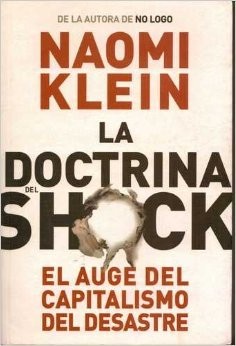
The Shock Doctrine
by Naomi Klein
★ Top 25 book of 2007 · #19 on Best Books of 2007
Naomi Klein argues that free market policies championed by Milton Friedman spread by exploiting national crises, when people are too shaken to respond. She also suggests some man-made events, such as the Iraq War, were meant to enable this.
Best for: Readers curious about politics and economics who enjoy provocative, debated arguments
The Shock Doctrine is #19 on BookWard's Best Books of 2007, out of 53 2007 books that cleared our data bar.
What The Shock Doctrine is about
Naomi Klein makes a bold claim in this 2007 study: that the free-market ideas associated with Milton Friedman and the Chicago school have often advanced by riding on catastrophe. Her argument is that when a war or natural disaster leaves people shaken and distracted, those in power can push through measures such as privatization and deregulation that voters would normally resist.
She builds the case across seven parts, moving from secret psychiatric experiments linked to the CIA, through Chile under Pinochet and several economies in transition, to the occupation of Iraq, Hurricane Katrina and the 2004 tsunami in Sri Lanka. The tone is investigative and pointed. It suits readers curious about how economic policy, power and crisis intersect, and who want an argument to test rather than a neutral survey.
The Shock Doctrine on the Best Books of 2007
The Shock Doctrine came out in 2007. Of the 53 books first published in 2007 that met BookWard's data bar, it ranks #19 on our Best Books of 2007 list.
Why it made the list: 242 readers have shelved it on Open Library; readers rate it 4.5 out of 5 (24 ratings). The list ranks each year’s books on how many readers have picked them up, how highly readers rate them, and how many are reading them right now.
Nearby on the 2007 list
- Nineteen Minutes Jodi Picoult, #17
- Schooled Gordon Korman, #18
- Double Take Catherine Coulter, #20
- Tweak Nic Sheff, #21
See all Best Books of 2007 Best books by year
More years: Best Books of 2006 Best Books of 2008.
The numbers behind it
- Readers: 199 want to read it, 12 are reading it now and 31 have read it, according to Open Library.
- Ratings: 4.5 out of 5 from 24 Open Library ratings.
| Signal | This book (0 to 100) | Weight |
|---|---|---|
| Reach | 43 | 55% |
| Reader love | 81 | 25% |
| Being read right now | 58 | 20% |
Questions about The Shock Doctrine
When was The Shock Doctrine published?
The Shock Doctrine by Naomi Klein was first published in 2007.
Was The Shock Doctrine one of the best books of 2007?
The Shock Doctrine is #19 on BookWard's Best Books of 2007, out of 53 2007 books that cleared our data bar. 242 readers have shelved it on Open Library; readers rate it 4.5 out of 5 (24 ratings).
Why is The Shock Doctrine on the Best Books of 2007 list?
242 readers have shelved it on Open Library; readers rate it 4.5 out of 5 (24 ratings).
More of the best books of 2007
- Dog Days Jeff Kinney, #1
- A Thousand Splendid Suns Khaled Hosseini, #2
- Harry Potter and the Deathly Hallows J. K. Rowling, #3
- The Titan's Curse Rick Riordan, #4
- The Name of the Wind Patrick Rothfuss, #5
- Rodrick Rules Jeff Kinney, #6
See the full Best Books of 2007, the Top 100, or new books on Rising.
How we know
This page uses public data: Open Library reader counts and ratings, and Wikipedia page views for recent years. The description is paraphrased from real source text. Rankings reflect reading interest, not quality or sales, and can be affected by data gaps. Lists update monthly.
Suits mature teens and adults interested in economics, politics and recent history.
Depends on the edition you pick.
A sweeping, argumentative history of crisis as an economic opening. 47% taste match
 BookWard’s take
A sweeping, argumentative history of crisis as an economic opening
Klein builds one big argument and tests it across decades and continents, from Chile in 1973 to Iraq. The opening is a jolt: it starts with psychiatric shock therapy and the covert experiments of Ewen Cameron before turning to Milton Friedman. The research is extensive, though some reviewers found the argument oversimplifies. Klein's voice is plainly opinionated and distinctive, and the politics sit front and center rather than lurking in the background. Readers who like a sustained, original thesis will find a lot to chew on. It is also long and sprawling, and that length is the cost of admission. Expect to be challenged, not comforted, and to finish with a framework you can apply to news you read later.
A seven-part, 21-chapter survey across many countries and decades makes this far longer than BookWard's tight preference.
Moves briskly from case to case, but the sheer density of material slows the going in places.
The central idea of crises exploited to push through policy is a distinctive framework, which BookWard rewards.
Clear, journalistic and direct, with force coming from argument rather than ornament.
Driven by an argument and a sequence of historical events, not by any one character's arc.
The picture it paints of exploited crises is bleak, with hope mostly in the possibility of resisting.
A conventional thesis book organised into parts and chapters moving through case studies.
A serious, indignant book where humor is rare.
Torture, coups and the exploitation of disasters make it a grim read.
Klein's anger and moral urgency give it real emotional force.
See all 50 dialsEvery position, side by side with this book
Where it lines up
- Authorial voiceBookWard 9 · book 9
- OriginalityBookWard 9 · book 8
- SentimentBookWard 8 · book 9
Where it pulls apart
- LengthBookWard 1 · book 9
- Story or ideasBookWard 3 · book 10
- ExpositionBookWard 2 · book 9
A seven-part, 21-chapter survey across many countries and decades makes this far longer than BookWard's tight preference.
It opens with psychiatric shock therapy and CIA-linked experiments, a startling start that matches BookWard's love of an immediate hook.
The core thesis reframes familiar events through one fresh lens rather than repeating standard economic narratives.
One thesis is carried consistently through every case study, though critics argue some links are stretched.
Moves briskly from case to case, but the sheer density of material slows the going in places.
The central idea of crises exploited to push through policy is a distinctive framework, which BookWard rewards.
People appear as actors in an argument, such as Friedman and Pinochet, rather than fully drawn individuals.
It closes an argument rather than a plot, leaving real-world questions open more than BookWard prefers.
Klein writes with anger and conviction, and her prose pushes feeling more than BookWard's restrained taste likes.
The darkness, including torture and coups, is the evidence for the thesis rather than decoration, which earns its place.
Heavily sourced and built on case studies, though some reviewers found it oversimplifies political events.
Klein's argumentative, campaigning voice is unmistakable and sets the book apart from neutral economic histories.
This is an idea-led book from start to finish, structured around a thesis, further than BookWard's story-led leaning.
Klein explains her argument outright and at length, the opposite of BookWard's preference for showing in scene.
The thesis keeps returning with fresh cases, though a long middle of country studies can feel repetitive.
Clear, journalistic and direct, with force coming from argument rather than ornament.
Driven by an argument and a sequence of historical events, not by any one character's arc.
The picture it paints of exploited crises is bleak, with hope mostly in the possibility of resisting.
A conventional thesis book organised into parts and chapters moving through case studies.
A serious, indignant book where humor is rare.
Dense with economics, history and many countries, it asks for sustained attention.
Klein's argument is told through many places, officials, economists and affected citizens.
Moves roughly forward through decades, though it jumps between countries and eras within the argument.
Entirely grounded in real events, policy and politics.
A very large roster of economists, politicians, generals and institutions appears across the book.
It spans continents and decades, from South America to Poland, China, South Africa, Russia and Iraq.
Focused on events, policy and institutions rather than anyone's inner life.
Mostly narrated argument and reporting, with little scene dialogue.
Romance plays no part in this book.
Moves through many countries and political settings that most readers will find unfamiliar.
Rooted in the late 20th century and the early 2000s, with Iraq near its end, but still relevant to current debates.
Its framework for reading crises keeps being applied to new events, so it outlasts its 2007 publication.
Klein speaks as an openly argumentative author, not a hidden or unreliable voice.
Klein's moral position is clear, though some reviewers argue the reality is more complicated than she allows.
Reportage and historical detail are present, but the focus stays on argument over scene-setting.
Part narrative history and part analysis, mixing case studies with a running thesis.
Klein writes as an engaged activist, so the perspective is committed rather than detached.
A standalone book, later turned into a 2009 documentary.
There are revelations in the case histories, but the thesis itself is announced early.
It confronts readers with uncomfortable claims about economic policy and power.
Torture, coups and the exploitation of disasters make it a grim read.
Klein's anger and moral urgency give it real emotional force.
Humor is largely absent, and what exists is dry.
Violence, including torture and coups, is discussed throughout as part of the argument.
Sexual content is absent.
Politics and economic policy are the entire subject.
Plain journalistic prose, though economic terms add some density.
Klein argues her case forcefully, and the book is anything but neutral.
Mostly historical, looking back at decades of policy, though it closes on present-day warnings.
Deeply skeptical of power and markets, with only a tentative hope for resistance.
Review written by BookWard, dial version 1, November 2026.
Who is The Shock Doctrine right for?
Suits mature teens and adults interested in economics, politics and recent history. It discusses torture, coups and war violence in a factual way.
Dense with economics, history and many countries, it asks for sustained attention.
Torture, coups and the exploitation of disasters make it a grim read.
Klein's anger and moral urgency give it real emotional force.
Violence, including torture and coups, is discussed throughout as part of the argument.
Book CompanionThe Shock Doctrine: ideas, characters, themes
Klein argues that neoliberal policies spread by exploiting disasters, wars and upheavals, pushing through unpopular reforms while people are too overwhelmed to resist.
- Shock therapy, from clinic to economy. The book opens with psychiatric shock therapy and Ewen Cameron's experiments, then uses shock as a metaphor for economic policy.
- The Chicago school and Friedman. Klein introduces Milton Friedman and the Chicago school as leaders of a drive for free markets less regulated than those before the Great Depression.
- Chile as the template. The 1973 coup led by Augusto Pinochet, advised by the Chicago Boys, is presented as an early test of the strategy, with torture tied to economic change.
- Milder variants elsewhere. Thatcher's Britain after the Falklands War and Bolivia's reforms show shock applied without the same extreme violence.
- A global survey. Later parts apply the idea to Poland, China, South Africa, Russia and the Asian Tigers, and to the Iraq War.
Characters
Milton Friedman
Economist
Leader of the Chicago school, whose free-market ideas Klein says rose to prominence through crises.
Augusto Pinochet
Chilean general
Led the 1973 coup in Chile, which Klein treats as a key early case.
Ewen Cameron
Psychiatrist
Conducted covert shock experiments in collusion with the CIA, discussed in the opening chapter.
Margaret Thatcher
British leader
Described as applying a milder shock facilitated by the Falklands War.
Themes
Using crises to push through policies people would otherwise reject.
How public disorientation can weaken democratic resistance.
The claimed link between economic reform and coercion or torture.
Whether free markets were truly welcomed where they were imposed.
Discussion questions
- Does the shock doctrine framework explain events you know of, or does it oversimplify them?
- How persuasive is the link Klein draws between torture and economic policy?
- Why might people be less able to resist change during a crisis?
- How should a reader weigh an openly activist author's argument?
- Which of the case studies convinced you most, and which least?
Personalize your Book Companion
This is the general edition. In BookWard, the Companion is written for you: your reading profile, your notes, and spoiler-safe to the page you are on.
Buy, listen or borrow The Shock Doctrine
Each link opens a search for this book on that store, in a new tab.
Read on a device
Borrow
Reviews and community
If you liked The Shock Doctrine
A muckraking tour of fast food, from drive-ins to slaughterhouse floors
1491Charles C. MannA rigorous, idea-rich rewrite of the Americas before Columbus
Creating Black AmericansNell Irvin PainterA sweeping, art-filled history of African Americans from Africa to hip-hop
CasteIsabel WilkersonA big idea about American hierarchy, argued through real lives
Find your own best books
Add what you have read, rate it, and BookWard will recommend what to read next.
Free to start. No credit card needed.