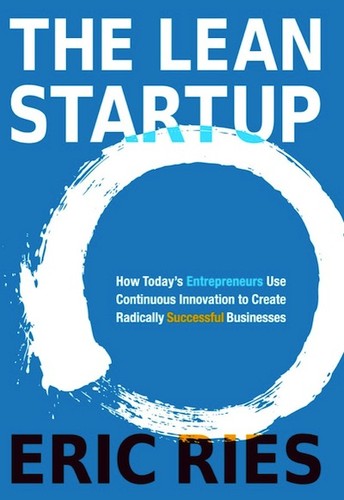
The Lean Startup
by Eric Ries
★ Top 25 book of 2011 · #13 on Best Books of 2011
Ries argues that startups fail because they build things nobody wants, not because of poor execution. He urges founders to test ideas continuously with customers and adjust their plans as feedback arrives.
Best for: Founders and corporate teams launching new products under uncertainty
The Lean Startup is #13 on BookWard's Best Books of 2011, out of 53 2011 books that cleared our data bar.
What The Lean Startup is about
Eric Ries, an entrepreneur, argues that most startups are built to fail, yet those failures can be prevented. His claim is that companies rarely fall short because of bad execution, missed deadlines or blown budgets. They fail because they build something nobody wants. Ries treats a startup's main job as finding out what customers will actually buy, and he calls his answer validated learning: gathering steady feedback so a team can adjust its plans bit by bit rather than clinging to an elaborate business plan. He says this applies whether a new venture starts in a garage or inside a large Fortune 500 company. It will help founders, product teams and anyone launching something new under uncertainty.
The Lean Startup on the Best Books of 2011
The Lean Startup came out in 2011. Of the 53 books first published in 2011 that met BookWard's data bar, it ranks #13 on our Best Books of 2011 list.
Why it made the list: 1,564 readers have shelved it on Open Library; readers rate it 3.9 out of 5 (76 ratings); 96 are reading it right now. The list ranks each year’s books on how many readers have picked them up, how highly readers rate them, and how many are reading them right now.
Nearby on the 2011 list
- Start with Why Simon Sinek, #11
- Outwitting the Devil Napoleon Hill, #12
- Cinder Marissa Meyer, #14
- Gone Girl Gillian Flynn, #15
See all Best Books of 2011 Best books by year
More years: Best Books of 2010 Best Books of 2012.
The numbers behind it
- Readers: 1,375 want to read it, 96 are reading it now and 92 have read it, according to Open Library.
- Ratings: 3.9 out of 5 from 76 Open Library ratings.
| Signal | This book (0 to 100) | Weight |
|---|---|---|
| Reach | 85 | 55% |
| Reader love | 32 | 25% |
| Being read right now | 83 | 20% |
Questions about The Lean Startup
When was The Lean Startup published?
The Lean Startup by Eric Ries was first published in 2011.
Was The Lean Startup one of the best books of 2011?
The Lean Startup is #13 on BookWard's Best Books of 2011, out of 53 2011 books that cleared our data bar. 1,564 readers have shelved it on Open Library; readers rate it 3.9 out of 5 (76 ratings); 96 are reading it right now.
Why is The Lean Startup on the Best Books of 2011 list?
1,564 readers have shelved it on Open Library; readers rate it 3.9 out of 5 (76 ratings); 96 are reading it right now.
More of the best books of 2011
- Sapiens Yuval Noah Harari, #1
- The Song of Achilles Madeline Miller, #2
- Thinking, Fast and Slow Daniel Kahneman, #3
- Steve Jobs Walter Isaacson, #4
- The Son of Neptune Rick Riordan, #5
- Shatter Me Tahereh Mafi, #6
See the full Best Books of 2011, the Top 100, or new books on Rising.
How we know
This page uses public data: Open Library reader counts and ratings, and Wikipedia page views for recent years. The description is paraphrased from real source text. Rankings reflect reading interest, not quality or sales, and can be affected by data gaps. Lists update monthly.
Best suited to adult readers and older teens with an interest in business or entrepreneurship.
Depends on the edition you pick.
A business method built on testing ideas against real customers early. 43% taste match
 BookWard’s take
A business method built on testing ideas against real customers early
Eric Ries argues that startups fail because they build something nobody wants, and he offers a method for finding out sooner: validated learning, with continuous customer feedback steering each change of direction. The book works from a coherent framework rather than a pile of anecdotes, though the evidence leans mostly on individual cases. The logic is a real strength, since each idea leads cleanly to the next. This is a book of ideas rather than story, and it explains its concepts outright instead of dramatizing them. It moves briskly and asks little of the reader, so it suits anyone who wants a usable framework quickly. Its appeal lies less in restraint or surprise than in handing you a method you can start using on Monday, and it spells out its terms plainly as it goes.
It moves steadily through its concepts without stalling, a little slower than BookWard likes.
Treating a startup as an experiment in learning what customers will buy was a distinctive framing for its moment.
The writing is plain and functional, built for clarity rather than ornament, close to BookWard's comfort zone.
There is no plot and no character arc, so the drive comes entirely from the argument.
It is optimistic that failure is preventable with the right approach, which fits BookWard's hopeful lean.
A conventional run of concept chapters, with nothing experimental in how it is organized.
Serious in manner, aimed at practical readers rather than at entertaining them.
Gentle throughout, with failure treated as something to learn from.
The register is practical and motivating rather than emotionally charged.
See all 50 dialsEvery position, side by side with this book
Where it lines up
- EndingBookWard 8 · book 7
- Internal logicBookWard 10 · book 8
- PaceBookWard 8 · book 6
Where it pulls apart
- Familiar tropesBookWard 10 · book 4
- ExpositionBookWard 2 · book 9
- LengthBookWard 1 · book 5
Business-book conventions of case studies and named frameworks are present, though the core method was fresh when it appeared.
Each concept builds on the last, from validated learning to adjusting direction, so the argument holds together well.
It moves steadily through its concepts without stalling, a little slower than BookWard likes.
Treating a startup as an experiment in learning what customers will buy was a distinctive framing for its moment.
People appear only as examples serving the argument, so there is no deep characterization.
The tone is encouraging and evangelistic rather than restrained, which sits a little warmer than BookWard prefers.
It rests on a structured framework with explicit definitions, though much of the support comes from cases rather than controlled evidence.
Ries writes as a confident practitioner with a clear stance, distinctive enough within the genre.
The book exists to deliver a method, so the idea clearly leads and BookWard's story-first taste is left behind.
Concepts are explained outright and named, the opposite of showing in scene, and far from BookWard's preference.
The writing is plain and functional, built for clarity rather than ornament, close to BookWard's comfort zone.
There is no plot and no character arc, so the drive comes entirely from the argument.
It is optimistic that failure is preventable with the right approach, which fits BookWard's hopeful lean.
A conventional run of concept chapters, with nothing experimental in how it is organized.
Serious in manner, aimed at practical readers rather than at entertaining them.
The ideas are explained simply and need little prior knowledge, making it an easy read.
Everything is filtered through the author's own single perspective on startups.
It moves forward through the method step by step, with little time-shifting.
Entirely grounded in real business practice.
A handful of example companies and people appear, but none carries the book.
It is about the work of small teams and ventures, though it argues the method applies in large organizations too.
Attention goes to actions, experiments and measurements rather than inner thoughts.
It is exposition, not conversation, so dialogue is minimal.
There is no romantic element at all.
Startup and product-team culture will be unfamiliar to some readers but is explained as it goes.
Rooted in 2010s startup culture and its tools, though the principles travel.
The core question of building what people want lasts, but tool and company examples will date.
The author states his case directly, with nothing unreliable in how it is told.
It prescribes a clear way to work and does not dwell in ethical gray areas.
Light on scene-setting, which stays in service of explanation.
It mixes illustrative stories with an analytical framework, leaning toward the analytical side.
Ries draws on his own entrepreneurial experience, giving it a practitioner's personal edge.
A standalone work with its own complete argument.
There are few surprises, since the thesis is announced up front.
It challenges habits like building elaborate plans before testing them, but gently.
Gentle throughout, with failure treated as something to learn from.
The register is practical and motivating rather than emotionally charged.
Humor is minor and mild when it appears.
None on the page.
None.
Not a political book; its concerns are business and management.
Plain language, with a few coined terms explained as they appear.
Ries argues a firm position and urges readers to adopt it, so it is strongly opinionated.
It is about building the future of products and companies, so it faces forward.
It believes disciplined learning can prevent failure, an optimistic and constructive view.
Review written by BookWard, dial version 1, November 2026.
Who is The Lean Startup right for?
Best suited to adult readers and older teens with an interest in business or entrepreneurship. Nothing in it is sensitive in content.
The ideas are explained simply and need little prior knowledge, making it an easy read.
Gentle throughout, with failure treated as something to learn from.
The register is practical and motivating rather than emotionally charged.
None on the page.
Book CompanionThe Lean Startup: ideas, characters, themes
Startups fail by building what nobody wants, so they should treat every product as an experiment and learn from customers continuously.
- Why startups fail. Ries argues failure comes from building something nobody wants, not from bad execution or blown budgets.
- Validated learning. Progress is measured by what you learn about customers, confirmed through real feedback.
- Constant adjustment. Rather than committing to an elaborate plan, teams shift direction in small steps as feedback arrives.
- Uncertainty is the starting condition. New ventures work under extreme uncertainty, so their first job is finding out what customers will buy.
- Applies beyond garages. The method is meant for startups of any origin, including new ventures inside mature companies.
Themes
Proving what you believe about customers through evidence rather than assumption.
Treating products and plans as tests to be run and revised.
Working honestly under conditions where the right answer is not yet known.
Letting real buyers steer what gets built next.
The idea that most startup failure comes from a fixable mistake.
Discussion questions
- Which of your own plans rest on assumptions you have never tested with real customers?
- How do you tell real evidence of progress from activity that only feels productive?
- Does continuous adjustment risk making a team lose its long-term vision?
- Can this method work as well inside a large company as in a garage startup?
- What would building the wrong thing cost you, and how early could you find out?
Personalize your Book Companion
This is the general edition. In BookWard, the Companion is written for you: your reading profile, your notes, and spoiler-safe to the page you are on.
Buy, listen or borrow The Lean Startup
Each link opens a search for this book on that store, in a new tab.
Read on a device
Borrow
Reviews and community
If you liked The Lean Startup
One big idea, built on Apple, King and Kennedy
DriveDaniel H. PinkA lively case that autonomy, mastery and purpose beat carrots and sticks
Get Better at AnythingScott YoungA clear framework for why some learning sticks and some stalls
UltralearningScott YoungA self-taught learner's practical blueprint for mastering hard skills fast
Find your own best books
Add what you have read, rate it, and BookWard will recommend what to read next.
Free to start. No credit card needed.