Updated November 2, 2026 · reading data through October 2026
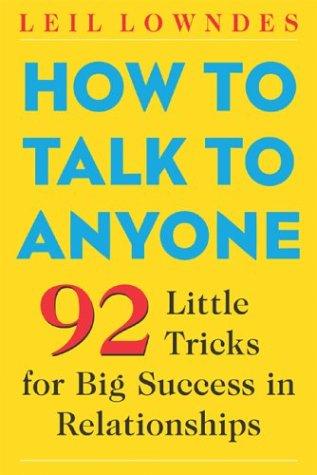
How to Talk to Anyone
by Leil Lowndes
Short, practical tips for starting conversations, making a good impression, and connecting with people. Quick to skim and easy to try. Read the full description
Best for: Introverts and people changing careers
How to Talk to Anyone is #47 on BookWard's Top 100 books for November 2026, with a BookWard Score of 64 out of 100. It climbed 8 places from #55 last month.
BookWard review of How to Talk to Anyone
4 of 5 stars 3.9 out of 5, from 61 reader ratings
BookWard rates How to Talk to Anyone 3.9 out of 5. That is the average of 61 reader ratings on Open Library (3.89), adjusted toward the typical book so that a small number of ratings cannot inflate it. Beyond the rating, it is #47 on BookWard's Top 100 books; 3,361 readers want to read it, 371 are reading it right now and 65 have finished it.
How this rating works
BookWard’s rating is calculated, not hand-scored. We take the average rating readers have given the book on Open Library and adjust it toward the typical book: adjusted = (n × average + 25 × 3.8) ÷ (n + 25), where n is the number of ratings. A book needs at least 50 ratings to be rated. The rating reflects how readers received the book, not whether it is right for you. Your own ratings on your shelf are private and are not part of this number.
How to Talk to Anyone: reading interest over the past 12 months
Sources: Open Library’s public reading-log and ratings data (dump of 2026-10-31), Wikipedia page views and Wikidata. Monthly counts are exact; they show relative interest among readers of these public sources, not total readership.
Ranked against the other books on this list, How to Talk to Anyone’s reading interest has run from #45 to #88 over these 12 months. Interest rank blends shelf adds, Wikipedia page views and rating activity, each compared with the other 99 books that month.
Shelf adds by month
How to Talk to Anyone was added to Open Library readers’ shelves 589 times in the past 12 months, peaking in October 2026 with 159 (224% above its monthly average of 49). Over the latest three months (Aug 2026 to Oct 2026) shelf adds were up 71% on the three months before. 88% of the adds were “want to read”, 11% “currently reading” and 1% “already read”.
Want to read Currently reading Already read
What the data says about How to Talk to Anyone
- Uneven demand. Monthly shelf adds swung widely around an average of 49, so interest arrives in bursts and not as a steady stream.
- Busiest and quietest months. October 2026 was its busiest month (159 adds), about 9.9 times its quietest, February 2026 (16).
- Against its genre. It had 72% fewer shelf adds than the average Self-help book on this list.
- Share of the list. It accounts for 0.6% of all shelf adds recorded for the Top 100 over these 12 months, #63 of 100.
- Its age. First published in 1999 (27 years ago), it is older than 58% of the books on the list.
Each finding is computed from the public data above and shown only when the numbers support it.
How to Talk to Anyone on the Top 100: rank history
| Month | Rank | Score |
|---|---|---|
| November 2026 | #47 | 64 |
| October 2026 | #55 | 62 |
| September 2026 | #53 | 63 |
Is How to Talk to Anyone rising or falling?
Holding steady Its weekly, monthly and yearly ranks are close together, so interest is steady rather than spiking.
On Open Library, How to Talk to Anyone ranks #31 this week, #47 this month, and #80 over the past year. A longer bar means a higher position. Comparing the three windows shows whether readers are arriving faster than the book's long-term pace. Readings as of 2026-11-02.
Why How to Talk to Anyone made the Top 100
How to Talk to Anyone made the list mainly on momentum (+29.6 points) and being read right now (+19.8 points). Its smallest contribution is rising (+1.2). The BookWard Score blends five public signals, each scored from 0 to 100 and weighted as shown.
The reading-now, rating and rank signals come from Open Library’s public data, not from BookWard’s own readers. The score measures reading interest, not quality or sales. How the score works.
Open Library reader stats for How to Talk to Anyone
Source: Open Library public reading logs, as of 2026-11-02. BookWard’s own monthly snapshots are added to the picture, and anonymous BookWard reader data will be layered in as the community grows.
More readers have How to Talk to Anyone open right now than 61% of the other books on this list. These counts come from one public source, so they show relative interest rather than total readership.
Where it sits among Self-help books
It is #9 of the 14 Self-help books on this month’s list.
About How to Talk to Anyone
What it’s about
Lowndes argues that the people everyone seems to love and respect are not luckier or more naturally charming than the rest of us. They simply handle other people with more skill, and those skills can be learned. Her book gathers 92 techniques that move from the first moment of meeting someone to the subtler methods used by people who thrive socially and professionally.
It offers nine ways to make a strong first impression, fourteen for mastering small talk, big talk, and body language, fourteen for carrying yourself with a VIP's confidence, six for sounding like an insider in any crowd, and seven for building deep rapport. The tone is chatty and upbeat. It will help anyone who dreads networking events, wants to be more at ease in conversation, or wants to make a better impression at work.
At a glance
- First published
- 1999
- Genre
- Self-help
- Length
- about 352 pages (the median across its editions)
- Languages
- editions in 2 languages listed on Open Library
- Editions
- 10 on Open Library
From Open Library and Wikidata public records. Missing rows mean the records do not list that fact.
Themes
- Conversation skills
- First impressions
- Confidence
What reading it is like
A tips-list format with short, numbered techniques.
At about 352 pages it is a longer read: roughly 7 hours at an average reading pace (about 250 words a minute, 300 words a page). Audiobook and edition lengths vary.
Good to know
Designed for skimming and dipping in.
The premise
Leil Lowndes offers 92 short tips for making a great impression and starting conversations, from body language to the words you choose.
What you’ll get
- Tactical, quick tips
- Easy to skim
- Confidence boosters for social events
You might skip it if you find scripted tactics artificial.
Pairs well with: How to Win Friends and Influence People · Influence
Keep exploring the chart
Also on the chart at #46 and #48
Questions about How to Talk to Anyone
What rank is How to Talk to Anyone on the Top 100 books?
How to Talk to Anyone is #47 on BookWard's Top 100 books for November 2026, with a BookWard Score of 64 out of 100. It climbed 8 places from #55 last month.
Is How to Talk to Anyone rising or falling?
Holding steady. Its weekly, monthly and yearly ranks are close together, so interest is steady rather than spiking. On Open Library, How to Talk to Anyone ranks #31 this week, #47 this month, and #80 over the past year.
Why is How to Talk to Anyone on the Top 100?
How to Talk to Anyone made the list mainly on momentum (+29.6 points) and being read right now (+19.8 points). Its smallest contribution is rising (+1.2).
How many people are reading How to Talk to Anyone right now?
Open Library's reading logs show 371 readers currently reading How to Talk to Anyone, 3,361 who want to read it and 65 who have logged it as read (as of 2026-11-02). These are counts from one public source, not all readers.
How much interest has How to Talk to Anyone had over the past year?
589 Open Library shelf adds in the past 12 months (peak October 2026, 159); latest three months up 71% on the prior three. Figures come from Open Library and Wikipedia public data.
Who is How to Talk to Anyone best for?
Introverts and people changing careers.
Ask a question about How to Talk to Anyone
Ask about this book's chart history, reading interest, or who it is for. Answers come from this page's data and can be wrong.
Answers are AI-written from BookWard’s own help content and can be wrong. Please do not share personal information: questions and answers may be saved and, if they are useful, shown on this site without your name.
How we know
This page is built from public data: Open Library’s dated reading-log and ratings dumps, Wikipedia page views, Wikidata, and BookWard’s own monthly Top 100 snapshots. The interest rank blends shelf adds (45%), Wikipedia page views (30%), rating activity (10%) and, for months where a snapshot exists, BookWard’s own score (15%), each as a percentile among the Top 100 books. Every month shown is real data; nothing is estimated. Rankings reflect reading interest, not quality or sales, and can be affected by data gaps. Last updated November 2026. Read the full methodology.
It suits teens and adults who want to feel more comfortable meeting people, with no mature content.
352 pages, about 5.5 to 8 hours.
92 named conversation techniques, built to be used at your next party. 41% taste match
 BookWard’s take
92 named conversation techniques, built to be used at your next party
Leil Lowndes organizes How to Talk to Anyone as a toolbox: 92 techniques, each given a catchy name so it sticks, running from first impressions to small talk, body language, phone manner and working a room. That makes it easy to dip into, with almost no sagging middle, because every chapter is a fresh set of tips. It is anecdotal rather than rigorous, built on one communication coach's experience instead of research, and the advice leans on familiar self-help moves. Its voice is brisk and distinctive, though, and the pace stays quick. Readers who want original ideas or deep rigor will find it light; readers who want practical moves to try tonight will find plenty.
At 352 pages with 92 short techniques, it runs longer than a tight read needs to, which is a stretch for BookWard's short-leaning taste.
Short numbered techniques keep things moving and let you skip ahead, which suits BookWard's fast-reading side.
Naming and packaging 92 tactics is a clever hook, but the underlying ideas are mostly well-worn social advice.
The language is plain and chatty, sitting plainer than BookWard's slightly richer middle.
There is no plot or character arc, so the plot versus character dial does not apply.
The whole premise is that anyone can become more charming and successful, an optimistic outlook BookWard likes.
A numbered series of techniques grouped by theme is conventional for the genre, close to BookWard's mildly traditional taste.
The catchy names and breezy tone add some lightness, though it stays a practical guide first.
Nothing here is dark; the content is light, social and encouraging.
Warm and encouraging, but not emotionally intense.
See all 50 dialsEvery position, side by side with this book
Where it lines up
- Sagging middleBookWard 8 · book 8
- PaceBookWard 8 · book 7
- Authorial voiceBookWard 9 · book 8
Where it pulls apart
- Familiar tropesBookWard 10 · book 3
- ExpositionBookWard 2 · book 9
- LengthBookWard 1 · book 5
At 352 pages with 92 short techniques, it runs longer than a tight read needs to, which is a stretch for BookWard's short-leaning taste.
The promise of instant social payoff and punchy named techniques pulls you in quickly, which matches how BookWard likes to start.
Much of the advice, like eye contact and flattering people, is standard self-help territory, well short of BookWard's appetite for the fresh.
Each technique comes with a rationale and example, but the claims rest on assertion more than proof, so it falls short of airtight.
Short numbered techniques keep things moving and let you skip ahead, which suits BookWard's fast-reading side.
Naming and packaging 92 tactics is a clever hook, but the underlying ideas are mostly well-worn social advice.
There are no characters to draw; this is a how-to, so the dial does not apply.
A technique collection has no plot to resolve, so an ending dial does not apply.
The tone is upbeat and encouraging, with a mild warmth that sits a little softer than BookWard's restrained taste.
Nothing here is dark or built to shock, so the dial does not apply.
It draws on one coach's experience and catchphrases rather than studies, which is anecdotal and below BookWard's preference for rigor.
Lowndes writes in an entertaining, straight-shooting style with memorable technique names, a distinctive voice that BookWard values.
It is entirely idea- and advice-led with no story, matching the practical bent of a self-help guide more than BookWard's story-led lean.
Techniques are explained outright to the reader, the opposite of BookWard's preference for showing in scene.
Because every entry is a self-contained tip, it never sags in the middle, which BookWard appreciates.
The language is plain and chatty, sitting plainer than BookWard's slightly richer middle.
There is no plot or character arc, so the plot versus character dial does not apply.
The whole premise is that anyone can become more charming and successful, an optimistic outlook BookWard likes.
A numbered series of techniques grouped by theme is conventional for the genre, close to BookWard's mildly traditional taste.
The catchy names and breezy tone add some lightness, though it stays a practical guide first.
Short, clear techniques make this an easy read that asks little effort, lighter than BookWard's modest challenge.
It speaks from a single advisory perspective, which is less varied than BookWard's many-voice preference.
It moves in a straight line from first impressions to advanced techniques, matching a linear structure.
This is a practical, real-world guide with nothing fantastical.
As a nonfiction guide it has no cast, so the dial does not apply.
It stays on one-to-one and small-group social moments, which is intimate in scale.
The advice mixes behavior and mindset in no clear lean, so the dial does not apply.
Example exchanges illustrate the techniques, adding a fair amount of dialogue, in line with BookWard's taste for it.
Dating and attraction come up as one application among many, but romance is minor.
The setting is everyday social and business life, entirely familiar ground.
Published in 1999, its examples lean on pre-smartphone social life, so it reads somewhat dated but still usable.
Basic human social dynamics endure, though some references and tactics reflect their time.
The author speaks plainly and directly, a reliable guide.
The advice is presented with clear, confident rules rather than gray areas.
Descriptions are brief and functional, serving the techniques rather than painting scenes.
It reads more as a tip catalog than a flowing narrative or deep analysis, leaning slightly narrative with anecdotes.
Lowndes draws on her own coaching experience and speaks to the reader directly, a personal perspective.
It stands alone as a single guide.
A tips book has no plot, so surprises do not apply.
The material is affirming and comfortable, aimed at helping readers feel more capable rather than unsettled.
Nothing here is dark; the content is light, social and encouraging.
Warm and encouraging, but not emotionally intense.
The playful technique names and light jokes lean broad rather than dry.
No violence appears in a book about conversation.
There is no sexual content, only social advice.
Politics is largely absent, aside from working a room like a politician.
The language is plain and conversational with no dense or dialect-heavy passages.
The author is openly opinionated, handing out strong advice and rules.
It aims at helping readers improve their future social and career prospects.
It believes that skill and effort can make anyone more liked and successful, an idealistic stance.
Review written by BookWard, dial version 1, November 2026.
Who is How to Talk to Anyone right for?
It suits teens and adults who want to feel more comfortable meeting people, with no mature content. Some tactics, like strategic flattery, are worth discussing with younger readers.
Short, clear techniques make this an easy read that asks little effort, lighter than BookWard's modest challenge.
Nothing here is dark; the content is light, social and encouraging.
Warm and encouraging, but not emotionally intense.
No violence appears in a book about conversation.
Book CompanionHow to Talk to Anyone: ideas, characters, themes
Charm and social success are skills made of learnable techniques, from how you make a first impression to how you work a room.
- Techniques have names. Lowndes gives each of her 92 techniques a catchy name so they are easy to remember and reuse.
- First impressions. The book opens with a set of ways to make a strong first impression.
- Small talk and body language. It teaches how to handle small talk, bigger conversations and nonverbal signals.
- Rapport and ego. Chapters cover building deep rapport and knowing when to flatter someone and when not to.
- Parties, phones and power. It extends to working a party, using the phone well and dealing with powerful people.
Themes
Making others feel at ease and connected to you.
How the opening moments of a meeting shape what follows.
How posture, gesture and presence send messages beyond words.
Gaining the poise to join any conversation or room.
Using people skills to rise in business and life.
Discussion questions
- Which of the named techniques would you actually use, and which feel too staged?
- Is it manipulative to use deliberate techniques to win someone over, or just good manners?
- How much of charm is learned skill versus personality?
- What has changed about conversation since the book was first published in 1999?
- Which situation, such as a party, a phone call or a meeting with a boss, would you most want help with?
Personalize your Book Companion
This is the general edition. In BookWard, the Companion is written for you: your reading profile, your notes, and spoiler-safe to the page you are on.
Buy, listen or borrow How to Talk to Anyone
Each link opens a search for this book on that store, in a new tab.
Read on a device
Borrow
Reviews and community
If you liked How to Talk to Anyone
A practical six-week money system with a bossy, friendly voice
How to live 365 days a yearJohn A. SchindlerA 1950s doctor's plain-spoken guide to wellbeing across the whole year
Crucial ConversationsKerry PattersonA practical playbook for talking when stakes and emotions are high
The Power of Positive ThinkingNorman Vincent PealePeale's faith-based playbook for swapping worry for confidence
Track How to Talk to Anyone and find your next favorite
Add it to your shelf, rate what you have read, and BookWard will recommend what fits you.
Free to start. No credit card needed.