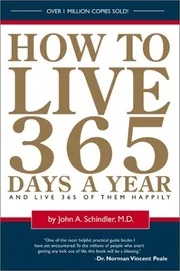
How to live 365 days a year
by John A. Schindler · 1954
It suits adult and older teen readers interested in health, habits and self-improvement.
222 pages, about 3.5 to 5 hours.
A 1950s doctor's plain-spoken guide to wellbeing across the whole year. 32% taste match
What it covers
How to Live 365 Days a Year is a work of popular self-help and health writing by John A. Schindler, first published in 1954. It belongs to the mid-twentieth-century tradition of physicians writing for general readers, and it draws on popular medicine and applied psychology to address how people can look after their wellbeing across the whole of the year rather than only in times of illness.
The book ranges across physical and mental health, touching on longevity, nutrition, and the connection between mind and body that psychosomatic medicine explores. It also turns to everyday practical concerns such as getting along with other people and the conduct of daily life, offering self-help techniques aimed at ordinary readers. Running to roughly 222 pages in its typical edition, it has appeared in around twenty editions since its first appearance. It opens by looking back across the vast span of human history, setting the individual life against the billions of people who have come before.
A great many people have lived on this earth since the human race began-billions and billions of them.
Themes
HealthLongevityMental healthPopular MedicinePsychosomatic MedicineRejuvenationNutritionSelf-help techniques
- Want to read 299
- Reading now 28
- Read 15
Most people shelving it are saving it for later.
Of 342 readers who put it on a shelf, 87% want to read it, 8% are reading it now, 4% have finished it and 0% stopped before the end.
By the numbers
- The median edition runs 222 pages. Counting about 275 words a page and an adult reading pace of 250 words a minute, that is about 4.1 hours of reading.
- Open Library tracks 20 editions from 12 publishers, the earliest dated 1954 and the latest 2004, across 4 languages.
- On reader demand it ranks in the top 5% of the classic books in our catalog (8,749 of them).
- Libraries shelve it under Dewey 131.3 and Library of Congress class RA-0790.00000000.S36 1954.
 BookWard’s take
A 1950s doctor's plain-spoken guide to wellbeing across the whole year
Schindler's 1954 book comes from the era when physicians wrote directly for ordinary readers, and it keeps its aims practical: look after body and mind every day, not only when ill. It opens by setting one life against the billions that came before, a better hook than most self-help manages. As a mid-century popular medicine book, it leans toward anecdote rather than the kind of evidence a modern health text would demand. It explains its ideas outright instead of dramatizing them, which suits a book of advice. The mind-body thread and the guidance on getting along with people still read as relevant, while the medical specifics belong to their moment. At 222 pages it stays short and focused.
At 222 pages it is compact and stays on its subject, which BookWard welcomes.
Mind-body health and getting along with others were familiar self-help themes even in 1954.
Popular medical writing for general readers favors plain, clear sentences over ornament.
There is no plot or cast to drive it, so the dial does not apply.
Its premise is that ordinary people can improve their health and daily life, which is an optimistic stance.
It is a serious health guide, not a comic one.
The subject is wellbeing, so the content stays gentle.
Its tone is calm and encouraging rather than intense.
See all 50 dialsEvery position, side by side with this book
Where it lines up
- LengthBookWard 1 · book 3
- PaceBookWard 8 · book 6
- Sagging middleBookWard 8 · book 6
Where it pulls apart
- Familiar tropesBookWard 10 · book 4
- Internal logicBookWard 10 · book 5
- ExpositionBookWard 2 · book 9
At 222 pages it is compact and stays on its subject, which BookWard welcomes.
Opening with the billions of people who came before gives it a reflective pull, though not an urgent one.
Self-help advice on health and daily conduct is well-worn ground, even if the physician's framing is its own.
Its mid-century medical reasoning holds together as a popular argument but would not meet today's standards of proof.
Mind-body health and getting along with others were familiar self-help themes even in 1954.
This is advice for readers, not a story with characters, so the dial does not apply.
A guide to living well has no plot to resolve, so the dial does not apply.
It leans toward encouragement over cold clinical detachment, a little warmer than BookWard prefers.
Nothing here relies on shock; it is calm, practical advice.
As popular medicine from the 1950s, it favors a physician's authority and general claims over rigorous evidence, short of BookWard's standard.
A doctor addressing ordinary readers directly gives it a personal, recognizable register.
The book is built from ideas and advice rather than narrative.
It tells readers outright what to do and why, with little shown in scene, which fits the form.
A short advice book of this size holds its focus from start to finish.
Popular medical writing for general readers favors plain, clear sentences over ornament.
There is no plot or cast to drive it, so the dial does not apply.
Its premise is that ordinary people can improve their health and daily life, which is an optimistic stance.
It is a serious health guide, not a comic one.
Written for general readers, it asks little of them.
A single physician's perspective runs through the whole book.
It moves forward through its topics, with only the opening glance back at human history.
Entirely grounded in health and daily life.
There is no cast, so the dial does not apply.
It opens on the span of human history but spends its pages on individual daily wellbeing.
With its attention on mind-body health and attitudes, it leans toward inner life over action.
Romance is not part of the book's subject.
The world is ordinary daily life, which is as familiar as settings get.
It dates from 1954 and reflects the mid-century outlook.
The mind-body and relationship themes endure, though the medical details are of their time.
The author speaks plainly in his own voice, with no unreliability.
It offers clear guidance on how to live rather than moral ambiguity.
Practical advice calls for little scene-setting or imagery.
A physician speaking directly to readers about their own lives is a personal stance.
It stands alone as a single volume.
A guide to wellbeing has no plot surprises.
It aims to encourage and reassure rather than unsettle.
The subject is wellbeing, so the content stays gentle.
Its tone is calm and encouraging rather than intense.
Humor is not a feature of the book, so the dial does not apply.
There is no violence in a health and conduct guide.
Sexual content is not part of its subject matter.
Health and personal conduct stay apart from politics.
Plain language aimed at general readers.
The physician-author's views and advice are the whole point of the book.
It aims at better living ahead, with the opening's look at history as a backdrop.
It believes ordinary people can live better, an idealistic premise.
Review written by BookWard, dial version 1, November 2026.
Who is How to live 365 days a year right for?
It suits adult and older teen readers interested in health, habits and self-improvement. Its medical advice reflects 1954 thinking and should not be treated as current guidance.
Written for general readers, it asks little of them.
The subject is wellbeing, so the content stays gentle.
Its tone is calm and encouraging rather than intense.
There is no violence in a health and conduct guide.
Book CompanionHow to live 365 days a year: ideas, characters, themes
Real wellbeing is built across every day of the year through attention to body, mind and relationships, not just in moments of illness.
- The long view of a life. The book opens by setting one life against the billions of people who have come before.
- Health all year round. Wellbeing is treated as a daily practice rather than something addressed only during sickness.
- Mind and body linked. It draws on psychosomatic medicine to connect mental state with physical health.
- Everyday practicalities. Nutrition, longevity and daily conduct are covered in a form meant for general readers.
- Getting along with others. It extends its self-help techniques to interpersonal relations as part of living well.
Themes
Health as a habit kept up across the whole year.
The idea that mental and physical health affect each other.
Living not just longer but better.
Practical choices about how to live and treat others.
A physician explaining health to general readers.
Discussion questions
- How does opening with the span of human history change the way you think about your own life?
- Which of the book's ideas about mind and body still feel convincing today?
- How do you weigh a 1950s physician's advice against current health guidance?
- Does treating wellbeing as a daily practice match how you actually live?
- How much of getting along with others is a technique, and how much is character?
Personalize your Book Companion
This is the general edition. In BookWard, the Companion is written for you: your reading profile, your notes, and spoiler-safe to the page you are on.
Buy, listen or borrow How to live 365 days a year
Each link opens a search for this book on that store, in a new tab.
Read on a device
Borrow
Reviews and community
If you liked How to live 365 days a year
Peale's faith-based playbook for swapping worry for confidence
Think and Grow RichNapoleon HillA 1937 success manual: 13 principles, big promises, thin proof
The Four AgreementsDon Miguel RuizFour short rules for living, delivered plainly and without padding
Attitude Is EverythingJeff KellerA short, upbeat twelve-lesson manual that trades rigor for encouragement
Sources: Open Library.
Track How to live 365 days a year and find your next favorite
Add it to your shelf, rate what you have read, and BookWard will recommend what fits you.
Free to start. No credit card needed.