Updated November 2, 2026 · reading data through October 2026
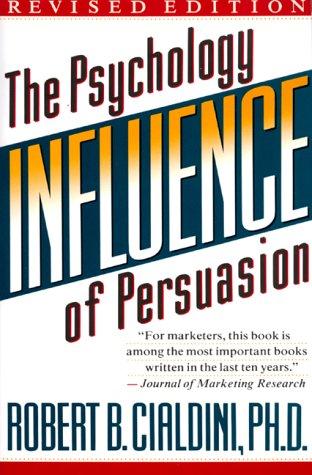
Influence
by Robert B. Cialdini
A social psychologist lays out the principles that make people say yes, from reciprocity to scarcity, with research and vivid examples. A staple for marketers and skeptics alike. Read the full description
Best for: Marketers, founders, and curious skeptics
Influence is #94 on BookWard's Top 100 books for November 2026, with a BookWard Score of 46 out of 100. It slipped 15 places from #79 last month.
BookWard review of Influence
4 of 5 stars 3.9 out of 5, from 73 reader ratings
BookWard rates Influence 3.9 out of 5. That is the average of 73 reader ratings on Open Library (3.95), adjusted toward the typical book so that a small number of ratings cannot inflate it. Beyond the rating, it is #94 on BookWard's Top 100 books; 1,548 readers want to read it, 139 are reading it right now and 91 have finished it.
How this rating works
BookWard’s rating is calculated, not hand-scored. We take the average rating readers have given the book on Open Library and adjust it toward the typical book: adjusted = (n × average + 25 × 3.8) ÷ (n + 25), where n is the number of ratings. A book needs at least 50 ratings to be rated. The rating reflects how readers received the book, not whether it is right for you. Your own ratings on your shelf are private and are not part of this number.
Influence: reading interest over the past 12 months
Sources: Open Library’s public reading-log and ratings data (dump of 2026-10-31), Wikipedia page views and Wikidata. Monthly counts are exact; they show relative interest among readers of these public sources, not total readership.
Ranked against the other books on this list, Influence’s reading interest has run from #65 to #99 over these 12 months. Interest rank blends shelf adds, Wikipedia page views and rating activity, each compared with the other 99 books that month.
Shelf adds by month
Influence was added to Open Library readers’ shelves 464 times in the past 12 months, peaking in October 2026 with 105 (172% above its monthly average of 39). Over the latest three months (Aug 2026 to Oct 2026) shelf adds were up 81% on the three months before. 91% of the adds were “want to read”, 6% “currently reading” and 3% “already read”.
Want to read Currently reading Already read
Wikipedia page views
Its Wikipedia article was viewed 28,943 times in the past 12 months, peaking in January 2026 with 2,951 views. The latest three months were up 4% on the three before.
Source: Wikimedia monthly page views for the article Influence: Science and Practice.
What the data says about Influence
- Uneven demand. Monthly shelf adds swung widely around an average of 39, so interest arrives in bursts and not as a steady stream.
- Busiest and quietest months. October 2026 was its busiest month (105 adds), about 11.7 times its quietest, December 2025 (9).
- Attention and shelf adds move independently. Its Wikipedia views and its shelf adds did not rise and fall together over these 12 months (correlation -0.36).
- Against its genre. It had 46% fewer shelf adds than the average Psychology book on this list.
- Share of the list. It accounts for 0.4% of all shelf adds recorded for the Top 100 over these 12 months, #80 of 100.
- Its age. First published in 1984 (42 years ago), it is older than 73% of the books on the list.
Each finding is computed from the public data above and shown only when the numbers support it.
Influence on the Top 100: rank history
| Month | Rank | Score |
|---|---|---|
| November 2026 | #94 | 46 |
| October 2026 | #79 | 53 |
| September 2026 | #72 | 55 |
Is Influence rising or falling?
Cooling It ranks lower this week than over the past year, so interest is softening from its recent level.
On Open Library, Influence ranks #131 this week, #81 this month, and #119 over the past year. A longer bar means a higher position. Comparing the three windows shows whether readers are arriving faster than the book's long-term pace. Readings as of 2026-11-02.
Why Influence made the Top 100
Influence made the list mainly on momentum (+21.1 points) and being read right now (+10.4 points). Its smallest contribution is rising (+1.3). The BookWard Score blends five public signals, each scored from 0 to 100 and weighted as shown.
The reading-now, rating and rank signals come from Open Library’s public data, not from BookWard’s own readers. The score measures reading interest, not quality or sales. How the score works.
Open Library reader stats for Influence
Source: Open Library public reading logs, as of 2026-11-02. BookWard’s own monthly snapshots are added to the picture, and anonymous BookWard reader data will be layered in as the community grows.
More readers have Influence open right now than 10% of the other books on this list. These counts come from one public source, so they show relative interest rather than total readership.
Where it sits among Psychology books
It is #7 of the 7 Psychology books on this month’s list.
About Influence
What it’s about
Robert B. Cialdini, a psychology professor at Arizona State University, explains why people say yes. His starting point is that in a world overloaded with information, we lean on mental shortcuts that usually let us act sensibly with little time or thought. Those same shortcuts can be turned into tools by anyone who understands them, which is where the so-called compliance professionals come in. Cialdini backs his points with studies from psychology, marketing, economics and anthropology, and he spent time working undercover in fields such as car sales to see these tactics up close. The most recent edition adds a seventh lever, unity. Readers in sales, marketing or management will find it useful, as will anyone who wants to notice when they are being nudged.
At a glance
- First published
- 1984
- Genre
- Psychology
- Length
- about 287 pages (the median across its editions)
- Original language
- English
- Languages
- editions in 2 languages listed on Open Library
- Editions
- 28 on Open Library
From Open Library and Wikidata public records. Missing rows mean the records do not list that fact.
Themes
- Reciprocity
- Social proof
- Persuasion
What reading it is like
Clear, research-based and full of examples.
At about 287 pages it is a medium-length read: roughly 6 hours at an average reading pace (about 250 words a minute, 300 words a page). Audiobook and edition lengths vary.
Good to know
Built around six principles of persuasion. Updated editions exist.
The premise
Psychologist Robert Cialdini describes six principles that make people say yes, such as reciprocity and social proof, and shows how to recognize and use them ethically.
What you’ll get
- Research-backed persuasion principles
- Memorable real-world examples
- Insights for marketers and consumers
You might skip it if you want a quick, light read.
Pairs well with: Thinking, Fast and Slow · How to Win Friends and Influence People
Keep exploring the chart
Also on the chart at #93 and #95
Questions about Influence
What rank is Influence on the Top 100 books?
Influence is #94 on BookWard's Top 100 books for November 2026, with a BookWard Score of 46 out of 100. It slipped 15 places from #79 last month.
Is Influence rising or falling?
Cooling. It ranks lower this week than over the past year, so interest is softening from its recent level. On Open Library, Influence ranks #131 this week, #81 this month, and #119 over the past year.
Why is Influence on the Top 100?
Influence made the list mainly on momentum (+21.1 points) and being read right now (+10.4 points). Its smallest contribution is rising (+1.3).
How many people are reading Influence right now?
Open Library's reading logs show 139 readers currently reading Influence, 1,548 who want to read it and 91 who have logged it as read (as of 2026-11-02). These are counts from one public source, not all readers.
How much interest has Influence had over the past year?
464 Open Library shelf adds in the past 12 months (peak October 2026, 105); latest three months up 81% on the prior three; 28,943 Wikipedia views in the past 12 months (up 4% over the latest three months). Figures come from Open Library and Wikipedia public data.
Who is Influence best for?
Marketers, founders, and curious skeptics.
Ask a question about Influence
Ask about this book's chart history, reading interest, or who it is for. Answers come from this page's data and can be wrong.
Answers are AI-written from BookWard’s own help content and can be wrong. Please do not share personal information: questions and answers may be saved and, if they are useful, shown on this site without your name.
How we know
This page is built from public data: Open Library’s dated reading-log and ratings dumps, Wikipedia page views, Wikidata, and BookWard’s own monthly Top 100 snapshots. The interest rank blends shelf adds (45%), Wikipedia page views (30%), rating activity (10%) and, for months where a snapshot exists, BookWard’s own score (15%), each as a percentile among the Top 100 books. Every month shown is real data; nothing is estimated. Rankings reflect reading interest, not quality or sales, and can be affected by data gaps. Last updated November 2026. Read the full methodology.
It suits teens and adults curious about psychology, sales or decision-making, and it is written in accessible language.
287 pages, about 4.5 to 6.5 hours.
Six levers of persuasion, laid out with evidence and field work. 53% taste match
 BookWard’s take
Six levers of persuasion, laid out with evidence and field work
Cialdini starts from the idea that overloaded people lean on mental shortcuts, and that those shortcuts can be turned against them. The book names the levers and backs each one with studies from psychology, marketing and economics, plus the author's own undercover stints in car sales and door-to-door selling. That fieldwork gives the argument real weight, and Cialdini's voice is distinctive and confident throughout. It is driven by ideas rather than stories, and it explains things outright instead of dramatizing them, which runs against my own taste for scenes. The opening is practical rather than gripping, and at 287 pages the length is moderate, though the structure of one lever per chapter keeps the middle from sagging. It has lasted well, because the mechanisms it describes have not gone out of date.
At 287 pages it is mid-sized for its subject, longer than BookWard's taste for tight books but not sprawling.
Turning compliance tactics into a set of named, evidence-backed principles was a fresh framing, and it still shapes how persuasion is discussed.
The writing is clear and plain, built to explain rather than decorate.
There is no plot or cast to drive it, so this dial does not apply.
It is neutral in outlook, warning about exploitation while also showing how to resist it.
A straightforward run of chapters, each devoted to one lever, is conventional by design.
The tone is serious and explanatory, with only occasional wry notes.
The subject is manipulation, but the treatment stays gentle and educational.
It engages the intellect far more than the emotions.
See all 50 dialsEvery position, side by side with this book
Where it lines up
- SentimentBookWard 8 · book 8
- Sagging middleBookWard 8 · book 8
- Shock for effectBookWard 9 · book 8
Where it pulls apart
- ExpositionBookWard 2 · book 9
- OpeningBookWard 10 · book 6
- Familiar tropesBookWard 10 · book 6
At 287 pages it is mid-sized for its subject, longer than BookWard's taste for tight books but not sprawling.
The self-improvement shelf is crowded, but organizing persuasion around a few named levers keeps it from reading as stock advice.
Each lever follows from the central claim that people rely on generalizations, so the argument holds together well.
Turning compliance tactics into a set of named, evidence-backed principles was a fresh framing, and it still shapes how persuasion is discussed.
It is a study of behavior rather than of individual characters, so this dial does not apply.
It treats manipulation analytically and does not wallow in feeling, matching BookWard's restraint.
Any unsettling effect comes from recognizing your own behavior, not from provocation, which BookWard respects.
Findings are backed by studies across psychology, marketing, economics and anthropology, plus the author's undercover work, which is strongly in BookWard's favor.
Cialdini writes as a researcher who went undercover himself, which gives the book a recognizable, authoritative voice.
It is built entirely around principles and their evidence, far from the story-led books BookWard leans toward.
It explains its concepts outright and then illustrates them, the opposite of BookWard's lean toward showing in scene.
A repeating structure of one lever per chapter keeps energy steady through the middle.
The writing is clear and plain, built to explain rather than decorate.
There is no plot or cast to drive it, so this dial does not apply.
It is neutral in outlook, warning about exploitation while also showing how to resist it.
A straightforward run of chapters, each devoted to one lever, is conventional by design.
The tone is serious and explanatory, with only occasional wry notes.
Accessible language and concrete examples make it an easy read for non-specialists.
It speaks in the single, consistent voice of the author.
It is organized by topic rather than by time, so it reads linearly.
It deals entirely with real people and documented behavior.
As a nonfiction argument it has no cast in the usual sense.
It concerns everyday decisions and encounters, though the principles apply widely.
It focuses on mental shortcuts and the inner triggers behind visible behavior.
It is mostly exposition and summary of studies rather than scenes of speech.
Romance plays no role in it.
It is set in ordinary buying, selling and social settings anyone recognizes.
First published in 1983, it is a past-era text, though revised editions have kept it current.
The shortcuts it describes are rooted in human behavior, so the book keeps its relevance across decades.
The author speaks plainly and directly as himself, with no unreliability.
It warns about exploitation while describing tactics neutrally, so its ethics are fairly clear but not preachy.
Description serves the examples and stays economical.
It blends case anecdotes with analysis, leaning a little toward the analytical side.
Cialdini draws on his own undercover experience, but the book remains mostly a research-driven argument.
It stands alone as a single book.
It offers insights rather than plot turns, so surprises are few.
It nudges readers to question their own habits without being harsh.
The subject is manipulation, but the treatment stays gentle and educational.
It engages the intellect far more than the emotions.
Where humor appears it is dry and understated.
There is essentially no violence on the page.
There is no sexual content.
Politics is peripheral to its psychological focus.
The language is plain and clear throughout.
Cialdini states clear views on how to recognize and resist persuasion tactics.
It balances insight from past research with practical advice for the future.
It is neither cynical nor idealistic, simply showing how things work and how to respond.
Review written by BookWard, dial version 1, November 2026.
Who is Influence right for?
It suits teens and adults curious about psychology, sales or decision-making, and it is written in accessible language. Nothing in it is graphic, though it discusses manipulative tactics that some readers may find uncomfortable.
Accessible language and concrete examples make it an easy read for non-specialists.
The subject is manipulation, but the treatment stays gentle and educational.
It engages the intellect far more than the emotions.
There is essentially no violence on the page.
Book CompanionInfluence: ideas, characters, themes
People facing too much information rely on mental shortcuts, and skilled persuaders can exploit those shortcuts to get a yes.
- Shortcuts are useful. Generalizations let people act correctly with limited time and thought, which is why they work so often.
- Shortcuts can be turned into weapons. Those who know the triggers can use them to push others toward particular actions.
- Levers of influence. The book organizes persuasion into a set of named principles, with a seventh on unity added in a recent edition.
- Evidence from the field. Findings are drawn from studies in psychology, marketing, economics, anthropology and social science.
- Undercover research. Cialdini worked undercover in fields such as car sales and door-to-door sales to see compliance tactics firsthand.
Characters
Robert B. Cialdini
Author and guide
A psychology professor at Arizona State University who draws on research and personal fieldwork to explain how compliance works.
Compliance professionals
The persuaders
Salespeople and others whose job is to win agreement, shown using the shortcuts the book describes.
Themes
How people are moved to agree or act.
The quick generalizations people use to decide under pressure.
The same knowledge can be used to manipulate or to resist manipulation.
Claims grounded in studies and field observation.
How ordinary choices in buying and social life are shaped.
Discussion questions
- Which of the levers have you noticed working on you in daily life?
- Is knowing these tactics enough to resist them?
- Where is the line between persuasion and manipulation?
- How does going undercover change the weight of the author's claims?
- Do these principles feel different now than when the book first appeared?
Personalize your Book Companion
This is the general edition. In BookWard, the Companion is written for you: your reading profile, your notes, and spoiler-safe to the page you are on.
Buy, listen or borrow Influence
Each link opens a search for this book on that store, in a new tab.
Read on a device
Borrow
Reviews and community
If you liked Influence
A lively case that autonomy, mastery and purpose beat carrots and sticks
Predictably IrrationalDan ArielyClever experiments that show how predictably we misjudge our own choices
What Every BODY Is SayingJoe NavarroA former FBI agent's field guide to reading body language
The millionaire next doorThomas J. StanleyA data-driven look at how ordinary Americans build wealth
Track Influence and find your next favorite
Add it to your shelf, rate what you have read, and BookWard will recommend what fits you.
Free to start. No credit card needed.