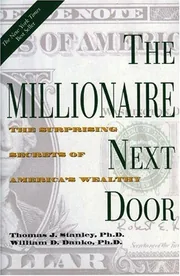
The millionaire next door
by Thomas J. Stanley, William D. Danko · 1996
Suited to adults and older teens interested in personal finance and how wealth is built.
258 pages, about 4 to 6 hours.
A data-driven look at how ordinary Americans build wealth. 50% taste match
What it covers
The Millionaire Next Door is a nonfiction work on personal finance and wealth in the United States, first published in 1996. Thomas J. Stanley wrote it with William D. Danko, and it brings together their research into the profiles of American millionaires. The book sits within business and money writing, touching on saving and investment, income, personal banking, and the economics of how fortunes are built.
The authors look at who the wealthy in America actually are and how they live, from the cars they drive and the places they shop to the way they invest and where their families came from. They set this against common assumptions about what makes people affluent, pointing instead to hard work, steady saving, and living below one's means. The book also considers why many well-educated, hard-working people with solid incomes never become wealthy themselves. It runs to roughly 258 pages and has appeared in 21 editions.
These people cannot be millionaires!
Setting
United StatesÉtats-Unis
Themes
Rich peopleMillionairesRichesseMillionnairesSaving and investmentRichesPersonal BankingEconomics
- Want to read 652
- Reading now 35
- Read 41
Most people shelving it are saving it for later.
Of 728 readers who put it on a shelf, 90% want to read it, 5% are reading it now, 6% have finished it and 0% stopped before the end.
By the numbers
- The median edition runs 258 pages. Counting about 275 words a page and an adult reading pace of 250 words a minute, that is about 4.7 hours of reading.
- Open Library tracks 21 editions from 15 publishers, the earliest dated 1996 and the latest 2020.
- On reader demand it ranks in the top 1% of the modern books in our catalog (15,152 of them).
- Libraries shelve it under Dewey 332.092273 and Library of Congress class HC-0110.00000000.W4 S73 1996b.
 BookWard’s take
A data-driven look at how ordinary Americans build wealth
The Millionaire Next Door is a compact piece of business writing that overturns a common picture of the rich. Stanley and Danko draw on their research into the profiles of American millionaires, and their answer to how fortunes get built is hard work, steady saving, and living below your means. It is driven by ideas rather than by story, and it rests firmly on collected research rather than anecdote. The authors explain their findings outright instead of dramatizing them. At around 258 pages it stays tight rather than sprawling, and it avoids feeling stale because its thesis contradicts popular assumptions about inheritance and degrees.
At roughly 258 pages it is a focused read, closer to tight than sprawling, which suits BookWard's preference for short books.
Findings arrive in steady, digestible chunks, a little slower than BookWard's brisk preference but never stalled.
Setting research on millionaires against popular assumptions was fresh in 1996, and the premise still holds up.
The writing is plain and workmanlike, aimed at clarity over ornament, a touch plainer than BookWard's middle ground.
There is no plot; the book is organized around patterns of behavior, so it sits far from the character-driven end BookWard favors.
The message that ordinary habits can build wealth is encouraging, which lines up with BookWard's hopeful lean.
It follows a conventional nonfiction layout of research findings and conclusions, with no formal experiments.
It is a serious, practical book with little humor, a bit drier than BookWard's lightly funny taste.
This is a gentle subject matter with no dark content.
The tone stays level and practical, not emotionally intense.
See all 50 dialsEvery position, side by side with this book
Where it lines up
- SentimentBookWard 8 · book 8
- Shock for effectBookWard 9 · book 9
- LengthBookWard 1 · book 3
Where it pulls apart
- ExpositionBookWard 2 · book 9
- Character depthBookWard 8 · book 2
- Story or ideasBookWard 3 · book 9
At roughly 258 pages it is a focused read, closer to tight than sprawling, which suits BookWard's preference for short books.
It opens on a string of direct questions about who the rich are, which pulls you in quickly, close to BookWard's taste.
Its central claim, that diligence and thrift beat inheritance and credentials, cuts against the usual picture of wealth.
The argument follows from the profiles it collects, with each claim about habits and spending building on the last.
Findings arrive in steady, digestible chunks, a little slower than BookWard's brisk preference but never stalled.
Setting research on millionaires against popular assumptions was fresh in 1996, and the premise still holds up.
The wealthy appear as profiles and patterns rather than fully drawn people, which sits below BookWard's love of depth.
A thesis-driven book closes by restating its conclusions, giving a resolved finish that fits BookWard's taste.
The tone is practical and matter-of-fact, with little sentimentality, which BookWard appreciates.
Its surprises are findings about frugality and habits, not provocation, so any jolt is earned by the research.
It is built on compiled research into millionaire profiles, giving it more weight than a purely anecdotal money book.
The authors write plainly and with a clear point of view, though the style is more functional than singular.
The book is driven by an argument about wealth, not a narrative, which is further toward ideas than BookWard usually likes.
Findings are stated and explained outright rather than shown in scene, well above BookWard's preference for showing.
The writing is plain and workmanlike, aimed at clarity over ornament, a touch plainer than BookWard's middle ground.
There is no plot; the book is organized around patterns of behavior, so it sits far from the character-driven end BookWard favors.
The message that ordinary habits can build wealth is encouraging, which lines up with BookWard's hopeful lean.
It follows a conventional nonfiction layout of research findings and conclusions, with no formal experiments.
It is a serious, practical book with little humor, a bit drier than BookWard's lightly funny taste.
The prose and concepts are accessible to a general reader, making it an easy read.
The authors speak with one consistent perspective throughout, so there is a single viewpoint.
The argument unfolds in a straightforward order, with no shifting timeline.
This is a grounded book about real money habits and real people in America.
There is no ensemble to track; the millionaires appear as profiles and groups, keeping the cast small.
It looks at individual households and habits, even as it speaks about wealth across a country, so it stays fairly intimate.
It focuses on observable behavior like spending, saving and investing more than on private thoughts.
This is an expository book with essentially no dialogue.
Romance plays no real part in a book about wealth and saving.
The setting is contemporary American life, so familiar to most readers.
Written in 1996, it reads as a late-twentieth-century snapshot but still addresses present-day money habits.
Its core advice about thrift and living below your means has outlasted the decade it was written in.
The authors report findings directly, so the narration is reliable and straightforward.
The book leans toward a clear message that discipline builds wealth, with limited ambiguity about its lessons.
Description is sparse and functional, used to illustrate habits rather than paint scenes.
It leans analytical, built around research and conclusions, though profiles of wealthy people add some narrative color.
The authors keep some distance as researchers, though they speak to the reader's own financial situation.
It stands alone as a single book.
The surprises are findings that overturn assumptions, offered at a moderate rate rather than as plot twists.
It asks readers to rethink spending and assumptions about wealth, which is mildly challenging rather than comforting.
This is a gentle subject matter with no dark content.
The tone stays level and practical, not emotionally intense.
Any humor is mild and dry, and it is not a funny book.
There is no violence on the page.
There is no sexual content.
It touches on economics and class but is not a political book at heart.
The language is plain and accessible throughout.
The authors argue a clear thesis, so the narration takes a definite stance.
It draws on observed behavior and past habits to explain wealth, looking back more than forward.
It holds out the idea that ordinary people can succeed through discipline, a modestly idealistic message.
Review written by BookWard, dial version 1, November 2026.
Who is The millionaire next door right for?
Suited to adults and older teens interested in personal finance and how wealth is built. It contains no graphic or sensitive content, though its discussion of money habits may prompt reflection on personal finances.
The prose and concepts are accessible to a general reader, making it an easy read.
This is a gentle subject matter with no dark content.
The tone stays level and practical, not emotionally intense.
There is no violence on the page.
Book CompanionThe millionaire next door: ideas, characters, themes
Wealth in America usually comes from hard work, steady saving, and living below your means rather than from inheritance, degrees, or high income alone.
- Who the wealthy really are. The authors profile American millionaires to show that the rich often look different from popular assumptions.
- Habits over inheritance. Fortunes are more often built through diligent saving and work than handed down.
- Living below your means. Spending less than you earn is presented as a central pattern among the wealthy.
- Income is not wealth. Many hard-working, well-educated, higher-income people never become affluent because of how they spend.
- Questioning assumptions. The book asks readers to test their beliefs about cars, shopping, investing, and what wealth looks like.
Themes
Careful spending and saving as the foundation of wealth.
The gap between what people earn and what they actually accumulate.
How popular images of the rich differ from the research findings.
Steady habits as a more reliable path than luck or inheritance.
How looking affluent can differ from being affluent.
Discussion questions
- Which assumptions about the wealthy did the book challenge for you?
- Why might high income not translate into wealth?
- How does living below your means look in practice?
- Does the book's advice depend on when and where it was written?
- What would you change in your own habits after reading it?
Personalize your Book Companion
This is the general edition. In BookWard, the Companion is written for you: your reading profile, your notes, and spoiler-safe to the page you are on.
Buy, listen or borrow The millionaire next door
Each link opens a search for this book on that store, in a new tab.
Read on a device
Borrow
Reviews and community
If you liked The millionaire next door
Six levers of persuasion, laid out with evidence and field work
ContagiousJonah BergerA practical, story-rich guide to why ideas spread
What Every BODY Is SayingJoe NavarroA former FBI agent's field guide to reading body language
Getting Things DoneDavid AllenA practical system for getting your head clear and your work moving
Sources: Open Library.
Track The millionaire next door and find your next favorite
Add it to your shelf, rate what you have read, and BookWard will recommend what fits you.
Free to start. No credit card needed.