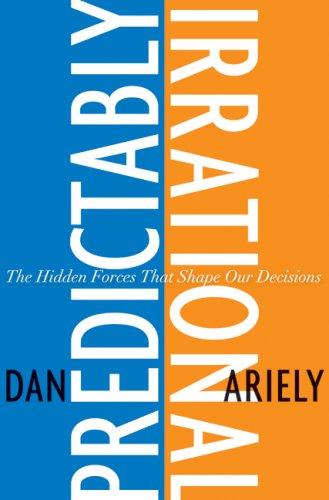
Predictably Irrational
by Dan Ariely
★ Top 25 book of 2008 · #14 on Best Books of 2008
Behavioral economist Dan Ariely uses clever experiments to show how expectations, emotions and social norms skew our reasoning. This revised edition applies those insights to money decisions and the 2008 financial crisis, arguing our mistakes are systematic and predictable.
Best for: Readers curious why people make irrational money decisions and economic mistakes
Predictably Irrational is #14 on BookWard's Best Books of 2008, out of 46 2008 books that cleared our data bar.
What Predictably Irrational is about
Dan Ariely, a behavioral economist at Duke University, challenges the comfortable idea that we make decisions by thinking rationally. Through a wide range of experiments, findings, and often amusing anecdotes, he shows that expectations, emotions, social norms, and other invisible forces bend our reasoning. His central point is that our mistakes are not random. They are systematic and repeat again and again, and seeing the pattern can help us avoid some of them.
The revised and expanded edition applies this thinking to the 2008 financial meltdown, asking why bankers lost sight of the economy and why individuals took on mortgages they could not afford. Ariely also warns that basing policy on standard economic theory may be dangerous. Witty and accessible, the book will suit anyone curious about why they and the people around them behave as they do, from shoppers and managers to anyone who has wondered about a bad decision.
Predictably Irrational on the Best Books of 2008
Predictably Irrational came out in 2008. Of the 46 books first published in 2008 that met BookWard's data bar, it ranks #14 on our Best Books of 2008 list.
Why it made the list: 300 readers have shelved it on Open Library; readers rate it 4.2 out of 5 (13 ratings); 20 are reading it right now. The list ranks each year’s books on how many readers have picked them up, how highly readers rate them, and how many are reading them right now.
Nearby on the 2008 list
- What Every BODY Is Saying Joe Navarro, #12
- In Defense of Food Michael Pollan, #13
- The Knife of Never Letting Go Patrick Ness, #15
- The Tales of Beedle the Bard J. K. Rowling, #16
See all Best Books of 2008 Best books by year
More years: Best Books of 2007 Best Books of 2009.
The numbers behind it
- Readers: 247 want to read it, 20 are reading it now and 33 have read it, according to Open Library.
- Ratings: 4.2 out of 5 from 13 Open Library ratings.
| Signal | This book (0 to 100) | Weight |
|---|---|---|
| Reach | 61 | 55% |
| Reader love | 50 | 25% |
| Being read right now | 74 | 20% |
Questions about Predictably Irrational
When was Predictably Irrational published?
Predictably Irrational by Dan Ariely was first published in 2008.
Was Predictably Irrational one of the best books of 2008?
Predictably Irrational is #14 on BookWard's Best Books of 2008, out of 46 2008 books that cleared our data bar. 300 readers have shelved it on Open Library; readers rate it 4.2 out of 5 (13 ratings); 20 are reading it right now.
Why is Predictably Irrational on the Best Books of 2008 list?
300 readers have shelved it on Open Library; readers rate it 4.2 out of 5 (13 ratings); 20 are reading it right now.
More of the best books of 2008
- The Hunger Games Suzanne Collins, #1
- End of Days Sylvia Browne, #2
- The Last Straw Jeff Kinney, #3
- Amulet Kazu Kibuishi, #4
- Outliers Malcolm Gladwell, #5
- Michelle Obama in Her Own Words Michelle Obama, #6
See the full Best Books of 2008, the Top 100, or new books on Rising.
How we know
This page uses public data: Open Library reader counts and ratings, and Wikipedia page views for recent years. The description is paraphrased from real source text. Rankings reflect reading interest, not quality or sales, and can be affected by data gaps. Lists update monthly.
Suited to curious teens and adults, with no special background needed.
Depends on the edition you pick.
Clever experiments that show how predictably we misjudge our own choices. 51% taste match
 BookWard’s take
Clever experiments that show how predictably we misjudge our own choices
Dan Ariely builds each chapter around an experiment you can picture, then uses it to show that our decision errors follow patterns instead of being random. That structure makes for a strong opening: you meet a puzzle in the first pages and want the answer. The book is firmly driven by ideas rather than story, which cuts against my own usual preference, but the ideas arrive through anecdote and scene, so the explaining feels lighter than you might expect. The rigor is fairly high. The studies are real and described concretely, though the book trades some depth for readability. Ariely's voice is chatty and personal, and he often draws on his own experiences. The pace is brisk, and because the chapters are self-contained, the middle does not sag.
A moderate, chapter-by-chapter read that stays well short of sprawling, which suits BookWard's preference for tight books.
Short, self-contained chapters keep things moving, close to the brisk pace BookWard favors.
Ariely's experiments and framing felt fresh for a general audience, though the field has since become well trodden.
Plain, clear, conversational prose that puts the idea first, close to BookWard's slightly plain preference.
There is no plot; the book is organized around concepts rather than characters or events.
The tone is constructive, suggesting that understanding our biases can help us do better.
A conventional run of themed chapters, each built on the same experiment-then-lesson pattern.
Amusing anecdotes and playful experiments lighten the tone, though it remains an informative book first.
A light, benign tone, even when discussing costly mistakes.
Curious and wry rather than emotionally intense.
See all 50 dialsEvery position, side by side with this book
Where it lines up
- PaceBookWard 8 · book 7
- Authorial voiceBookWard 9 · book 8
- Sagging middleBookWard 8 · book 7
Where it pulls apart
- Familiar tropesBookWard 10 · book 6
- Character depthBookWard 8 · book 2
- Story or ideasBookWard 3 · book 9
A moderate, chapter-by-chapter read that stays well short of sprawling, which suits BookWard's preference for tight books.
Each chapter opens with a puzzle or experiment that pulls you in quickly, a good match for BookWard's taste for immediate hooks.
Behavioral economics popularizing has well-worn conventions, so the packaging is familiar even when individual findings surprise.
Claims follow from described experiments, though the leap from lab results to everyday life is sometimes generous.
Short, self-contained chapters keep things moving, close to the brisk pace BookWard favors.
Ariely's experiments and framing felt fresh for a general audience, though the field has since become well trodden.
There are no developed characters; people appear as subjects and anecdote, which is fine for this kind of book.
Warm and conversational but not mawkish, sitting a little more sentimental than BookWard's restrained taste.
Findings are sometimes startling, but they serve the argument rather than shock for its own sake.
Built on real experiments, but written for a broad audience, so it is less exacting than a strict academic treatment.
Ariely's personal, curious, self-deprecating voice is distinctive and carries much of the book's appeal.
Ideas drive everything here, with each chapter built around a concept rather than a plot, far from BookWard's story-led lean.
Concepts are explained outright, but usually after a concrete experiment, so it is less lecture-like than many idea books.
Self-contained chapters with fresh experiments keep energy steady, so there is no real middle slump.
Plain, clear, conversational prose that puts the idea first, close to BookWard's slightly plain preference.
There is no plot; the book is organized around concepts rather than characters or events.
The tone is constructive, suggesting that understanding our biases can help us do better.
A conventional run of themed chapters, each built on the same experiment-then-lesson pattern.
Amusing anecdotes and playful experiments lighten the tone, though it remains an informative book first.
Accessible and easy to read, requiring no background in economics or psychology.
A single authorial perspective guides the whole book.
Told in a straightforward sequence with no timeline games.
Entirely grounded in real-world experiments and everyday decisions.
Few recurring figures beyond the author; experiment subjects stay mostly anonymous.
Focused on individual choices, with some reach into markets and policy.
Mostly about the mind and how we reason, not action.
Dialogue is minimal; the text is mainly explanation and experiment description.
Romance is barely present beyond occasional examples about dating or relationships.
The setting is everyday life, shopping, work and relationships, which will feel familiar.
Rooted in the late 2000s but concerned with present-day habits and choices.
Human biases endure, though some examples and framing date the book to its period.
Ariely narrates plainly and reliably, reporting his own work and experiences.
It is not a moral tale; it aims to describe behavior, with only light normative nudges.
Description is functional, setting up experiments and examples rather than painting scenes.
A blend of storytelling and analysis, leaning slightly narrative through anecdote.
Ariely's own experiences and curiosity are woven in, making it feel personal rather than detached.
A standalone work, though the author wrote follow-ups.
Counterintuitive results work as small surprises throughout.
It gently challenges your belief in your own rationality without being heavy.
A light, benign tone, even when discussing costly mistakes.
Curious and wry rather than emotionally intense.
The humor is gentle and observational, mostly dry with some playful moments.
Essentially absent.
Little to none, apart from a limited discussion of arousal's effect on choices.
Touches on economic policy and markets but is not a political book.
Clear, plain language throughout.
Ariely offers clear opinions and conclusions, though grounded in his experiments.
Aimed at helping readers make better decisions going forward.
Cautiously optimistic that awareness can improve our choices.
Review written by BookWard, dial version 1, November 2026.
Who is Predictably Irrational right for?
Suited to curious teens and adults, with no special background needed. Content is mild, with only brief mention of topics like arousal and dishonesty in the context of experiments.
Accessible and easy to read, requiring no background in economics or psychology.
A light, benign tone, even when discussing costly mistakes.
Curious and wry rather than emotionally intense.
Essentially absent.
Book CompanionPredictably Irrational: ideas, characters, themes
Our decisions depart from rationality in systematic, predictable ways, and understanding those patterns can help us choose better.
- Irrationality is systematic. Ariely argues that our mistakes follow consistent patterns instead of being random noise.
- Experiments over theory. The book relies on clever, often amusing experiments to test assumptions of standard economics.
- Everyday relevance. Examples span money, relationships and daily choices, so the findings feel close to home.
- Economic stakes. The expanded edition links these decision errors to the 2008 financial crisis and to policy.
- Learning to avoid mistakes. Seeing how our errors repeat is presented as the first step toward avoiding some of them.
Themes
How far people actually live up to the idea of the rational decision-maker.
The hidden forces, such as expectations and emotions, that steer our choices.
How we think about prices, worth and spending, often inconsistently.
The unwritten rules that influence behavior alongside market logic.
Knowing our own biases as a route to better choices.
Discussion questions
- Which of the book's experiments felt most true to your own behavior?
- Does knowing we are predictably irrational change how you would make a big decision?
- How much should policy and institutions account for these human tendencies?
- Where might lab experiments fail to capture real-world decision-making?
- Which everyday habit would you most like to change after reading this?
Personalize your Book Companion
This is the general edition. In BookWard, the Companion is written for you: your reading profile, your notes, and spoiler-safe to the page you are on.
Buy, listen or borrow Predictably Irrational
Each link opens a search for this book on that store, in a new tab.
Read on a device
Borrow
Reviews and community
If you liked Predictably Irrational
A lively case that autonomy, mastery and purpose beat carrots and sticks
InfluenceRobert B. CialdiniSix levers of persuasion, laid out with evidence and field work
Think AgainAdam GrantA cheerful, idea-led case for doubting yourself on purpose
Four Thousand WeeksOliver BurkemanA philosophical case for giving up on getting everything done
Find your own best books
Add what you have read, rate it, and BookWard will recommend what to read next.
Free to start. No credit card needed.