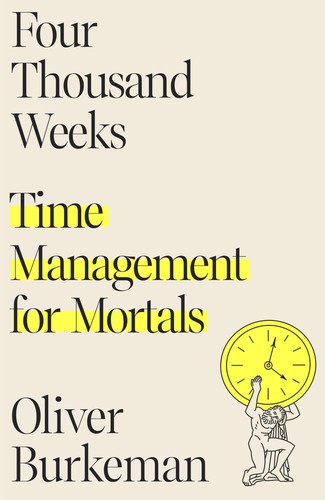
Four Thousand Weeks
by Oliver Burkeman
★ Top 25 book of 2021 · #24 on Best Books of 2021
Burkeman starts from the fact that a life of eighty years lasts only about four thousand weeks. He rejects the urge to get everything done and offers a more realistic way to approach time and build a meaningful life.
Best for: Overwhelmed people tired of to-do lists who want a more realistic view of time
Four Thousand Weeks is #24 on BookWard's Best Books of 2021, out of 60 2021 books that cleared our data bar.
What Four Thousand Weeks is about
If you live to 80, you get roughly four thousand weeks. Oliver Burkeman starts from that sobering number and asks how we might spend them well. He looks at our overflowing to-do lists, crowded inboxes, constant distraction and shrinking attention spans, and argues they trouble us because they are symptoms of a deeper problem: what to do with a short life.
His answer rejects the modern urge to get everything done. He points out that our unhelpful habits of thinking about time are choices made by individuals and by society, not fixed truths, which means they can be changed. Drawing on philosophers, psychologists and spiritual teachers, old and new, he offers tools for building a meaningful life. The tone is reflective and wry. It will suit anyone who feels permanently behind and wants a kinder way to think about time.
Four Thousand Weeks on the Best Books of 2021
Four Thousand Weeks came out in 2021. Of the 60 books first published in 2021 that met BookWard's data bar, it ranks #24 on our Best Books of 2021 list.
Why it made the list: 343 readers have shelved it on Open Library; readers rate it 4.3 out of 5 (20 ratings). The list ranks each year’s books on how many readers have picked them up, how highly readers rate them, and how many are reading them right now.
Nearby on the 2021 list
- She Drives Me Crazy Kelly Quindlen, #22
- The Things We Leave Unfinished Rebecca Yarros, #23
- People We Meet on Vacation Emily Henry, #25
See all Best Books of 2021 Best books by year
More years: Best Books of 2020 Best Books of 2022.
The numbers behind it
- Readers: 299 want to read it, 10 are reading it now and 34 have read it, according to Open Library.
- Ratings: 4.3 out of 5 from 20 Open Library ratings.
| Signal | This book (0 to 100) | Weight |
|---|---|---|
| Reach | 50 | 55% |
| Reader love | 87 | 25% |
| Being read right now | 40 | 20% |
Questions about Four Thousand Weeks
When was Four Thousand Weeks published?
Four Thousand Weeks by Oliver Burkeman was first published in 2021.
Was Four Thousand Weeks one of the best books of 2021?
Four Thousand Weeks is #24 on BookWard's Best Books of 2021, out of 60 2021 books that cleared our data bar. 343 readers have shelved it on Open Library; readers rate it 4.3 out of 5 (20 ratings).
Why is Four Thousand Weeks on the Best Books of 2021 list?
343 readers have shelved it on Open Library; readers rate it 4.3 out of 5 (20 ratings).
More of the best books of 2021
- The Love Hypothesis Ali Hazelwood, #1
- Twisted Games Ana Huang, #2
- Project Hail Mary Andy Weir, #3
- As Good as Dead Holly Jackson, #4
- You've Reached Sam Dustin Thao, #5
- Twisted Love Ana Huang, #6
See the full Best Books of 2021, the Top 100, or new books on Rising.
How we know
This page uses public data: Open Library reader counts and ratings, and Wikipedia page views for recent years. The description is paraphrased from real source text. Rankings reflect reading interest, not quality or sales, and can be affected by data gaps. Lists update monthly.
It suits adult readers and thoughtful older teens interested in work, time, and meaning.
Depends on the edition you pick.
A philosophical case for giving up on getting everything done. 60% taste match
 BookWard’s take
A philosophical case for giving up on getting everything done
Oliver Burkeman opens with a startling piece of arithmetic: a long life comes to roughly four thousand weeks. From there he argues that our obsession with productivity is the problem, not the cure. This is a book driven by ideas rather than story, and it earns its arguments by drawing steadily on philosophers, psychologists and spiritual teachers instead of leaning on stray anecdote. The voice is distinctive: wry, candid, and willing to say uncomfortable things plainly. The outlook is hopeful without turning sentimental. It also feels fresh, because Burkeman rejects the standard self-help promise of fitting more in. The reading is moderately demanding; the ideas are weighty, but the writing is clear. The opening hooks at once on that brutal number.
A focused, moderately sized argument that stays on one question rather than sprawling, which suits a taste for tight books.
Drawing on philosophy to reject time-management orthodoxy gives it a fresh angle, even if some ideas are borrowed from older thinkers.
The writing is clear and conversational with occasional elegant turns, plain rather than ornate.
There is no plot or character arc to speak of, so this dial does not apply.
It is realistic about limits but ultimately offers relief and a more livable way to spend your time.
The book follows a conventional chapter-by-chapter argument without formal experiments.
There is gentle wit and wry observation, but the book stays mostly thoughtful and earnest.
Mortality is the starting point, but the tone stays calm and consoling rather than grim.
There is quiet emotional weight in confronting a finite life, handled with composure.
See all 50 dialsEvery position, side by side with this book
Where it lines up
- Authorial voiceBookWard 9 · book 9
- OpeningBookWard 10 · book 9
- EndingBookWard 8 · book 7
Where it pulls apart
- Story or ideasBookWard 3 · book 9
- ExpositionBookWard 2 · book 8
- LengthBookWard 1 · book 4
A focused, moderately sized argument that stays on one question rather than sprawling, which suits a taste for tight books.
It opens on the stark fact of a human life being about four thousand weeks, which grabs attention immediately.
It pushes against the usual productivity-book promise of doing more, which keeps it clear of the genre's stock moves.
The argument builds step by step from its central premise about limited time, with each idea following from the last.
Drawing on philosophy to reject time-management orthodoxy gives it a fresh angle, even if some ideas are borrowed from older thinkers.
This is an argument-driven book with no cast to draw, so character depth does not apply.
It closes by gathering its themes into practical, settled conclusions rather than leaving the question dangling.
It touches mortality and meaning with warmth but keeps a dry, clear-eyed tone instead of tugging at feelings.
The book is not built on shock; its bluntness about death serves the argument rather than seeking effect.
It leans on named philosophical and psychological sources rather than loose anecdote, though it stays popular rather than academic.
Burkeman's candid, self-deprecating, quietly witty voice is unmistakable and carries the whole book.
Ideas drive everything here; examples exist to illustrate an argument about time, not to tell a story.
The author states his points outright and explains them, which is the natural mode for an argument book.
Its central thesis keeps returning in fresh forms, so momentum holds across the whole book.
The writing is clear and conversational with occasional elegant turns, plain rather than ornate.
There is no plot or character arc to speak of, so this dial does not apply.
It is realistic about limits but ultimately offers relief and a more livable way to spend your time.
The book follows a conventional chapter-by-chapter argument without formal experiments.
There is gentle wit and wry observation, but the book stays mostly thoughtful and earnest.
The concepts are weighty, yet the clear prose keeps it accessible to any attentive reader.
It draws on many thinkers across eras, though the framing stays with a single authorial perspective.
The argument progresses in a straight line without jumping around in time.
Fully grounded in everyday life, work, and the real experience of time.
There is no cast in the fiction sense; occasional thinkers and examples appear only to support the argument.
It is intimate in focus, concerned with the shape of one ordinary life and its days.
The book dwells on attitudes, habits, and how we think about time rather than on action.
Argument and exposition replace dialogue; speech is scarce on the page.
Romance is not a concern of this book.
The setting is the reader's own familiar world of inboxes, to-do lists, and busy schedules.
It speaks directly to modern life, including distraction, email, and constant connectivity.
Its roots in ancient and modern philosophy suggest the core questions will stay relevant.
The author speaks plainly in his own voice, so there is no unreliable narration.
It argues for a particular stance on time but acknowledges trade-offs rather than preaching absolutes.
The prose favors ideas and examples over scenic or sensory description.
It mixes a clear analytical argument with a conversational, story-adjacent flow rather than pure analysis.
Burkeman writes openly about his own struggles with time, so the perspective is close and personal.
It stands on its own as a complete book.
The surprises are reframings of familiar assumptions rather than plot turns.
It asks readers to give up the dream of getting everything done, which is a real challenge to habit.
Mortality is the starting point, but the tone stays calm and consoling rather than grim.
There is quiet emotional weight in confronting a finite life, handled with composure.
Where humor appears, it is dry and understated rather than broad.
There is essentially no violence on the page.
There is no sexual content.
It touches on society's attitudes toward work and time but is not a political book.
The language is plain and contemporary, with no dense or dialect-heavy passages.
The author argues a clear position and says so openly throughout.
It reflects on how we got here while pointing toward a more sustainable way of living ahead.
It is realistic about limits, yet leans toward a hopeful vision of a more meaningful life.
Review written by BookWard, dial version 1, November 2026.
Who is Four Thousand Weeks right for?
It suits adult readers and thoughtful older teens interested in work, time, and meaning. It deals with mortality in a calm, reflective way, which may resonate more strongly with readers facing loss or burnout.
The concepts are weighty, yet the clear prose keeps it accessible to any attentive reader.
Mortality is the starting point, but the tone stays calm and consoling rather than grim.
There is quiet emotional weight in confronting a finite life, handled with composure.
There is essentially no violence on the page.
Book CompanionFour Thousand Weeks: ideas, characters, themes
Because a life is only about four thousand weeks, chasing the fantasy of getting everything done is a mistake; a meaningful life comes from accepting limits and choosing what matters.
- Life is brief. The book begins with the arithmetic of roughly four thousand weeks to reframe how we think about time.
- Productivity is a trap. The drive to clear our to-do lists can crowd out the things that give life meaning.
- Our view of time is a choice. The unhelpful ways we think about time are not fixed truths but habits shaped by individuals and society.
- Limits can liberate. Accepting that we cannot do everything frees us to focus on what is worth doing.
- Wisdom from many traditions. Burkeman draws on philosophers, psychologists, and spiritual teachers to build tools for a meaningful life.
Themes
Facing the shortness of life as a starting point for how to live.
Questioning the modern obsession with getting everything done.
What we choose to focus on shapes the life we actually live.
Building a life that matters rather than a life that is merely efficient.
Making peace with limits instead of fighting them.
Discussion questions
- How does thinking of life as four thousand weeks change how you view your own week?
- Where do you feel the pull of getting everything done, and what does it cost you?
- Is the way we think about time truly a choice, or are we stuck with it?
- What would you let go of if you accepted that you cannot do it all?
- Which of the philosophical ideas in the book felt most useful to you, and why?
Personalize your Book Companion
This is the general edition. In BookWard, the Companion is written for you: your reading profile, your notes, and spoiler-safe to the page you are on.
Buy, listen or borrow Four Thousand Weeks
Each link opens a search for this book on that store, in a new tab.
Read on a device
Borrow
Reviews and community
If you liked Four Thousand Weeks
Ancient wisdom on happiness, tested against modern psychology, by Jonathan Haidt
DriveDaniel H. PinkA lively case that autonomy, mastery and purpose beat carrots and sticks
How to Do NothingJenny OdellA sharp, idea-led case for reclaiming your attention
Predictably IrrationalDan ArielyClever experiments that show how predictably we misjudge our own choices
Find your own best books
Add what you have read, rate it, and BookWard will recommend what to read next.
Free to start. No credit card needed.