Best for adult and older teen readers who enjoy reflective, idea-driven nonfiction.
256 pages, about 4 to 6 hours.
A sharp, idea-led case for reclaiming your attention. 52% taste match
What it covers
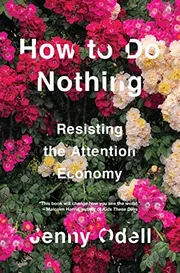
How to Do Nothing is a work of nonfiction by Jenny Odell, first published in 2019. Odell is an artist and critic, and the book sits at the meeting point of philosophy, technology, art, and environmental thought. It takes up the attention economy and asks how people spend their focus in a world shaped by digital platforms and constant online activity. Its subjects include the social side of information technology, the nature of work, and the idea of resistance, along with reflection as a practice. Internet art and digital art also figure in its discussion.
The book is set largely in the San Francisco Bay Area, with Oakland and San Jose among the places it draws on, and its frame of reference runs across the years from 1990 to 2020. Odell describes it as a field guide to doing nothing, in the sense that capitalism defines it, and proposes that redirecting attention can open the way to political action, a different relationship with the natural environment, and new ideas about happiness and progress. It runs to roughly 256 pages and has appeared in 13 editions.
Nothing is harder to do than nothing.
Setting
San FranciscoOaklandSan JoseBay Area
Period
1990-2020
Themes
Information technologySocial aspectsReflection (Philosophy)AttentionPhilosophyWorkArtsART / Digital
- Want to read 129
- Reading now 3
- Read 30
Most people shelving it are saving it for later.
Of 162 readers who put it on a shelf, 80% want to read it, 2% are reading it now, 19% have finished it and 0% stopped before the end.
By the numbers
- The median edition runs 256 pages. Counting about 275 words a page and an adult reading pace of 250 words a minute, that is about 4.7 hours of reading.
- Open Library tracks 13 editions from 9 publishers, the earliest dated 2019 and the latest 2021.
- On reader demand it ranks in the top 5% of the recent books in our catalog (6,647 of them).
- Libraries shelve it under Dewey 303.48 and Library of Congress class HM-0851.00000000.O374 2019.
 BookWard’s take
A sharp, idea-led case for reclaiming your attention
Jenny Odell's 2019 book argues that attention is our most precious and overdrawn resource, and that spending it differently opens the way to political action and a new relationship with the natural environment. It is driven by ideas rather than story, and the Bay Area setting gives the argument ground to stand on. The thinking is serious and the voice is distinctively her own, an artist's rather than a pundit's. It is no simple anti-technology screed, which is where its originality shows. My reservations are about method and tempo. The book explains its ideas outright rather than dramatizing them, and its pace is reflective rather than brisk, which may test readers who want momentum. Still, a thoughtful read for anyone who feels worn down by their feeds.
At roughly 256 pages it is moderate in size, longer than a pamphlet but well short of sprawling, which suits BookWard's liking for tight books.
Reflective and essayistic, it moves at a considered pace that runs slower than BookWard prefers.
Treating doing nothing as a form of resistance is a distinctive angle, and BookWard rewards that kind of fresh framing.
Thoughtful and well-made without being showy, the prose is a touch more literary than plain, close to BookWard's middle.
It has no plot or characters to drive it, so this dial does not apply.
It argues that redirecting attention can open real possibility, which gives it a hopeful lean that matches BookWard.
It moves through linked essays on a theme rather than a straight run, a mild departure from convention.
The tone is thoughtful and earnest, with little comedy, which is a touch more serious than BookWard's leaning.
The subject is serious but the treatment is gentle, with little that is dark.
The feeling is measured and reflective rather than intense, which fits BookWard's restraint.
See all 50 dialsEvery position, side by side with this book
Where it lines up
- Shock for effectBookWard 9 · book 9
- Authorial voiceBookWard 9 · book 9
- OriginalityBookWard 9 · book 8
Where it pulls apart
- OpeningBookWard 10 · book 6
- Story or ideasBookWard 3 · book 9
- ExpositionBookWard 2 · book 8
At roughly 256 pages it is moderate in size, longer than a pamphlet but well short of sprawling, which suits BookWard's liking for tight books.
It opens with an argument rather than a scene, so the pull is intellectual and builds gradually, a little gentler than BookWard's taste for an instant hook.
It sidesteps the usual back-to-nature meditation and anti-technology rant, which is exactly the freshness BookWard looks for.
Its case builds step by step from attention to action, which holds together well, though it is an essayist's argument rather than a proof.
Reflective and essayistic, it moves at a considered pace that runs slower than BookWard prefers.
Treating doing nothing as a form of resistance is a distinctive angle, and BookWard rewards that kind of fresh framing.
This is nonfiction without a cast of characters to draw, so the dial does not apply.
It closes on an action plan and a call to attend differently rather than a neat resolution, so it lands part way to BookWard's fondness for full closure.
It leans reflective and earnest rather than sugary, with some warmth toward its subject, a little more tender than BookWard's restraint.
It persuades through argument and observation, never shock, which fits BookWard's dislike of darkness used for effect.
It draws on philosophy, art and environmental thought with real seriousness, though as an essay it reads more argued than data-driven.
Odell writes as an artist and critic with her own angle, and the voice is unmistakably hers, which BookWard values highly.
Ideas carry the book from start to finish, with the Bay Area as a lived setting rather than a plot, which is further toward ideas than BookWard usually goes.
It lays out its thinking directly, which suits an argument but runs well past BookWard's preference for showing in scene.
A book of linked essays keeps its thread, though the reflective stretches can drift slightly in the middle.
Thoughtful and well-made without being showy, the prose is a touch more literary than plain, close to BookWard's middle.
It has no plot or characters to drive it, so this dial does not apply.
It argues that redirecting attention can open real possibility, which gives it a hopeful lean that matches BookWard.
It moves through linked essays on a theme rather than a straight run, a mild departure from convention.
The tone is thoughtful and earnest, with little comedy, which is a touch more serious than BookWard's leaning.
It asks for attention to ideas from philosophy and art, which makes it a little more demanding than BookWard's usual pick.
One author's voice leads, though it brings in thinkers and artists along the way, which gives it a modest range.
The argument moves between the present and earlier ideas without being strictly chronological.
It is entirely grounded in real places and real life, with nothing fantastical.
As an essay-driven nonfiction work, it has no cast to size up.
It stays close to personal attention and local places while gesturing at larger systems, so it is more intimate than epic.
The book dwells on attention, reflection and thought far more than on action.
As an essayistic work it uses almost no dialogue, which sits below BookWard's liking for it.
Romance plays no part in this book.
The Bay Area and everyday digital life make for a familiar setting, which is more recognizable than BookWard's taste for the unfamiliar.
It speaks directly to the attention economy and the years from 1990 to 2020, so it is firmly of the present day.
Its questions about attention should outlast the specific platforms it discusses, though some references are tied to its moment.
The author speaks plainly in her own voice, so this is a reliable narrator by nature.
It takes a clear stance on how we spend attention, though it leaves room for readers to find their own way.
It describes places and artworks with care, which gives it more richness than a purely abstract argument.
It blends personal anecdote with analysis, leaning a little toward the analytical.
Odell writes from her own experience and place, which makes it more personal than detached.
It stands alone as a single book.
It is an argument, so there is little in the way of twists.
It asks readers to rethink how they spend their time, which is a gentle but real challenge to habit.
The subject is serious but the treatment is gentle, with little that is dark.
The feeling is measured and reflective rather than intense, which fits BookWard's restraint.
What humor appears is dry rather than broad.
There is no violence on the page.
There is no sexual content.
It treats attention as a political resource and argues for resistance, so politics is a strong thread though not a party-political one.
The language is plain enough, with some critical and philosophical vocabulary.
It argues a position openly and in the first person, so it is far from neutral.
It looks forward to different ways of attending and acting, while drawing on earlier thinkers.
It believes things can be done differently, which makes it more idealistic than cynical.
Review written by BookWard, dial version 1, November 2026.
Who is How to Do Nothing right for?
Best for adult and older teen readers who enjoy reflective, idea-driven nonfiction. It contains no graphic or sensitive material, though it does engage with political and economic criticism.
It asks for attention to ideas from philosophy and art, which makes it a little more demanding than BookWard's usual pick.
The subject is serious but the treatment is gentle, with little that is dark.
The feeling is measured and reflective rather than intense, which fits BookWard's restraint.
There is no violence on the page.
Book CompanionHow to Do Nothing: ideas, characters, themes
Attention is our most precious and overdrawn resource, and refusing to spend it as the attention economy demands is a form of resistance.
- Attention as a resource. Odell treats focus as something valuable that is constantly drawn upon by digital platforms and constant online activity.
- Doing nothing as resistance. The book defines doing nothing in opposition to how capitalism defines it, as a refusal of 24/7 productivity.
- Beyond anti-technology. It is not a simple screed against technology nor a back-to-nature meditation, but a call to think outside narratives of efficiency.
- A different relationship with place. Rooted in the Bay Area, it asks readers to reimagine humankind's role in the environment through closer attention.
- New ideas of progress. Redirected attention can open bolder political action and more meaningful understandings of happiness and progress.
Themes
What we choose to focus on shapes our lives and our politics.
Withholding productivity and attention can be a meaningful act.
How digital tools and the demands of work shape how we spend our time.
A renewed sense of place and humankind's role in nature.
Pausing to think as a practice with real value.
Discussion questions
- What does doing nothing mean to you, and how does Odell's definition change it?
- Where do you notice your attention being pulled hardest each day?
- Is refusing productivity a political act, or a privilege?
- How does paying attention to a place change how you relate to it?
- What would a different idea of progress look like in your own life?
Personalize your Book Companion
This is the general edition. In BookWard, the Companion is written for you: your reading profile, your notes, and spoiler-safe to the page you are on.
Buy, listen or borrow How to Do Nothing
Each link opens a search for this book on that store, in a new tab.
Read on a device
Borrow
Reviews and community
If you liked How to Do Nothing
Ancient wisdom on happiness, tested against modern psychology, by Jonathan Haidt
Four Thousand WeeksOliver BurkemanA philosophical case for giving up on getting everything done
Trans TechnologiesOliver L. HaimsonA research-backed look at technology built by and for trans people
QuietSusan CainA well-researched case for the value of introverts
Sources: Open Library.
Track How to Do Nothing and find your next favorite
Add it to your shelf, rate what you have read, and BookWard will recommend what fits you.
Free to start. No credit card needed.