Updated November 2, 2026 · reading data through October 2026
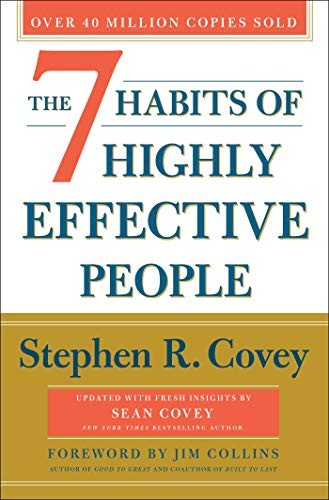
The 7 Habits of Highly Effective People
by Stephen R. Covey
Top 25
A principle-based framework for taking ownership of your time, priorities, and relationships. Structured, thoughtful, and a foundation for much modern productivity writing. Read the full description
Best for: People who like frameworks and long-term planning
The 7 Habits of Highly Effective People is #13 on BookWard's Top 100 books for November 2026, with a BookWard Score of 78 out of 100. It climbed 7 places from #20 last month.
BookWard review of The 7 Habits of Highly Effective People
4 of 5 stars 4.0 out of 5, from 288 reader ratings
BookWard rates The 7 Habits of Highly Effective People 4.0 out of 5. That is the average of 288 reader ratings on Open Library (4.04), adjusted toward the typical book so that a small number of ratings cannot inflate it. Beyond the rating, it is #13 on BookWard's Top 100 books; 7,138 readers want to read it, 676 are reading it right now and 342 have finished it.
How this rating works
BookWard’s rating is calculated, not hand-scored. We take the average rating readers have given the book on Open Library and adjust it toward the typical book: adjusted = (n × average + 25 × 3.8) ÷ (n + 25), where n is the number of ratings. A book needs at least 50 ratings to be rated. The rating reflects how readers received the book, not whether it is right for you. Your own ratings on your shelf are private and are not part of this number.
The 7 Habits of Highly Effective People: reading interest over the past 12 months
Sources: Open Library’s public reading-log and ratings data (dump of 2026-10-31), Wikipedia page views and Wikidata. Monthly counts are exact; they show relative interest among readers of these public sources, not total readership.
Ranked against the other books on this list, The 7 Habits of Highly Effective People’s reading interest has run from #24 to #50 over these 12 months. Interest rank blends shelf adds, Wikipedia page views and rating activity, each compared with the other 99 books that month.
Shelf adds by month
The 7 Habits of Highly Effective People was added to Open Library readers’ shelves 1,465 times in the past 12 months, peaking in October 2026 with 314 (157% above its monthly average of 122). Over the latest three months (Aug 2026 to Oct 2026) shelf adds were up 120% on the three months before. 86% of the adds were “want to read”, 9% “currently reading” and 5% “already read”.
Want to read Currently reading Already read
Wikipedia page views
Its Wikipedia article was viewed 220,239 times in the past 12 months, peaking in November 2025 with 25,288 views. The latest three months were down 2% on the three before.
Source: Wikimedia monthly page views for the article The 7 Habits of Highly Effective People.
What the data says about The 7 Habits of Highly Effective People
- Moderate swings. Monthly shelf adds averaged 122 with some ups and downs.
- Busiest and quietest months. October 2026 was its busiest month (314 adds), about 4.8 times its quietest, May 2026 (66).
- Attention and shelf adds move independently. Its Wikipedia views and its shelf adds did not rise and fall together over these 12 months (correlation -0.16).
- Against its genre. It had 29% fewer shelf adds than the average Self-help book on this list.
- Share of the list. It accounts for 1.4% of all shelf adds recorded for the Top 100 over these 12 months, #15 of 100.
- Its age. First published in 1989 (37 years ago), it is older than 69% of the books on the list.
Each finding is computed from the public data above and shown only when the numbers support it.
The 7 Habits of Highly Effective People on the Top 100: rank history
| Month | Rank | Score |
|---|---|---|
| November 2026 | #13 | 78 |
| October 2026 | #20 | 77 |
| September 2026 | #18 | 78 |
Is The 7 Habits of Highly Effective People rising or falling?
Holding steady Its weekly, monthly and yearly ranks are close together, so interest is steady rather than spiking.
On Open Library, The 7 Habits of Highly Effective People ranks #9 this week, #11 this month, and #15 over the past year. A longer bar means a higher position. Comparing the three windows shows whether readers are arriving faster than the book's long-term pace. Readings as of 2026-11-02.
Why The 7 Habits of Highly Effective People made the Top 100
The 7 Habits of Highly Effective People made the list mainly on momentum (+32.9 points) and being read right now (+22.5 points). Its smallest contribution is rising (+0.1). The BookWard Score blends five public signals, each scored from 0 to 100 and weighted as shown.
The reading-now, rating and rank signals come from Open Library’s public data, not from BookWard’s own readers. The score measures reading interest, not quality or sales. How the score works.
Open Library reader stats for The 7 Habits of Highly Effective People
Source: Open Library public reading logs, as of 2026-11-02. BookWard’s own monthly snapshots are added to the picture, and anonymous BookWard reader data will be layered in as the community grows.
More readers have The 7 Habits of Highly Effective People open right now than 85% of the other books on this list. These counts come from one public source, so they show relative interest rather than total readership.
Where it sits among Self-help books
It is #4 of the 14 Self-help books on this month’s list.
About The 7 Habits of Highly Effective People
What it’s about
Stephen R. Covey's 1989 book goes over his ideas on how to spur and nurture personal change, built around seven habits he identified as conducive to personal growth. It asks what effectiveness actually means and how to achieve results. A central argument is that we should build our values on character, meaning who we are and how we act, rather than on personality and image. The publisher reports more than 40 million copies sold, and a 30th anniversary edition adds fresh takeaways from Sean Covey. It will help anyone who wants to manage their time and relationships more deliberately, whether as a leader at work or in everyday life.
At a glance
- First published
- 1989
- Genre
- Self-help
- Also described as
- essay
- Length
- about 374 pages (the median across its editions)
- Original language
- English
- Languages
- editions in 9 languages listed on Open Library
- Editions
- 78 on Open Library
From Open Library and Wikidata public records. Missing rows mean the records do not list that fact.
Themes
- Personal responsibility
- Proactivity
- Working with others
What reading it is like
Structured, earnest and framework-heavy. It reads like a course.
At about 374 pages it is a longer read: roughly 7 hours at an average reading pace (about 250 words a minute, 300 words a page). Audiobook and edition lengths vary.
Good to know
Organized as seven habits that move from independence to working with others.
The premise
Stephen Covey presents seven principles for personal and professional effectiveness, from taking initiative to renewing yourself. It is structured, values-driven, and built for reflection.
What you’ll get
- A framework for priorities
- Exercises for reflection
- Ideas for leaders and families
You might skip it if you want a short, modern read.
Pairs well with: Atomic Habits · Think and Grow Rich
Keep exploring the chart
Also on the chart at #12 and #14
Questions about The 7 Habits of Highly Effective People
What rank is The 7 Habits of Highly Effective People on the Top 100 books?
The 7 Habits of Highly Effective People is #13 on BookWard's Top 100 books for November 2026, with a BookWard Score of 78 out of 100. It climbed 7 places from #20 last month.
Is The 7 Habits of Highly Effective People rising or falling?
Holding steady. Its weekly, monthly and yearly ranks are close together, so interest is steady rather than spiking. On Open Library, The 7 Habits of Highly Effective People ranks #9 this week, #11 this month, and #15 over the past year.
Why is The 7 Habits of Highly Effective People on the Top 100?
The 7 Habits of Highly Effective People made the list mainly on momentum (+32.9 points) and being read right now (+22.5 points). Its smallest contribution is rising (+0.1).
How many people are reading The 7 Habits of Highly Effective People right now?
Open Library's reading logs show 676 readers currently reading The 7 Habits of Highly Effective People, 7,138 who want to read it and 342 who have logged it as read (as of 2026-11-02). These are counts from one public source, not all readers.
How much interest has The 7 Habits of Highly Effective People had over the past year?
1,465 Open Library shelf adds in the past 12 months (peak October 2026, 314); latest three months up 120% on the prior three; 220,239 Wikipedia views in the past 12 months (down 2% over the latest three months). Figures come from Open Library and Wikipedia public data.
Who is The 7 Habits of Highly Effective People best for?
People who like frameworks and long-term planning.
Ask a question about The 7 Habits of Highly Effective People
Ask about this book's chart history, reading interest, or who it is for. Answers come from this page's data and can be wrong.
Answers are AI-written from BookWard’s own help content and can be wrong. Please do not share personal information: questions and answers may be saved and, if they are useful, shown on this site without your name.
How we know
This page is built from public data: Open Library’s dated reading-log and ratings dumps, Wikipedia page views, Wikidata, and BookWard’s own monthly Top 100 snapshots. The interest rank blends shelf adds (45%), Wikipedia page views (30%), rating activity (10%) and, for months where a snapshot exists, BookWard’s own score (15%), each as a percentile among the Top 100 books. Every month shown is real data; nothing is estimated. Rankings reflect reading interest, not quality or sales, and can be affected by data gaps. Last updated November 2026. Read the full methodology.
Suits teens and adults, especially those thinking about work, relationships or personal direction.
374 pages, about 6 to 8.5 hours.
Seven habits, laid out plainly, with ideas ahead of story. 31% taste match
 BookWard’s take
Seven habits, laid out plainly, with ideas ahead of story
Covey builds his case around one argument: lasting effectiveness comes from character, not from personality tricks. It is a distinctive stance, and the seven-habit structure makes it easy to follow. The biggest mismatch for me is that this is idea-led through and through, when I tend to lean toward story. The ideas are also explained outright rather than shown in scene. The rigor is mixed, since the book leans on anecdote and illustration over hard evidence. Where it does connect is the authorial voice, which is confident and unmistakable, and the staying power, as it has stayed in print since 1989. The tone runs warm and earnest, a little above what I usually prefer in a restrained register. It is a framework to apply, not a narrative to get lost in.
At 374 pages it runs fuller than a tight read, and the repeated framing stretches it further than the ideas strictly need.
Self-improvement was crowded territory, but the character-ethic framing and habit sequence gave it a clear identity.
The writing is plain and functional, built to explain rather than to ornament.
The whole premise is that anyone can change and grow, which makes it strongly hopeful.
The seven-habit sequence is a conventional, easy-to-navigate scaffold with nothing experimental about it.
It is earnest and instructional, with humor kept to a minimum.
The material is wholesome and constructive.
Feeling is present in the stirring tone but kept at a moderate level.
See all 50 dialsEvery position, side by side with this book
Where it lines up
- Authorial voiceBookWard 9 · book 8
- EndingBookWard 8 · book 6
- Sagging middleBookWard 8 · book 6
Where it pulls apart
- Familiar tropesBookWard 10 · book 4
- LengthBookWard 1 · book 6
- OpeningBookWard 10 · book 5
At 374 pages it runs fuller than a tight read, and the repeated framing stretches it further than the ideas strictly need.
Self-help conventions are everywhere, though the character-ethic framing gives it a recognizable angle of its own.
The seven habits build in a clear sequence from personal mastery to working with others, so the structure holds together well.
Self-improvement was crowded territory, but the character-ethic framing and habit sequence gave it a clear identity.
There is no developed cast here; people appear as brief illustrations of a principle, not as drawn characters.
The tone is earnest and uplifting, warmer than the restraint BookWard favors.
Covey's confident, teacherly register is easy to recognize, and it drives the whole book.
This is an idea-led book from first page to last, the opposite end of the dial from BookWard's story lean.
Concepts are named, defined and explained directly, not dramatized, which runs against BookWard's preference.
The writing is plain and functional, built to explain rather than to ornament.
The whole premise is that anyone can change and grow, which makes it strongly hopeful.
The seven-habit sequence is a conventional, easy-to-navigate scaffold with nothing experimental about it.
It is earnest and instructional, with humor kept to a minimum.
The language is accessible, though applying the ideas takes real reflection and effort.
Everything comes from Covey's single teaching perspective.
It moves in a straight line through the habits in order.
It deals entirely in everyday work, family and personal life.
The focus stays on individual lives, families and workplaces, not sweeping events.
Much of the work is about mindset, values and self-reflection.
Romance does not feature as a theme.
It dates from 1989, though a 30th anniversary edition adds modern touches.
Still read widely decades on, it has proven durable beyond its original moment.
Covey speaks as a direct, open guide with no hidden agenda.
The book states plainly what it considers right and wrong conduct.
Description is sparse; the text favors explanation over scene-setting.
It leans toward illustrative anecdote and personal stories more than detached analysis.
Covey draws on family and personal experience, so the perspective feels close, not detached.
It stands alone as a single book.
There are no surprises of plot; the ideas unfold as signposted.
It asks readers to examine their own habits, which is a gentle challenge more than a comfort.
The material is wholesome and constructive.
Feeling is present in the stirring tone but kept at a moderate level.
There is essentially none.
None to speak of.
It stays focused on personal and professional growth, not politics.
The language is plain and easy to follow.
Covey argues his case forcefully and tells you what to do.
It holds a strongly idealistic belief in human potential and principled living.
Review written by BookWard, dial version 1, November 2026.
Who is The 7 Habits of Highly Effective People right for?
Suits teens and adults, especially those thinking about work, relationships or personal direction. Nothing in it is graphic or distressing.
The language is accessible, though applying the ideas takes real reflection and effort.
The material is wholesome and constructive.
Feeling is present in the stirring tone but kept at a moderate level.
There is essentially none.
Book CompanionThe 7 Habits of Highly Effective People: ideas, characters, themes
Lasting effectiveness comes from building principled character through seven habits, not from surface techniques of personality.
- Character over personality. Covey argues that lasting success rests on inner character and values, not on image or quick tactics.
- Seven habits as a path. The habits move from personal mastery toward working well with other people.
- Effectiveness as results. The book frames effectiveness as achieving results in a sustainable way.
- Personal change. It sets out to spur and nurture change in the reader's own life.
- A timeless framework. The ideas have stayed in circulation since 1989, and a 30th anniversary edition adds modern takeaways from Sean Covey.
Themes
The belief that who you are matters more than how you present yourself.
Deliberate, habit-by-habit change in how you think and act.
Reaching meaningful results in a way that lasts.
Guiding values that shape choices over time.
Owning your choices and responses instead of blaming circumstances.
Discussion questions
- Do you agree that character matters more than personality for lasting success, and why?
- Which of the seven habits feels easiest for you, and which hardest?
- Where have you seen quick-fix tactics fail compared with deeper change?
- How well does a single framework suit very different lives and jobs?
- What would applying one habit this month look like in practice?
Personalize your Book Companion
This is the general edition. In BookWard, the Companion is written for you: your reading profile, your notes, and spoiler-safe to the page you are on.
Buy, listen or borrow The 7 Habits of Highly Effective People
Each link opens a search for this book on that store, in a new tab.
Read on a device
Borrow
Reviews and community
If you liked The 7 Habits of Highly Effective People
Chopra's case that aging bends to belief, argued with conviction
Emotional IntelligenceDaniel GolemanGoleman's case that emotional skill can outweigh IQ, and can be taught
The Artist's WayJulia CameronA twelve-week creative recovery program built on daily writing
Think and Grow RichNapoleon HillA 1937 success manual: 13 principles, big promises, thin proof
Track The 7 Habits of Highly Effective People and find your next favorite
Add it to your shelf, rate what you have read, and BookWard will recommend what fits you.
Free to start. No credit card needed.