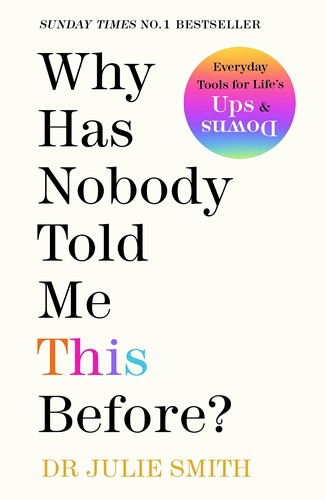
Why Has Nobody Told Me This Before?
by Julie Smith
★ Top 25 book of 2022 · #14 on Best Books of 2022
A clinical psychologist shares practical lessons from her therapy sessions in short, easy-to-dip-into entries. Readers can jump straight to the topic they need, from anxiety and criticism to confidence, motivation and self-forgiveness.
Best for: Anyone wanting quick, practical tools for everyday mental health challenges
Why Has Nobody Told Me This Before? is #14 on BookWard's Best Books of 2022, out of 62 2022 books that cleared our data bar.
What Why Has Nobody Told Me This Before? is about
Dr Julie Smith is a British clinical psychologist, and this is her first book. She wrote it for anyone who has wondered why nobody ever explained how to handle the hard parts of being a person. Drawing on her years of clinical work, she gathers simple advice, practical strategies and coping techniques meant to help readers stay positive and resilient.
The entries are short and written in a warm, informal voice, so there is no need to read from the first page to the last. You can turn straight to the section that fits what you are facing, whether that is anxiety, criticism, low mood, shaky confidence, a lack of motivation or the difficulty of forgiving yourself. It will suit readers who want calm, usable guidance rather than theory.
Why Has Nobody Told Me This Before? on the Best Books of 2022
Why Has Nobody Told Me This Before? came out in 2022. Of the 62 books first published in 2022 that met BookWard's data bar, it ranks #14 on our Best Books of 2022 list.
Why it made the list: 855 readers have shelved it on Open Library; readers rate it 3.5 out of 5 (16 ratings); 25 are reading it right now. The list ranks each year’s books on how many readers have picked them up, how highly readers rate them, and how many are reading them right now.
Nearby on the 2022 list
- Corrupted Chaos Shain Rose, #12
- Lightlark Alex Aster, #13
- Babel R. F. Kuang, #15
- The Final Gambit Jennifer Lynn Barnes, #16
See all Best Books of 2022 Best books by year
More years: Best Books of 2021 Best Books of 2023.
The numbers behind it
- Readers: 817 want to read it, 25 are reading it now and 13 have read it, according to Open Library.
- Ratings: 3.5 out of 5 from 16 Open Library ratings.
| Signal | This book (0 to 100) | Weight |
|---|---|---|
| Reach | 87 | 55% |
| Reader love | 10 | 25% |
| Being read right now | 76 | 20% |
Questions about Why Has Nobody Told Me This Before?
When was Why Has Nobody Told Me This Before? published?
Why Has Nobody Told Me This Before? by Julie Smith was first published in 2022.
Was Why Has Nobody Told Me This Before? one of the best books of 2022?
Why Has Nobody Told Me This Before? is #14 on BookWard's Best Books of 2022, out of 62 2022 books that cleared our data bar. 855 readers have shelved it on Open Library; readers rate it 3.5 out of 5 (16 ratings); 25 are reading it right now.
Why is Why Has Nobody Told Me This Before? on the Best Books of 2022 list?
855 readers have shelved it on Open Library; readers rate it 3.5 out of 5 (16 ratings); 25 are reading it right now.
More of the best books of 2022
- I'm Glad My Mom Died Jennette McCurdy, #1
- King of Wrath Ana Huang, #2
- I Fell in Love with Hope Lancali, #3
- It Starts with Us Colleen Hoover, #4
- Things We Never Got over Lucy Score, #5
- The Ballad of Never After Stephanie Garber, #6
See the full Best Books of 2022, the Top 100, or new books on Rising.
How we know
This page uses public data: Open Library reader counts and ratings, and Wikipedia page views for recent years. The description is paraphrased from real source text. Rankings reflect reading interest, not quality or sales, and can be affected by data gaps. Lists update monthly.
Suits adults and older teens looking for practical help with everyday stress and low mood.
Depends on the edition you pick.
Short, practical mental health tools from a clinical psychologist, easy to dip into. 38% taste match
 BookWard’s take
Short, practical mental health tools from a clinical psychologist, easy to dip into
Julie Smith's first book is a handbook built from bite-sized entries, so you can go straight to the problem in front of you, whether that is anxiety, low mood, criticism or motivation. It reads easily, in a warm, informal voice, and the structure means there is no sagging middle to worry about, since each entry stands alone. The techniques are explained outright rather than shown in scene, which suits a manual. The rigor is moderate: it draws on years in the therapy room and favours usable strategies over dense evidence. The outlook is hopeful and the content stays gentle. Expect a reliable, practical companion rather than a surprising or airtight one.
Short, self-contained entries keep it compact and easy to take in small doses, which fits BookWard's taste for tight reads.
Brisk, bite-sized sections keep things moving, close to how BookWard likes to read.
It packages established psychological approaches in an accessible format rather than breaking new ground.
Plain, conversational writing keeps the focus on clarity.
The whole book is oriented toward resilience and feeling better, so it is strongly hopeful.
A conventional topic-by-topic handbook layout you can dip into anywhere.
Friendly and light in manner but mostly earnest, since the subject is mental health.
Deals with anxiety and low mood but in a gentle, constructive way.
Emotionally warm and validating without being heavy.
See all 50 dialsEvery position, side by side with this book
Where it lines up
- Sagging middleBookWard 8 · book 8
- PaceBookWard 8 · book 7
- SentimentBookWard 8 · book 6
Where it pulls apart
- Familiar tropesBookWard 10 · book 4
- ExpositionBookWard 2 · book 9
- Story or ideasBookWard 3 · book 9
Short, self-contained entries keep it compact and easy to take in small doses, which fits BookWard's taste for tight reads.
Self-help territory is well trodden, and many of its ideas will feel familiar, which sits below BookWard's preference.
Brisk, bite-sized sections keep things moving, close to how BookWard likes to read.
It packages established psychological approaches in an accessible format rather than breaking new ground.
Warm and encouraging in tone, yet focused on practical strategies rather than sentimentality.
Grounded in clinical experience and offered as dependable guidance, though written for accessibility, not academic depth.
Dr Julie's warm, informal style gives it a recognisable, approachable personality.
This is a book of ideas and strategies, with no story to follow, so it sits far from BookWard's story-led lean.
Concepts and techniques are explained directly, which is the point of a handbook but opposite to BookWard's taste for showing.
Standalone entries mean there is no middle to sag, and every section is useful on its own.
Plain, conversational writing keeps the focus on clarity.
The whole book is oriented toward resilience and feeling better, so it is strongly hopeful.
A conventional topic-by-topic handbook layout you can dip into anywhere.
Friendly and light in manner but mostly earnest, since the subject is mental health.
Short entries and plain language make it very easy to pick up and use.
One authoritative, consistent voice guides the reader throughout.
No narrative timeline; sections are organised by problem, not sequence.
Entirely grounded in everyday life and real psychological practice.
There is no cast to speak of, just the author and the reader.
Intimate by nature, focused on the individual reader's daily struggles.
The focus is on thoughts, feelings and how to work with them.
Not a theme; the book concerns personal wellbeing.
A 2022 book addressing contemporary pressures, so firmly of the present day.
The core coping ideas are durable, though the framing is contemporary.
A straightforward, reliable guide speaking in her own professional voice.
Guidance is practical and clear rather than morally ambiguous.
Little scene-setting; the writing prioritises explanation over atmosphere.
Practical and instructional, drawing on therapy-room insight, balanced between anecdote and analysis.
Written in a close, personal tone, with a professional's perspective behind it.
A standalone first book.
A reference-style handbook with no plot surprises.
Reassuring and supportive, designed to comfort and equip readers.
Deals with anxiety and low mood but in a gentle, constructive way.
Emotionally warm and validating without being heavy.
Gentle, approachable warmth rather than jokes or broad comedy.
None on the page.
No sexual content.
Concerned with personal wellbeing, not political argument.
Plain, clear language aimed at any reader.
Offers clear recommendations and advice, so it is moderately opinionated.
Focused on helping readers move forward with practical habits.
Optimistic that change is possible with small, doable steps.
Review written by BookWard, dial version 1, November 2026.
Who is Why Has Nobody Told Me This Before? right for?
Suits adults and older teens looking for practical help with everyday stress and low mood. It discusses anxiety and low mood, so it is worth pairing with professional support for serious difficulties.
Short entries and plain language make it very easy to pick up and use.
Deals with anxiety and low mood but in a gentle, constructive way.
Emotionally warm and validating without being heavy.
None on the page.
Book CompanionWhy Has Nobody Told Me This Before?: ideas, characters, themes
Everyday mental health challenges can be eased with simple, practical strategies drawn from the therapy room.
- Built to dip into. Short, bite-sized entries let you turn straight to the challenge you are facing.
- Therapy-room insight. Advice draws on Julie Smith's years as a clinical psychologist.
- Everyday problems. It tackles anxiety, criticism, low mood, motivation and self-confidence.
- Practical over theoretical. The focus is on tools and coping techniques you can use immediately.
- Warm, informal tone. The style aims to feel approachable and reassuring rather than clinical.
Themes
Staying steady and recovering when life gets difficult.
Learning to forgive yourself and treat yourself kindly.
Concrete techniques you can apply to daily struggles.
Building the belief and drive to act.
Making psychology practical and understandable for everyone.
Discussion questions
- Which chapter or challenge did you turn to first, and why?
- How do you usually respond to criticism, and did the book change that?
- Which technique felt easiest to try in daily life?
- Does an informal, bite-sized format make mental health advice easier to use?
- What would you want to add to a handbook like this?
Personalize your Book Companion
This is the general edition. In BookWard, the Companion is written for you: your reading profile, your notes, and spoiler-safe to the page you are on.
Buy, listen or borrow Why Has Nobody Told Me This Before?
Each link opens a search for this book on that store, in a new tab.
Read on a device
Borrow
Reviews and community
If you liked Why Has Nobody Told Me This Before?
A clear, practical guide for adults raised by emotionally unavailable parents
MindsetCarol S. DweckOne big idea, two mindsets, applied to work, love and parenting
UltralearningScott YoungA self-taught learner's practical blueprint for mastering hard skills fast
Emotional Intelligence 2.0Travis BradberryA short, practical workbook for raising your emotional intelligence
Find your own best books
Add what you have read, rate it, and BookWard will recommend what to read next.
Free to start. No credit card needed.