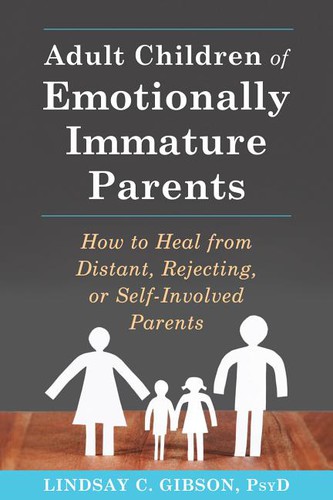
Adult Children of Emotionally Immature Parents
by Lindsay C. Gibson
★ Top 25 book of 2015 · #15 on Best Books of 2015
A clinical psychologist examines how emotionally immature or unavailable parents leave lasting hurt in their grown children. She describes four difficult parent types and offers guidance on healing, handling these parents, and forming healthier relationships.
Best for: Adults hoping to heal from a emotionally neglectful childhood and build better relationships
Adult Children of Emotionally Immature Parents is #15 on BookWard's Best Books of 2015, out of 55 2015 books that cleared our data bar.
What Adult Children of Emotionally Immature Parents is about
Some people grow up with a parent who is emotionally immature, unavailable, or focused mainly on themselves. Clinical psychologist Lindsay C. Gibson writes for those readers, who may carry anger, loneliness, a sense of betrayal, or old feelings of abandonment. Many took on adult responsibilities as children to make up for what a parent could not provide.
Gibson argues that this kind of parenting leaves a lasting sense of neglect, but that the wounds can be healed. She describes four types of difficult parents, including the emotional parent, who creates instability and anxiety, the driven parent, who stays busy trying to perfect everything and everyone, and the passive parent. From there, the book shows readers how to recover their true nature, manage how they respond to their parents, avoid repeated disappointment, and build healthier new relationships. It will help anyone trying to make sense of their family history, in a voice that is explanatory and validating.
Adult Children of Emotionally Immature Parents on the Best Books of 2015
Adult Children of Emotionally Immature Parents came out in 2015. Of the 55 books first published in 2015 that met BookWard's data bar, it ranks #15 on our Best Books of 2015 list.
Why it made the list: 394 readers have shelved it on Open Library; readers rate it 4.6 out of 5 (16 ratings). The list ranks each year’s books on how many readers have picked them up, how highly readers rate them, and how many are reading them right now.
Nearby on the 2015 list
- Everything, Everything Nicola Yoon, #13
- Children of Time Adrian Tchaikovsky, #14
- Neverseen Shannon Messenger, #16
- The Mistake Elle Kennedy, #17
See all Best Books of 2015 Best books by year
More years: Best Books of 2014 Best Books of 2016.
The numbers behind it
- Readers: 358 want to read it, 15 are reading it now and 21 have read it, according to Open Library.
- Ratings: 4.6 out of 5 from 16 Open Library ratings.
| Signal | This book (0 to 100) | Weight |
|---|---|---|
| Reach | 64 | 55% |
| Reader love | 87 | 25% |
| Being read right now | 53 | 20% |
Questions about Adult Children of Emotionally Immature Parents
When was Adult Children of Emotionally Immature Parents published?
Adult Children of Emotionally Immature Parents by Lindsay C. Gibson was first published in 2015.
Was Adult Children of Emotionally Immature Parents one of the best books of 2015?
Adult Children of Emotionally Immature Parents is #15 on BookWard's Best Books of 2015, out of 55 2015 books that cleared our data bar. 394 readers have shelved it on Open Library; readers rate it 4.6 out of 5 (16 ratings).
Why is Adult Children of Emotionally Immature Parents on the Best Books of 2015 list?
394 readers have shelved it on Open Library; readers rate it 4.6 out of 5 (16 ratings).
More of the best books of 2015
- Six of Crows Leigh Bardugo, #1
- The Hired Girl Laura Amy Schlitz, #2
- Queen of Shadows Sarah J. Maas, #3
- November 9 Colleen Hoover, #4
- Red Queen Victoria Aveyard, #5
- The Sword of Summer Rick Riordan, #6
See the full Best Books of 2015, the Top 100, or new books on Rising.
How we know
This page uses public data: Open Library reader counts and ratings, and Wikipedia page views for recent years. The description is paraphrased from real source text. Rankings reflect reading interest, not quality or sales, and can be affected by data gaps. Lists update monthly.
It suits adult readers reflecting on their upbringing, and some older teens may find it useful.
Depends on the edition you pick.
A clear, practical guide for adults raised by emotionally unavailable parents. 42% taste match
 BookWard’s take
A clear, practical guide for adults raised by emotionally unavailable parents
Lindsay Gibson, a clinical psychologist, sorts difficult parents into four types: the emotional, the driven, the passive and the rejecting. That framework is the book's backbone, and it gives readers a vocabulary for experiences that are often hard to name. The voice is warm and direct, though more clinical than singular. The ideas are explained outright rather than dramatized, which suits a self-help book, even if I tend to prefer ideas shown in scene. The argument rests on clinical experience and case illustration rather than data. The outlook is hopeful, built around healing, setting boundaries and building better relationships. It is gentle in content, easy to read, and arranged so you can find your own parent in it quickly.
A focused self-help book of moderate size, closer to tight than sprawling, with a clear structure and no padding for its subject.
The topic has many neighbors, but naming and sorting parent types gives it a distinct angle.
The writing is plain and accessible, chosen for clarity over ornament.
Without a plot, the interest lies in inner experience and relationships, which tilts toward character.
Healing is its central promise, so it lands firmly on the hopeful end.
It follows a conventional self-help arc: describe the problem, name the types, then offer recovery steps.
It is serious throughout, with little room for humor given the subject.
The subject is painful, but the treatment is gentle and constructive.
It engages strong feelings of neglect and loss, handled with care.
See all 50 dialsEvery position, side by side with this book
Where it lines up
- Shock for effectBookWard 9 · book 9
- EndingBookWard 8 · book 7
- PaceBookWard 8 · book 6
Where it pulls apart
- Familiar tropesBookWard 10 · book 4
- ExpositionBookWard 2 · book 9
- Story or ideasBookWard 3 · book 9
A focused self-help book of moderate size, closer to tight than sprawling, with a clear structure and no padding for its subject.
Self-help conventions are present, though the four-type framework gives it a recognizable and useful shape.
The four parent types and the steps toward recovery follow a coherent, easy-to-follow progression.
The topic has many neighbors, but naming and sorting parent types gives it a distinct angle.
People appear as types and illustrations to explain patterns, not as deeply drawn characters.
It closes on resolution and forward steps instead of leaving questions hanging, which fits BookWard.
It speaks with empathy and validation, warmer than BookWard's restrained preference.
It does not use shock; its subject is painful but treated plainly and without sensationalism.
It draws on a clinician's experience and case illustration instead of heavy research, a bit under BookWard's bar.
The tone is steady, compassionate and professional, recognizable but not strikingly singular.
It is entirely idea-led, organized around a framework and strategies instead of a story.
It explains concepts outright and directly, the opposite of BookWard's preference for showing in scene.
The structure by parent type and by recovery step keeps energy fairly even across the book.
The writing is plain and accessible, chosen for clarity over ornament.
Without a plot, the interest lies in inner experience and relationships, which tilts toward character.
Healing is its central promise, so it lands firmly on the hopeful end.
It follows a conventional self-help arc: describe the problem, name the types, then offer recovery steps.
It is serious throughout, with little room for humor given the subject.
Easy to read, though some passages may be emotionally heavy for readers with painful histories.
It speaks from a single clinical perspective addressed to the reader.
It moves in a straightforward order from understanding to recovery, without time shifts.
It is entirely grounded in everyday family life and relationships.
It involves few recurring figures, mostly types of parents and the adult child.
It is intimate, concerned with family dynamics and personal healing.
It centers on feelings, reactions and the inner experience of growing up.
Romance is not a focus, though later relationships come up as a topic.
The setting is ordinary family life, familiar to most readers.
It addresses contemporary psychology and modern relationships, so it reads as present-day.
Family patterns persist, though the framing is tied to current self-help language.
The author speaks openly and straightforwardly, as a reliable guide.
It takes a clear stance on healing and boundaries, though family dynamics are treated with some nuance.
Description is sparse, used mainly to illustrate patterns instead of to paint scenes.
It leans analytical, sorting patterns and strategies more than telling a continuous story.
Written with empathy and direct address, it feels personal more than detached.
It stands alone as a single book.
There are no plot surprises; revelations come as moments of recognition.
It can be uncomfortable to confront, but it reassures more than it unsettles.
The subject is painful, but the treatment is gentle and constructive.
It engages strong feelings of neglect and loss, handled with care.
Humor does not apply; the book is serious in tone.
There is no violence on the page.
Sexual content is not part of the book.
Politics is absent; the focus is family and personal psychology.
The language is plain and accessible, with some psychological terminology.
The author states clear positions on healthy and unhealthy parenting.
It points forward, toward recovery and better relationships.
It holds that people can heal and build better lives, an optimistic view.
Review written by BookWard, dial version 1, November 2026.
Who is Adult Children of Emotionally Immature Parents right for?
It suits adult readers reflecting on their upbringing, and some older teens may find it useful. It discusses emotional neglect and painful family dynamics, which may be heavy for some readers.
Easy to read, though some passages may be emotionally heavy for readers with painful histories.
The subject is painful, but the treatment is gentle and constructive.
It engages strong feelings of neglect and loss, handled with care.
There is no violence on the page.
Book CompanionAdult Children of Emotionally Immature Parents: ideas, characters, themes
Parents who are emotionally immature leave lasting marks on their children, and adult children can name those patterns and heal from them.
- Four parent types. Gibson describes the emotional, driven, passive and rejecting parent, each shaping a child's sense of safety differently.
- Neglect without cruelty. The book shows how childhood can feel emotionally empty even when a parent is not openly abusive.
- Taking on adult roles. Children of these parents often take on adult responsibilities to compensate for what the parent does not provide.
- Recovering your true nature. Freeing yourself from a parent's immaturity is presented as a way to reconnect with who you actually are.
- Choosing your reactions. The book offers ways to control how you respond to your parents and avoid repeated disappointment.
Themes
Needs that go unmet even in a home that looks fine from outside.
Recovery from childhood wounds through understanding and new habits.
Deciding how much emotional access difficult parents have to you.
Children carrying adult responsibilities in a family.
Building connections with people who can meet your emotional needs.
Discussion questions
- Which of the four parent types, if any, felt familiar to you, and why?
- How does naming a pattern change the way you relate to it?
- What is the difference between emotional neglect and open mistreatment?
- How might a reader balance compassion for a parent with protecting themselves?
- What would a healthy relationship look like after reading this book?
Personalize your Book Companion
This is the general edition. In BookWard, the Companion is written for you: your reading profile, your notes, and spoiler-safe to the page you are on.
Buy, listen or borrow Adult Children of Emotionally Immature Parents
Each link opens a search for this book on that store, in a new tab.
Read on a device
Borrow
Reviews and community
If you liked Adult Children of Emotionally Immature Parents
Short, practical mental health tools from a clinical psychologist, easy to dip into
MindsetCarol S. DweckOne big idea, two mindsets, applied to work, love and parenting
101 Essays That Will Change The Way You ThinkBrianna WiestShort, quotable self-help essays you can read one idea at a time
No Excuses!Brian TracyA 21-chapter push to swap excuses for self-discipline
Find your own best books
Add what you have read, rate it, and BookWard will recommend what to read next.
Free to start. No credit card needed.