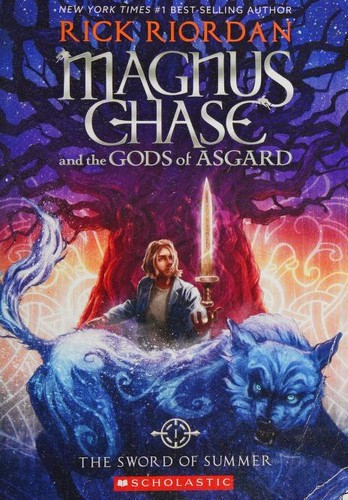
The Sword of Summer
by Rick Riordan
★ Top 10 book of 2015 · #6 on Best Books of 2015
Magnus Chase lives rough on Boston's streets until his uncle tracks him down with talk of Norse gods and a long-lost weapon. A fire giant attack then forces a choice between safety and saving others.
Best for: Young readers who enjoy mythology-based adventure, especially Norse gods and monsters
The Sword of Summer is #6 on BookWard's Best Books of 2015, out of 55 2015 books that cleared our data bar.
What The Sword of Summer is about
For two years, Magnus Chase has lived alone on the streets of Boston, ever since his mother told him to run on a terrible night. He survives by his wits and keeps ahead of the police and the truant officers. The one person he cannot shake is his uncle Randolph, a man his mother warned him about, who is hunting for him and rambling about Norse history and a birthright: a weapon lost for thousands of years.
Old stories about the gods of Asgard, wolves, and Doomsday begin drifting back into Magnus's memory. Then a fire giant attacks the city, and he must choose between saving himself and saving hundreds of strangers. Rick Riordan's novel is about family secrets, sacrifice, and the idea that a new life sometimes demands an ending.
The Sword of Summer on the Best Books of 2015
The Sword of Summer came out in 2015. Of the 55 books first published in 2015 that met BookWard's data bar, it ranks #6 on our Best Books of 2015 list.
Why it made the list: 688 readers have shelved it on Open Library; readers rate it 4.3 out of 5 (61 ratings); 44 are reading it right now. The list ranks each year’s books on how many readers have picked them up, how highly readers rate them, and how many are reading them right now.
Nearby on the 2015 list
- November 9 Colleen Hoover, #4
- Red Queen Victoria Aveyard, #5
- All the Bright Places Jennifer Niven, #7
- A Little Life Hanya Yanagihara, #8
See all Best Books of 2015 Best books by year
More years: Best Books of 2014 Best Books of 2016.
The numbers behind it
- Readers: 513 want to read it, 44 are reading it now and 131 have read it, according to Open Library.
- Ratings: 4.3 out of 5 from 61 Open Library ratings.
| Signal | This book (0 to 100) | Weight |
|---|---|---|
| Reach | 84 | 55% |
| Reader love | 84 | 25% |
| Being read right now | 87 | 20% |
Questions about The Sword of Summer
When was The Sword of Summer published?
The Sword of Summer by Rick Riordan was first published in 2015.
Was The Sword of Summer one of the best books of 2015?
The Sword of Summer is #6 on BookWard's Best Books of 2015, out of 55 2015 books that cleared our data bar. 688 readers have shelved it on Open Library; readers rate it 4.3 out of 5 (61 ratings); 44 are reading it right now.
Why is The Sword of Summer on the Best Books of 2015 list?
688 readers have shelved it on Open Library; readers rate it 4.3 out of 5 (61 ratings); 44 are reading it right now.
More of the best books of 2015
- Six of Crows Leigh Bardugo, #1
- The Hired Girl Laura Amy Schlitz, #2
- Queen of Shadows Sarah J. Maas, #3
- November 9 Colleen Hoover, #4
- Red Queen Victoria Aveyard, #5
- All the Bright Places Jennifer Niven, #7
See the full Best Books of 2015, the Top 100, or new books on Rising.
How we know
This page uses public data: Open Library reader counts and ratings, and Wikipedia page views for recent years. The description is paraphrased from real source text. Rankings reflect reading interest, not quality or sales, and can be affected by data gaps. Lists update monthly.
Suits middle-grade and younger teen readers, and adults who enjoy light fantasy.
Depends on the edition you pick.
Norse myth meets a homeless Boston teen, fast and funny. 50% taste match
 BookWard’s take
Norse myth meets a homeless Boston teen, fast and funny
Rick Riordan's first Magnus Chase book opens with a kid living rough in Boston, chased by an uncle and a prophecy, and it hooks at once. The pace is quick, and the humor is a big part of the appeal, well beyond what most adventure novels bother to offer. The first-person voice is distinctive. Where it falters is in familiarity: the chosen kid with a lost weapon is well-worn ground, and the book tends to explain its mythology outright when it could let scenes carry that weight. It is also the first of a series, and the ending points onward rather than closing everything. Fun and brisk, if more comfortable than daring.
Chases, fights and revelations keep it moving quickly, in step with BookWard's fast preference.
Norse myth in modern Boston is a fresh setting, but the structure follows a familiar formula, short of BookWard's originality.
Plain, conversational and quick to read, slightly plainer than BookWard's middle ground.
Plot and quest events drive things more than inner change, leaning slightly away from BookWard's character focus.
Despite grim circumstances, the tone is upbeat and warm, a close fit with BookWard's hopeful lean.
A straightforward quest told in order, more conventional than BookWard's middle position.
Sarcasm and jokes run throughout, a clear match for and above BookWard's funny lean.
Death and homelessness are present but handled with a light touch, close to BookWard's middle.
Feelings are real but kept brisk and joke-cushioned, close to BookWard's middle setting.
See all 50 dialsEvery position, side by side with this book
Where it lines up
- PaceBookWard 8 · book 8
- Authorial voiceBookWard 9 · book 9
- Story or ideasBookWard 3 · book 3
Where it pulls apart
- Familiar tropesBookWard 10 · book 3
- LengthBookWard 1 · book 6
- Internal logicBookWard 10 · book 6
A runaway teen, a hunting uncle and a fire giant arrive early, matching BookWard's love of an immediate pull.
The chosen-one, lost-weapon, secret-heritage setup is familiar genre territory, well short of BookWard's tropes-avoiding bar.
Myth-based rules hold together well enough for the adventure, though not airtight in the way BookWard prizes.
Chases, fights and revelations keep it moving quickly, in step with BookWard's fast preference.
Norse myth in modern Boston is a fresh setting, but the structure follows a familiar formula, short of BookWard's originality.
Magnus has a clear history and wit, though supporting figures lean on type, a little under BookWard's depth.
The central conflict resolves but the story clearly points to further books, so closure is partial against BookWard's full resolution.
Warm and a touch sentimental about found family, softer than BookWard's restrained taste.
Danger and death carry real stakes, and the darkness serves the plot rather than shock for its own sake.
Not applicable; this is fiction.
Magnus's wisecracking first-person narration is unmistakable, a strong match for BookWard's love of distinctive voice.
Firmly story-led, driven by quests and fights, close to BookWard's story-first lean.
Mythology is frequently explained outright in dialogue and narration, more than BookWard's show-in-scene preference.
Momentum mostly holds, with the occasional detour into explanation, a little under BookWard's sustained standard.
Plain, conversational and quick to read, slightly plainer than BookWard's middle ground.
Plot and quest events drive things more than inner change, leaning slightly away from BookWard's character focus.
Despite grim circumstances, the tone is upbeat and warm, a close fit with BookWard's hopeful lean.
A straightforward quest told in order, more conventional than BookWard's middle position.
Sarcasm and jokes run throughout, a clear match for and above BookWard's funny lean.
Easy, breezy reading with little effort required, lighter than BookWard's moderate preference.
Told entirely from Magnus's point of view, narrower than BookWard's lean toward many viewpoints.
Events unfold in order, more linear than BookWard's middle position.
Gods, giants and the afterlife make this fully fantastical, well above BookWard's moderate setting.
A sizable cast of gods, warriors and allies, larger than BookWard's middle position.
Doomsday and world-ending stakes give it a big canvas, more epic than BookWard's middle.
Action and quests dominate over reflection, tilting outward from BookWard's balance.
Banter carries a lot of the book, matching BookWard's dialogue-heavy lean.
Romance stays in the background, a bit lighter than BookWard's middle position.
Norse realms and an afterlife hall are unfamiliar and vivid, matching BookWard's taste for new settings.
Set in present-day Boston, in line with BookWard's present-day lean.
Charming and popular, but tied to a recognizable modern young-adult formula, so less enduring than BookWard hopes.
Magnus narrates honestly and directly, reliable and more so than BookWard's unreliable lean.
Heroes and villains are fairly clearly drawn, clearer than BookWard's ambiguity-friendly taste.
Settings are sketched with energy but kept light, near BookWard's middle position.
Not applicable; this is fiction.
Not applicable; this is fiction.
It is the opening book of a trilogy, well above BookWard's middle position.
Reveals about heritage and the gods keep landing, near BookWard's lean toward surprises.
Comforting and accessible, well below BookWard's preference for being challenged.
Death and homelessness are present but handled with a light touch, close to BookWard's middle.
Feelings are real but kept brisk and joke-cushioned, close to BookWard's middle setting.
Jokes lean broad and sarcastic rather than dry, a bit above BookWard's middle.
Battles and fights are frequent but not graphic, near BookWard's middle position.
Essentially absent, below BookWard's middle position.
Politics barely register, below BookWard's middle position.
Plain, accessible language with little dense dialect, below BookWard's middle position.
Magnus's narration is full of strong opinions and asides, above BookWard's lean.
Rooted in ancient myth yet pointing to an impending Doomsday, balanced about like BookWard's lean.
Loyalty, courage and found family win out, close to BookWard's idealistic lean.
Review written by BookWard, dial version 1, November 2026.
Who is The Sword of Summer right for?
Suits middle-grade and younger teen readers, and adults who enjoy light fantasy. It includes homelessness, peril, battles and death, but the tone stays adventurous and humorous.
Easy, breezy reading with little effort required, lighter than BookWard's moderate preference.
Death and homelessness are present but handled with a light touch, close to BookWard's middle.
Feelings are real but kept brisk and joke-cushioned, close to BookWard's middle setting.
Battles and fights are frequent but not graphic, near BookWard's middle position.
Book CompanionThe Sword of Summer: ideas, characters, themes
A homeless teenager discovers he is tied to Norse gods and must claim a lost weapon to stop a looming Doomsday.
- A runaway's life. Magnus has survived on Boston's streets for two years, which sets his wit and self-reliance.
- The hunting uncle. Randolph tracks Magnus down and starts explaining Norse history and a lost birthright.
- Memory and myth. Stories of Asgard, wolves and Doomsday resurface as the pieces fall into place.
- The fire giant. An attack on the city forces Magnus to choose between his safety and hundreds of lives.
- A new life through death. The book's premise is that starting over may require an ending first.
Characters
Magnus Chase
Protagonist
A street-smart teenager living alone in Boston, pursued by his past and a mythic inheritance.
Randolph
Uncle
A relative Magnus's mother warned him about, who knows the family's Norse secrets.
Themes
Learning who you are by discovering where you come from.
Staying alive through wits when no one is there to help.
Putting others' safety ahead of your own.
Old gods and stories breaking into everyday life.
Warnings and hidden histories that shape a person's path.
Discussion questions
- Why might Magnus's life on the streets make him a good hero for a myth story?
- How does the book blend humor with life-or-death stakes?
- What does Magnus risk when he faces the fire giant?
- How does his mother's warning about Randolph change how we read Randolph?
- What would you do with a hidden inheritance like Magnus's?
Personalize your Book Companion
This is the general edition. In BookWard, the Companion is written for you: your reading profile, your notes, and spoiler-safe to the page you are on.
Buy, listen or borrow The Sword of Summer
Each link opens a search for this book on that store, in a new tab.
Read on a device
Borrow
Reviews and community
If you liked The Sword of Summer
A fast, funny Greek-myth quest told by a god turned teenager
The Tyrant's TombRick RiordanApollo's fourth mortal trial: fast, funny, and deep in the series
The Throne of FireRick RiordanTwo wisecracking siblings race to wake a sleeping sun god
The Hidden OracleRick RiordanA fallen god, a teenage body, and a very funny voice
Find your own best books
Add what you have read, rate it, and BookWard will recommend what to read next.
Free to start. No credit card needed.