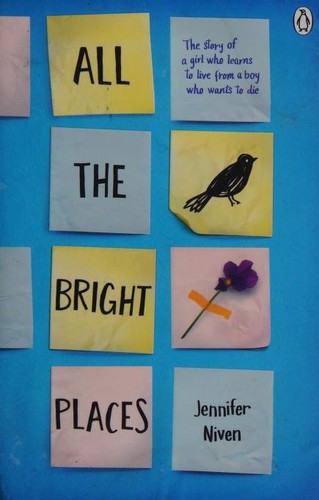
All the Bright Places
by Jennifer Niven
★ Top 10 book of 2015 · #7 on Best Books of 2015
Theodore Finch, preoccupied with death, and Violet Markey, grieving her sister, meet on a school bell tower ledge. A shared project exploring their state's natural wonders helps each find new ways to live, though Finch's world narrows.
Best for: Teen and young adult readers drawn to emotional stories about grief, mental health and connection
All the Bright Places is #7 on BookWard's Best Books of 2015, out of 55 2015 books that cleared our data bar.
What All the Bright Places is about
Violet and Finch first meet at the top of their school's bell tower, both thinking about jumping. Finch talks Violet down, and from that moment the two are tied together. Violet is still grieving her sister Eleanor, who died in a car accident nine months earlier, and she carries survivor's guilt. Finch is fascinated by death, has depression with "Awake" periods, and is treated by classmates as a freak.
When they are paired for a school project exploring places around Indiana, including Hoosier Hill, their friendship deepens into love. Finch helps Violet talk about her sister and begin writing again. But his own struggles run deep. He is abused by his father and refuses to be given a diagnosis, because labels make him feel trapped. Violet's parents grow wary of him after a night out, and trouble at school pushes things toward a harder place.
Jennifer Niven's first young adult novel draws on her own story. It is tender and bittersweet, and heavy in subject, so it is best for readers ready to sit with grief and mental illness.
All the Bright Places on the Best Books of 2015
All the Bright Places came out in 2015. Of the 55 books first published in 2015 that met BookWard's data bar, it ranks #7 on our Best Books of 2015 list.
Why it made the list: 1,259 readers have shelved it on Open Library; readers rate it 4.2 out of 5 (65 ratings); 86 are reading it right now. The list ranks each year’s books on how many readers have picked them up, how highly readers rate them, and how many are reading them right now.
It earns Being read right now.
Nearby on the 2015 list
- Red Queen Victoria Aveyard, #5
- The Sword of Summer Rick Riordan, #6
- A Little Life Hanya Yanagihara, #8
- Corrupt Penelope Douglas, #9
See all Best Books of 2015 Best books by year
More years: Best Books of 2014 Best Books of 2016.
The numbers behind it
- Readers: 1,051 want to read it, 86 are reading it now and 122 have read it, according to Open Library.
- Ratings: 4.2 out of 5 from 65 Open Library ratings.
| Signal | This book (0 to 100) | Weight |
|---|---|---|
| Reach | 91 | 55% |
| Reader love | 62 | 25% |
| Being read right now | 91 | 20% |
Questions about All the Bright Places
When was All the Bright Places published?
All the Bright Places by Jennifer Niven was first published in 2015.
Was All the Bright Places one of the best books of 2015?
All the Bright Places is #7 on BookWard's Best Books of 2015, out of 55 2015 books that cleared our data bar. 1,259 readers have shelved it on Open Library; readers rate it 4.2 out of 5 (65 ratings); 86 are reading it right now.
Why is All the Bright Places on the Best Books of 2015 list?
1,259 readers have shelved it on Open Library; readers rate it 4.2 out of 5 (65 ratings); 86 are reading it right now.
More of the best books of 2015
- Six of Crows Leigh Bardugo, #1
- The Hired Girl Laura Amy Schlitz, #2
- Queen of Shadows Sarah J. Maas, #3
- November 9 Colleen Hoover, #4
- Red Queen Victoria Aveyard, #5
- The Sword of Summer Rick Riordan, #6
See the full Best Books of 2015, the Top 100, or new books on Rising.
How we know
This page uses public data: Open Library reader counts and ratings, and Wikipedia page views for recent years. The description is paraphrased from real source text. Rankings reflect reading interest, not quality or sales, and can be affected by data gaps. Lists update monthly.
Suited to older teens and adults who enjoy emotional YA.
Depends on the edition you pick.
Two teenagers meet on a ledge and change each other. 56% taste match
 BookWard’s take
Two teenagers meet on a ledge and change each other
Jennifer Niven's debut YA novel opens on a school bell tower, with two teenagers on the ledge at the same moment, and that scene grabs you at once. The hook is strong, and the road-trip project across Indiana keeps things moving without a real sag. Finch and Violet are drawn with care, which is where the book is at its best, and the alternating voices let you live inside both of them. Where I part company with it is sentiment: this is a tearjerker that reaches for big feeling rather than restraint, and its familiar types (the quirky boy, the grieving girl) are well worn. It handles depression and suicide directly, with an emotional pull that is entirely deliberate. A warm, quick read if you can accept that.
A standard YA novel of moderate length rather than a sprawling one, which suits BookWard's liking for the tight.
The Indiana trip structure keeps things moving at a good clip, close to what BookWard likes.
The premise of two people saving each other has been done often, so it feels more familiar than fresh.
The writing is clear and accessible rather than ornate, a little plainer than BookWard's middle ground.
Its force comes from the two leads and their relationship more than from plot machinery.
Moments of joy are set against a heavy subject, and the overall outlook leans sombre.
It follows a conventional alternating-narrator shape without formal experiment.
Finch's quirky energy brings lightness, but the book stays serious at heart.
Depression, suicide and grief are central, so the content is heavy and dark.
The book is built to hit hard emotionally, so the feeling runs intense.
See all 50 dialsEvery position, side by side with this book
Where it lines up
- Story or ideasBookWard 3 · book 3
- OpeningBookWard 10 · book 9
- PaceBookWard 8 · book 7
Where it pulls apart
- Familiar tropesBookWard 10 · book 4
- Internal logicBookWard 10 · book 6
- OriginalityBookWard 9 · book 4
A standard YA novel of moderate length rather than a sprawling one, which suits BookWard's liking for the tight.
Two teenagers on the same school ledge in the opening scene is an immediate hook, and BookWard rewards that.
The quirky boy and the grieving girl are familiar YA figures, which sits against BookWard's wish to avoid tropes.
The events follow a clear emotional line, though the plot leans on coincidence to bring the pair together.
The Indiana trip structure keeps things moving at a good clip, close to what BookWard likes.
The premise of two people saving each other has been done often, so it feels more familiar than fresh.
Finch and Violet are given real inner lives and histories, which BookWard values, though some supporting figures are thin.
The story drives toward a definite conclusion rather than leaving things open, which BookWard prefers.
The book aims openly for tears and big feeling, the opposite of the restraint BookWard favours.
The darkness serves the story's subject, but it can lean on emotional impact for effect.
This is fiction, so the dial does not apply.
Two distinct narrators give it recognisable personality, though the style stays within YA conventions.
This is firmly story-led, driven by the two characters and their bond, in line with BookWard.
Backstory is mostly revealed through the characters' thoughts and scenes, with some direct explaining.
The travel project gives the middle a steady purpose, so it holds up well.
The writing is clear and accessible rather than ornate, a little plainer than BookWard's middle ground.
Its force comes from the two leads and their relationship more than from plot machinery.
Moments of joy are set against a heavy subject, and the overall outlook leans sombre.
It follows a conventional alternating-narrator shape without formal experiment.
Finch's quirky energy brings lightness, but the book stays serious at heart.
It reads easily and quickly, asking little effort beyond emotional openness.
The story alternates between two narrators, so it has a few viewpoints rather than many.
The story moves forward in a mostly linear way, close to the opposite of BookWard's shifting taste.
It is set in the real world with no fantastical element.
Attention stays on the two leads, with a small supporting cast around them.
The stakes are personal and intimate rather than epic.
Most of the weight sits in the characters' thoughts and feelings rather than outward action.
The relationship is carried largely through conversation and exchanges, which BookWard enjoys.
The bond between the two leads is the heart of the book, more central than BookWard usually seeks.
A small Indiana town is a familiar, everyday setting.
It is set in a contemporary American high school world, in line with BookWard's present-day lean.
The themes endure, though the teen-romance style is tied to its YA moment.
The narrators are open about their own thoughts, so they read as largely reliable.
The book takes a fairly clear stance on compassion and care, with limited ambiguity.
Settings, like the Indiana sites, are sketched with moderate detail rather than lushly.
This is fiction, so the dial does not apply.
The intimate first-person voices make it deeply personal rather than detached.
It stands alone as a single novel.
The story builds more through emotional turns than shock reveals, with a few surprises.
It deals with hard subjects, but its tone offers some comfort alongside the difficulty.
Depression, suicide and grief are central, so the content is heavy and dark.
The book is built to hit hard emotionally, so the feeling runs intense.
Humor is gentle and quirky, tilting a little dry in places.
Harm is largely discussed or implied rather than shown in graphic scenes.
A teenage relationship includes some intimacy, handled briefly.
It is concerned with personal lives rather than public affairs.
The language is plain and conversational throughout.
The narrators' voices carry strong personal feelings and views.
It dwells mostly on the present and the weight of the past, so it looks backward more than ahead.
Beneath the pain, it believes in connection and small bright moments.
Review written by BookWard, dial version 1, November 2026.
Who is All the Bright Places right for?
Suited to older teens and adults who enjoy emotional YA. It deals directly with suicide, depression and grief, so it may be hard going for anyone sensitive to those subjects.
It reads easily and quickly, asking little effort beyond emotional openness.
Depression, suicide and grief are central, so the content is heavy and dark.
The book is built to hit hard emotionally, so the feeling runs intense.
Harm is largely discussed or implied rather than shown in graphic scenes.
Book CompanionAll the Bright Places: ideas, characters, themes
Two teenagers, one grieving and one fascinated by death, find in each other a reason to keep living.
- A meeting on the ledge. Finch and Violet both climb the school bell tower intending to jump, and each talks the other down.
- A shared project. Finch pairs them for a school assignment to explore Indiana, which pulls both of them out of their isolation.
- Roadside Indiana. The trips take them to unusual sites such as homemade roller coasters and Hoosier Hill.
- Grief and guilt. Violet carries survivor's guilt over her sister Eleanor's death in a car accident.
- Finch's hidden struggle. Finch lives with depression and long 'Awake' periods, and his family doesn't understand what he is facing.
Characters
Theodore Finch
Narrator and co-lead
A boy labelled a freak by his peers, fascinated by death, yet funny and fully alive with Violet.
Violet Markey
Narrator and co-lead
A once-popular girl counting the days to graduation, weighed down by guilt over her sister's death.
Eleanor
Violet's late sister
Her death in a car accident nine months earlier shapes Violet's grief.
Themes
How loss reshapes a person and how guilt can linger.
The isolation of depression and how little others may understand it.
How one person can make another feel seen and able to live.
The gap between how Finch is labelled and who he is with Violet.
Violet moving from counting down days to actually living them.
Discussion questions
- Why do you think Finch and Violet are able to help each other when others cannot?
- How does the book portray the way people misread Finch's behaviour?
- What role does the Indiana project play in changing Violet?
- Does the book handle depression and suicide responsibly, and why?
- How did the alternating narrators affect your sympathy for each character?
Personalize your Book Companion
This is the general edition. In BookWard, the Companion is written for you: your reading profile, your notes, and spoiler-safe to the page you are on.
Buy, listen or borrow All the Bright Places
Each link opens a search for this book on that store, in a new tab.
Read on a device
Borrow
Reviews and community
If you liked All the Bright Places
A mother, a daughter, and a death that unravels both
I Fell in Love with HopeLancaliA hospital heist, a found family, and a girl with sun eyes
Heart BonesColleen HooverA summer fling with a rip current underneath
ConfessColleen HooverA secrets-driven Dallas romance that favors feeling over surprise
Find your own best books
Add what you have read, rate it, and BookWard will recommend what to read next.
Free to start. No credit card needed.