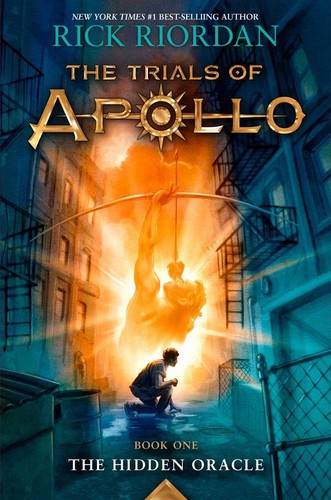
The Hidden Oracle
by Rick Riordan
★ Top 5 book of 2016 · #5 on Best Books of 2016
After angering Zeus, the god Apollo is punished by being turned into an ordinary teenage boy and dropped into New York City. Powerless and hunted by enemies, he turns to Camp Half-Blood, a haven for modern demigods.
Best for: Fans of mythology-inspired adventure and humor with a god out of his depth
The Hidden Oracle is #5 on BookWard's Best Books of 2016, out of 70 2016 books that cleared our data bar.
What The Hidden Oracle is about
Apollo, once a glittering god, is punished by Zeus and tossed into New York City as a mortal teenager named Lester Papadopoulos. Weak, confused and thoroughly out of his depth, he is rescued from two muggers by a girl named Meg McCaffrey, who claims him as her servant until his trials are done. Together they head for Camp Half-Blood, helped along the way by Percy Jackson and his mother, Sally.
The camp is in trouble. The Oracle of Delphi has gone silent, travel and communication are failing, and campers are vanishing into the woods. To earn Zeus's pardon, Apollo must take back the five oracles of Ancient Greece, and a secretive company seems to be after them too. First in The Trials of Apollo series, it is told in Apollo's vain, funny voice and suits readers who enjoy mythology with humor and adventure.
The Hidden Oracle on the Best Books of 2016
The Hidden Oracle came out in 2016. Of the 70 books first published in 2016 that met BookWard's data bar, it ranks #5 on our Best Books of 2016 list.
Why it made the list: 982 readers have shelved it on Open Library; readers rate it 4.5 out of 5 (61 ratings); 59 are reading it right now. The list ranks each year’s books on how many readers have picked them up, how highly readers rate them, and how many are reading them right now.
It earns Reader favorite.
Nearby on the 2016 list
- The Subtle Art of Not Giving a F*ck Mark Manson, #3
- Never Split the Difference Chris Voss, #4
- Born a Crime Trevor Noah, #6
- Ikigai Héctor García, #7
See all Best Books of 2016 Best books by year
More years: Best Books of 2015 Best Books of 2017.
The numbers behind it
- Readers: 801 want to read it, 59 are reading it now and 122 have read it, according to Open Library.
- Ratings: 4.5 out of 5 from 61 Open Library ratings.
| Signal | This book (0 to 100) | Weight |
|---|---|---|
| Reach | 81 | 55% |
| Reader love | 97 | 25% |
| Being read right now | 86 | 20% |
Questions about The Hidden Oracle
When was The Hidden Oracle published?
The Hidden Oracle by Rick Riordan was first published in 2016.
Was The Hidden Oracle one of the best books of 2016?
The Hidden Oracle is #5 on BookWard's Best Books of 2016, out of 70 2016 books that cleared our data bar. 982 readers have shelved it on Open Library; readers rate it 4.5 out of 5 (61 ratings); 59 are reading it right now.
Why is The Hidden Oracle on the Best Books of 2016 list?
982 readers have shelved it on Open Library; readers rate it 4.5 out of 5 (61 ratings); 59 are reading it right now.
More of the best books of 2016
- It Ends with Us Colleen Hoover, #1
- Dog Man Dav Pilkey, #2
- The Subtle Art of Not Giving a F*ck Mark Manson, #3
- Never Split the Difference Chris Voss, #4
- Born a Crime Trevor Noah, #6
- Ikigai Héctor García, #7
See the full Best Books of 2016, the Top 100, or new books on Rising.
How we know
This page uses public data: Open Library reader counts and ratings, and Wikipedia page views for recent years. The description is paraphrased from real source text. Rankings reflect reading interest, not quality or sales, and can be affected by data gaps. Lists update monthly.
Suits middle grade readers and fans of Percy Jackson, and works for adults who enjoy a light, funny read.
Depends on the edition you pick.
A fallen god, a teenage body, and a very funny voice. 57% taste match
 BookWard’s take
A fallen god, a teenage body, and a very funny voice
The Hidden Oracle opens with Apollo landing in a New York dumpster, newly human and furious about it, and the hook lands almost at once. The big draw is the voice: Apollo narrates as a vain, self-regarding deity learning humility, and the humor carries the book. It is firmly story-led and character-driven, with a brisk pace and a mythology-meets-modern-world setup that feels fresh within a familiar Percy Jackson frame. The ties to the wider series are strong, since this launches The Trials of Apollo, so it is not a standalone. The hook and the narration are the real strengths, though the book leans on comfortable tropes rather than avoiding them, and the tone stays light and hopeful rather than restrained. A lively, easy read for fans of the camp and its world.
A middle grade adventure of moderate size that moves along without sprawling, closer to tight than long.
Short chapters and constant incident keep things moving at a quick clip, matching BookWard's taste for speed.
A god forced into a teenager's body is a lively twist, though it sits inside an established franchise.
The prose is plain, conversational and quick, built for clarity and jokes rather than ornament.
Quest events drive the book, but Apollo's changing outlook gives it a character-led core.
Despite his exile, the tone leans optimistic and warm about friendship and growth.
A conventional linear quest told in short chapters with no formal experiments.
Humor runs through nearly every page, mostly via Apollo's self-regard and pop-culture asides.
Danger and monsters appear, but the tone stays gentle and pitched at younger readers.
Feelings come through in friendship and loss, but jokes keep them from running too intense.
See all 50 dialsEvery position, side by side with this book
Where it lines up
- PaceBookWard 8 · book 8
- Authorial voiceBookWard 9 · book 9
- OpeningBookWard 10 · book 9
Where it pulls apart
- Familiar tropesBookWard 10 · book 4
- LengthBookWard 1 · book 4
- Internal logicBookWard 10 · book 7
A middle grade adventure of moderate size that moves along without sprawling, closer to tight than long.
Apollo falls into a dumpster as a human teenager in the first scene, so the book grabs attention immediately, as BookWard likes.
Chosen-camp, quest-and-prophecy beats are familiar territory from Percy Jackson, which is comfortable but not the tropes-avoiding freshness BookWard prizes.
Greek myth gives the world clear rules, though the plot leans on convenient rescues and sudden reveals.
Short chapters and constant incident keep things moving at a quick clip, matching BookWard's taste for speed.
A god forced into a teenager's body is a lively twist, though it sits inside an established franchise.
Apollo's arc from vanity toward humility gives real shape, while other characters are drawn more lightly.
The story resolves its central threat but clearly leaves larger questions open for the next volume.
It has warm friendship moments but keeps them undercut by jokes, landing in the middle.
Dangers and losses are present but handled with a light touch rather than shock for its own sake.
Not applicable to a work of fiction.
Apollo's boastful, self-mocking first-person narration is the book's signature and unmistakable.
This is plain adventure storytelling, driven by what happens next rather than by ideas.
Apollo often explains myth and backstory directly in his chatty asides, balanced by plenty of action scenes.
Momentum mostly holds, with only a mild dip when the camp setup takes its time.
The prose is plain, conversational and quick, built for clarity and jokes rather than ornament.
Quest events drive the book, but Apollo's changing outlook gives it a character-led core.
Despite his exile, the tone leans optimistic and warm about friendship and growth.
A conventional linear quest told in short chapters with no formal experiments.
Humor runs through nearly every page, mostly via Apollo's self-regard and pop-culture asides.
Easy reading, written for middle grade with clear language and brisk scenes.
Everything comes through Apollo's single first-person narration.
The story moves forward in a straightforward sequence.
Gods, monsters and a hidden camp for demigods make it heavily fantastical.
Camp Half-Blood brings in a sizable crowd of demigods, gods and returning series figures.
The personal stakes of one god are set against bigger threats to the oracles, giving moderate scope.
Apollo's reactions matter, but quests and fights keep the focus slightly on outward action.
Banter among Apollo, Meg and the campers carries a lot of the book.
Romance sits in the background, with friendship and growth taking the lead.
Modern New York mixed with the mythic camp feels half familiar, half new.
Present-day New York and contemporary references set it firmly in modern times.
Its jokes and franchise ties are tied to its moment, though the myths themselves endure.
Apollo mostly tells it straight but is vain and blind to his flaws, bending the picture slightly.
Right and wrong are clear, with villains plainly opposed and heroes plainly decent.
Description serves the action and jokes, with only brief colorful touches.
Not applicable to a work of fiction.
Not applicable to a work of fiction.
It opens The Trials of Apollo and connects to the wider Percy Jackson world.
There are a fair number of reveals, but the mystery feels light and guessable.
A comforting, fun read with little to unsettle its young audience.
Danger and monsters appear, but the tone stays gentle and pitched at younger readers.
Feelings come through in friendship and loss, but jokes keep them from running too intense.
Humor leans broad, with exaggerated vanity and cheeky asides, mixed with some wry touches.
There are monster fights and peril, kept bloodless and PG in style.
Essentially absent, in keeping with its middle grade audience.
Politics barely register beyond divine rivalries and camp matters.
Language is plain and modern, with only a few mythological names to learn.
Apollo's narration is strongly opinionated, full of boasts, complaints and judgments.
It reaches back to ancient myth while pointing toward trials still ahead.
Friendship, courage and humility are treated as real virtues, giving it an idealistic lean.
Review written by BookWard, dial version 1, November 2026.
Who is The Hidden Oracle right for?
Suits middle grade readers and fans of Percy Jackson, and works for adults who enjoy a light, funny read. It has monsters and peril but keeps its tone gentle.
Easy reading, written for middle grade with clear language and brisk scenes.
Danger and monsters appear, but the tone stays gentle and pitched at younger readers.
Feelings come through in friendship and loss, but jokes keep them from running too intense.
There are monster fights and peril, kept bloodless and PG in style.
Book CompanionThe Hidden Oracle: ideas, characters, themes
A vain, formerly all-powerful god is stripped of his powers and made a human teenager, and must earn his way back by helping demigods.
- A god turned teen. Zeus punishes Apollo by casting him down to New York as a human named Lester Papadopoulos.
- Meg claims his service. Meg McCaffrey saves Apollo from muggers and binds him to her until his trials are done.
- Camp Half-Blood in trouble. The Oracle of Delphi can no longer give prophecies, and travel and communication are failing.
- Missing campers. Chiron mentions that campers are disappearing into the woods, adding a mystery to the setup.
- A bigger goal. To win Zeus's pardon, Apollo must regain control of the five oracles of Ancient Greece.
Characters
Apollo
Narrator and fallen god
Once an Olympian, now a human teenager who must learn humility.
Meg McCaffrey
Young demigod ally
Rescues Apollo and claims his service; she carries golden rings that become sickles.
Percy Jackson
Returning hero
Helps Apollo and Meg on their way to Camp Half-Blood.
Chiron
Camp leader
The centaur who explains the camp's troubles, including the missing campers.
Themes
A proud god must learn to rely on others.
Apollo can win back his place only by earning it.
Unlikely allies make survival and success possible.
Apollo has to see himself differently when he loses his powers.
Ancient gods and monsters are placed inside contemporary New York.
Discussion questions
- How does Apollo's narration shape how likable or annoying he seems?
- What does Zeus's choice of punishment suggest about power and growth?
- Why might Meg want to claim Apollo's service?
- How does the story use humor to handle danger?
- What would you want to know about the oracles after finishing this first book?
Personalize your Book Companion
This is the general edition. In BookWard, the Companion is written for you: your reading profile, your notes, and spoiler-safe to the page you are on.
Buy, listen or borrow The Hidden Oracle
Each link opens a search for this book on that store, in a new tab.
Read on a device
Borrow
Reviews and community
If you liked The Hidden Oracle
Apollo's fourth mortal trial: fast, funny, and deep in the series
The Burning MazeRick RiordanA fast, funny Greek-myth quest told by a god turned teenager
The Sword of SummerRick RiordanNorse myth meets a homeless Boston teen, fast and funny
Aru Shah and the End of TimeRoshani ChokshiA fib lights a lamp and frees a demon
Find your own best books
Add what you have read, rate it, and BookWard will recommend what to read next.
Free to start. No credit card needed.