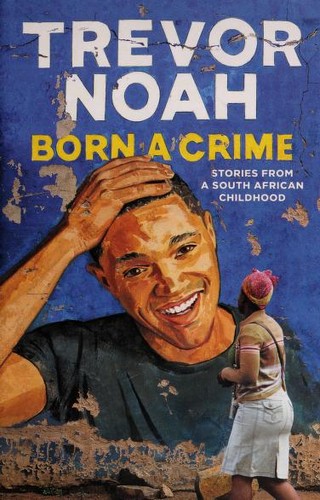
Born a Crime
by Trevor Noah
★ Top 10 book of 2016 · #6 on Best Books of 2016
Trevor Noah recounts growing up in a world where his very existence was never meant to happen, guided by his fearless, devout mother. His funny, dramatic and honest stories trace a boy surviving poverty, danger and a damaged society.
Best for: Readers who like witty, heartfelt memoirs about family, resilience and growing up
Born a Crime is #6 on BookWard's Best Books of 2016, out of 70 2016 books that cleared our data bar.
What Born a Crime is about
Trevor Noah was born in South Africa at a time when apartheid made his parents' relationship illegal. His very existence was against the law, and he grew up as a mischievous boy in a world that had no place for him. These stories follow him from childhood into restless young adulthood, and they are just as much about his mother: fearless, rebellious and deeply religious, and determined to rescue her son from poverty, violence and abuse, even at great risk to herself.
The tales range from eating caterpillars when money ran out to surviving an attempted kidnapping to the awkward business of high school dating. Noah tells them with wit and unflinching honesty, finding humor in hardship without brushing past the pain. Readers who enjoy funny, candid memoirs, or who want to understand life under apartheid, will find much to like.
Born a Crime on the Best Books of 2016
Born a Crime came out in 2016. Of the 70 books first published in 2016 that met BookWard's data bar, it ranks #6 on our Best Books of 2016 list.
Why it made the list: 957 readers have shelved it on Open Library; readers rate it 4.6 out of 5 (65 ratings); 56 are reading it right now. The list ranks each year’s books on how many readers have picked them up, how highly readers rate them, and how many are reading them right now.
It earns Reader favorite.
Nearby on the 2016 list
- Never Split the Difference Chris Voss, #4
- The Hidden Oracle Rick Riordan, #5
- Ikigai Héctor García, #7
- Punk 57 Penelope Douglas, #8
See all Best Books of 2016 Best books by year
More years: Best Books of 2015 Best Books of 2017.
The numbers behind it
- Readers: 808 want to read it, 56 are reading it now and 93 have read it, according to Open Library.
- Ratings: 4.6 out of 5 from 65 Open Library ratings.
| Signal | This book (0 to 100) | Weight |
|---|---|---|
| Reach | 79 | 55% |
| Reader love | 99 | 25% |
| Being read right now | 84 | 20% |
Questions about Born a Crime
When was Born a Crime published?
Born a Crime by Trevor Noah was first published in 2016.
Was Born a Crime one of the best books of 2016?
Born a Crime is #6 on BookWard's Best Books of 2016, out of 70 2016 books that cleared our data bar. 957 readers have shelved it on Open Library; readers rate it 4.6 out of 5 (65 ratings); 56 are reading it right now.
Why is Born a Crime on the Best Books of 2016 list?
957 readers have shelved it on Open Library; readers rate it 4.6 out of 5 (65 ratings); 56 are reading it right now.
More of the best books of 2016
- It Ends with Us Colleen Hoover, #1
- Dog Man Dav Pilkey, #2
- The Subtle Art of Not Giving a F*ck Mark Manson, #3
- Never Split the Difference Chris Voss, #4
- The Hidden Oracle Rick Riordan, #5
- Ikigai Héctor García, #7
See the full Best Books of 2016, the Top 100, or new books on Rising.
How we know
This page uses public data: Open Library reader counts and ratings, and Wikipedia page views for recent years. The description is paraphrased from real source text. Rankings reflect reading interest, not quality or sales, and can be affected by data gaps. Lists update monthly.
Suits mature teens and adults, and is widely read in schools and book groups.
Depends on the edition you pick.
A funny, hard-edged childhood memoir from apartheid South Africa. 68% taste match
 BookWard’s take
A funny, hard-edged childhood memoir from apartheid South Africa
Trevor Noah's memoir is a set of linked stories about growing up in South Africa as the child of an illegal interracial relationship during apartheid. It does nearly everything a memoir should. The voice is unmistakable, the humor is real, and the book stays restrained even when the material is painful. It earns its darkness rather than leaning on shock. The characters have real depth, especially Noah's fearless, devout mother, who anchors the whole book. Because it is told as stories rather than a strict chronicle, it moves quickly and the middle holds up. It is more personal and anecdotal than analytical, and that is where it falls a little short for a reader who wants rigor or a broader reckoning with the period. Expect a warm, wry read with real stakes underneath.
Built from short, self-contained stories, it moves briskly and stays lean for a memoir, close to BookWard's liking for tight books.
The story-by-story format keeps things moving, matching BookWard's preference for pace.
A comedian's view of apartheid-era childhood is a distinctive angle, though memoir as a form is familiar.
The writing is plain, conversational and clear rather than ornate, a bit plainer than BookWard's middle ground.
The drive comes from Noah and his mother rather than any plot machinery, matching BookWard's lean toward character.
Hardship is real, but humor and his mother's determination leave an uplifting current.
Essentially a collection of linked stories, a mild departure from a straight chronological memoir.
Humor is central and frequent, well above BookWard's comfortable level of wit.
It deals with poverty, abuse and danger, though humor keeps the tone from turning bleak.
Moments with his mother and moments of peril hit hard emotionally.
See all 50 dialsEvery position, side by side with this book
Where it lines up
- PaceBookWard 8 · book 8
- Character depthBookWard 8 · book 8
- Sagging middleBookWard 8 · book 8
Where it pulls apart
- Internal logicBookWard 10 · book 7
- Rigor (nonfiction)BookWard 9 · book 5
- LengthBookWard 1 · book 3
Built from short, self-contained stories, it moves briskly and stays lean for a memoir, close to BookWard's liking for tight books.
The premise of a child who was never supposed to exist grabs attention early, though it opens a little more gently than BookWard's ideal.
It avoids the standard celebrity-memoir arc by staying rooted in specific, odd, lived episodes.
Events connect cleanly and the cause behind each story is easy to follow, which suits BookWard.
The story-by-story format keeps things moving, matching BookWard's preference for pace.
A comedian's view of apartheid-era childhood is a distinctive angle, though memoir as a form is familiar.
His mother is drawn with real depth and contradiction, which BookWard rewards.
Affection for his mother is plain but the book avoids syrup, keeping the feeling earned.
Harsh episodes are told because they happened and matter, not for effect, which BookWard values.
It is firsthand memoir rather than evidence-driven argument, so it sits below BookWard's rigor preference.
Noah's comic, candid voice is unmistakable and carries the whole book, exactly what BookWard prizes.
It is firmly story-led, with ideas about race and identity arising from episodes, which BookWard favors.
Background on apartheid is woven into anecdotes, though Noah does explain some context directly.
Each story has its own shape and stakes, so the book holds energy throughout.
The writing is plain, conversational and clear rather than ornate, a bit plainer than BookWard's middle ground.
The drive comes from Noah and his mother rather than any plot machinery, matching BookWard's lean toward character.
Hardship is real, but humor and his mother's determination leave an uplifting current.
Essentially a collection of linked stories, a mild departure from a straight chronological memoir.
Humor is central and frequent, well above BookWard's comfortable level of wit.
Easy to read and quick to absorb, a bit easier than BookWard's typical middle ground.
Told entirely through Noah's own eyes, a single viewpoint.
Largely follows his childhood and youth in order, so it reads close to linear.
Entirely grounded in real events and real places.
Centered on a small circle, chiefly Noah and his mother, with others passing through.
The focus is a family and a childhood, though set against a nation's history.
It balances reflection with things happening, leaning slightly toward events.
Conversations and scenes carry a fair share of the storytelling, though not dominantly.
Romance appears only in passing, including high school dating, and is not a focus.
For many readers, apartheid-era South Africa is an unfamiliar setting, which BookWard likes.
The childhood is set in the past, though the telling is contemporary.
Its themes of family, identity and resilience should outlast the moment of publication.
Noah narrates his own life candidly, so he reads as a reliable guide.
The book is clear about the injustice of apartheid while allowing personal complexity.
Places and people are vividly sketched without becoming heavy.
It is storytelling first, not analysis, and reads like a conversation.
This is an intensely personal account told from inside his own life.
A standalone memoir.
Some episodes land unexpected turns, but it is not built on surprises.
It raises uncomfortable truths about race and poverty, balanced by warmth.
It deals with poverty, abuse and danger, though humor keeps the tone from turning bleak.
Moments with his mother and moments of peril hit hard emotionally.
Wry observation mixed with some broader comic set pieces.
Violence, including abuse and a kidnapping attempt, appears but is not dwelt on gratuitously.
Sexual content is minimal and incidental.
Apartheid and race are inseparable from the story, putting politics near the front.
The language is plain and accessible, with only occasional local terms.
Noah's views and jokes color nearly every page, making the narration openly opinionated.
It looks back on a childhood, though with an eye to what it made him.
Cynicism about the system is balanced by faith in family and humor, leaning mildly idealistic.
Review written by BookWard, dial version 1, November 2026.
Who is Born a Crime right for?
Suits mature teens and adults, and is widely read in schools and book groups. It includes poverty, abuse, violence and frank discussion of race, which may need context for younger readers.
Easy to read and quick to absorb, a bit easier than BookWard's typical middle ground.
It deals with poverty, abuse and danger, though humor keeps the tone from turning bleak.
Moments with his mother and moments of peril hit hard emotionally.
Violence, including abuse and a kidnapping attempt, appears but is not dwelt on gratuitously.
Book CompanionBorn a Crime: ideas, characters, themes
A boy born of an illegal mixed-race union learns to survive, and laugh, in a society built to deny his existence.
- Born illegal. Noah's very existence was a crime under apartheid, shaping how he moved through the world as a child.
- A formidable mother. His fearless, rebellious and deeply religious mother is the book's emotional center and his lifelong teammate.
- Poverty and hunger. Hard times bring scarcity, including meals as modest as caterpillars, told without self-pity.
- Danger close at hand. Episodes such as an attempted kidnapping show how precarious daily life could be.
- Humor as armor. Wit and mischief are how the young Noah, and the book itself, make sense of a damaged world.
Characters
Trevor Noah
Narrator and subject
A mischievous boy who grows into a restless young man searching for where he belongs.
Noah's mother
Parent and protector
Fearless, rebellious and fervently religious, she is determined to save her son from poverty, violence and abuse.
Themes
Finding a place in a world that had no category for you.
A mother's unconventional, unconditional devotion as a source of strength.
How a legal system of separation shaped everyday life and who a person could be.
Surviving poverty and danger through wit, grit and adaptability.
Laughter as a way to tell painful truths.
Discussion questions
- How does humor change the way difficult events land for you as a reader?
- What does the book suggest about identity when the law refuses to recognize you?
- Which of his mother's choices most shaped who Noah became?
- How does telling history through personal stories differ from a straight history?
- Where did the book surprise you most, and why?
Personalize your Book Companion
This is the general edition. In BookWard, the Companion is written for you: your reading profile, your notes, and spoiler-safe to the page you are on.
Buy, listen or borrow Born a Crime
Each link opens a search for this book on that store, in a new tab.
Read on a device
Borrow
Reviews and community
If you liked Born a Crime
A child's-eye memoir of revolution, drawn in stark black and white
The Color of WaterJames McBrideA son's memoir, and his mother's own voice breaking through it
Kitchen ConfidentialAnthony BourdainBourdain's unfiltered, funny tour through the back of the house
AssataAssata ShakurA wry, furious memoir that refuses the state's version of her
Find your own best books
Add what you have read, rate it, and BookWard will recommend what to read next.
Free to start. No credit card needed.