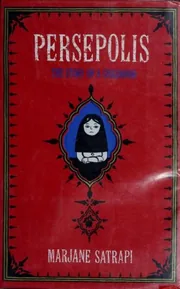
Persepolis 1 & 2
by Marjane Satrapi · 2003
It suits teens and adults, and is often read by younger teens.
160 pages, about 2.5 to 3.5 hours.
A child's-eye memoir of revolution, drawn in stark black and white. 73% taste match
The story
Persepolis 1 & 2 is a graphic memoir by Marjane Satrapi, first published in 2003. Told in black-and-white comic strip panels, it follows the author's life in Tehran from the age of six to fourteen, drawing on her own childhood to recount a period of upheaval in Iran. The book opens with an image of herself at ten years old and moves outward from there into the world around her.
Those years cover the fall of the Shah's regime, the rise of the Islamic Revolution, and the war with Iraq. Satrapi was the only child of committed Marxists and a great-granddaughter of one of Iran's last emperors, so her family story is closely bound up with the history of the country. The memoir looks at daily life through a child's eyes, including the gap between what happened at home and what was expected in public. It sits within Biography & Memoir and also belongs to the tradition of nonfiction graphic novels, with attention to girlhood, adolescence, and Iranian culture. The book runs to roughly 160 pages in a typical edition.
This is me when I was 10 years old.
Themes
Iran, biographyGirls, biographyAuthors, biographyWomen, biographyNew York Times bestsellerComic books, stripsTeens - biographyTeens - life & relationships
- Want to read 107
- Reading now 6
- Read 58
Readers are split between finishing it and saving it for later.
Of 171 readers who put it on a shelf, 63% want to read it, 4% are reading it now, 34% have finished it and 0% stopped before the end.
By the numbers
- The median edition runs 160 pages. Counting about 275 words a page and an adult reading pace of 250 words a minute, that is about 2.9 hours of reading.
- Open Library tracks 10 editions from 7 publishers, the earliest dated 2003 and the latest 2020, across 2 languages.
- On reader demand it ranks in the top 4% of the modern books in our catalog (15,152 of them).
- Libraries shelve it under Dewey 955.0542092 and Library of Congress class DS-0318.84000000.
 BookWard’s take
A child's-eye memoir of revolution, drawn in stark black and white
Marjane Satrapi follows her own life in Tehran from age six to fourteen, and the child's-eye view is the book's great strength. Her voice is unmistakable, and few memoirs of political upheaval look or sound like this one, with black-and-white panels that are all her own. It is short, and the opening image of herself at ten hooks quickly. The history arrives through scenes at home and on the street rather than lecture, so the exposition never weighs the story down. The subject is heavy and asks some patience of the reader, yet the telling is so plain and funny that it keeps its force long after the last page. Humor and heartbreak share the same page, and the book trusts restraint over sentiment, which is exactly why it lands.
At roughly 160 pages, it covers eight years of a childhood and a nation without sprawl, which fits BookWard's taste for tight books.
Short comic-strip episodes move briskly through years, though the war chapters carry a steadier, heavier tread.
A memoir of the Islamic Revolution drawn as stark black-and-white strips is a form and perspective that feels truly its own.
The words are plain and spare, letting the images and the child's perspective carry the weight.
The through-line is Marjane growing up and changing, with history as the setting that shapes her.
Laughter survives alongside loss and fear, giving it grit and resilience more than outright optimism.
The comic panel form is distinctive, yet the book moves in a simple chronological run.
It is serious at heart, but the child's blunt humor keeps surfacing and lightens the load.
State violence and war are present throughout, balanced by humor and warmth.
Fear, grief and affection run strong, but are expressed with restraint.
See all 50 dialsEvery position, side by side with this book
Where it lines up
- LengthBookWard 1 · book 1
- OriginalityBookWard 9 · book 9
- Character depthBookWard 8 · book 8
Where it pulls apart
- OpeningBookWard 10 · book 8
- Familiar tropesBookWard 10 · book 8
- Rigor (nonfiction)BookWard 9 · book 6
At roughly 160 pages, it covers eight years of a childhood and a nation without sprawl, which fits BookWard's taste for tight books.
It opens on an image of the author at ten years old, and the immediacy of a child's voice pulls you in fast.
A war and revolution memoir told through a girl's eyes in comic panels avoids the usual shapes of the genre.
Events connect cleanly from home life to street life to national history, so the cause and effect never wobbles.
Short comic-strip episodes move briskly through years, though the war chapters carry a steadier, heavier tread.
A memoir of the Islamic Revolution drawn as stark black-and-white strips is a form and perspective that feels truly its own.
Marjane and her Marxist family are drawn with contradictions, humor and vulnerability rather than as symbols of a cause.
As a memoir of ages six to fourteen it closes a chapter of her life, though the larger story clearly continues.
Even at its saddest, the plain drawing and dry observation keep it from tipping into sentimentality.
The whippings, war and repression are shown because they happened, not to jolt the reader, so the darkness is earned.
It is a personal memoir grounded in real events and family history rather than a documented study, though it is faithful to its period.
Satrapi's drawing style and blunt, wry child's-eye narration make it instantly recognizable from the first panel.
Ideas about revolution and repression arrive through lived story, so it stays firmly story-led.
History is learned as Marjane learns it, in scenes and conversations rather than explained outright.
Episodic strips keep every stretch of the book purposeful, with little room for slack.
The words are plain and spare, letting the images and the child's perspective carry the weight.
The through-line is Marjane growing up and changing, with history as the setting that shapes her.
Laughter survives alongside loss and fear, giving it grit and resilience more than outright optimism.
The comic panel form is distinctive, yet the book moves in a simple chronological run.
It is serious at heart, but the child's blunt humor keeps surfacing and lightens the load.
The format and plain language make it easy to read, even when the subject is difficult.
We see everything through one person's eyes, from childhood into early adolescence.
It moves forward through her childhood in order, with little jumping around.
This is a grounded memoir of real events, with no fantastical elements.
Family, neighbors and schoolmates fill her world without ballooning into a crowd.
A national upheaval is seen at kitchen-table and classroom scale, which keeps it intimate.
It balances her inner questioning with the outer events of revolution and war.
Conversations at home and school carry much of the story, though images do plenty of the work.
Romance is not a focus, as the book follows girlhood and family.
For many readers, daily life in revolutionary Tehran is an unfamiliar setting, made vivid through a child's eyes.
The events belong to the past, from the Shah's fall through the war with Iraq.
Its portrait of growing up under political repression keeps its relevance long after publication.
Marjane tells her own story directly and honestly, with no sense of trickery.
Right and wrong are often clear to the child, while the adult world around her is full of contradiction.
Description comes mostly through the black-and-white drawings rather than lengthy text.
It reads as a story told in scenes, not an analytical argument.
This is the author's own life, told from deep inside her experience.
Collected as Persepolis 1 and 2, it belongs to a larger telling of her story.
Events unfold as history and family life dictate, with few contrived surprises.
It asks readers to face war, repression and loss, though the telling stays accessible.
State violence and war are present throughout, balanced by humor and warmth.
Fear, grief and affection run strong, but are expressed with restraint.
The humor is deadpan and observational, rising from a child's blunt view of absurdity.
Whippings, war and repression appear on the page, though the plain drawing style keeps them from feeling gratuitous.
Sexual content is minimal, in keeping with a childhood narrative.
Revolution, war and repression drive the whole story, so politics is unavoidable.
The language is straightforward and easy to follow.
Satrapi tells it with a clear point of view and plenty of attitude.
It looks back on a childhood, though its concerns about repression still speak to the present.
Her family holds committed ideals, but the book weighs them against disillusion and loss.
Review written by BookWard, dial version 1, November 2026.
Who is Persepolis 1 & 2 right for?
It suits teens and adults, and is often read by younger teens. It includes depictions of war, state violence and repression, which may be heavy for sensitive readers.
The format and plain language make it easy to read, even when the subject is difficult.
State violence and war are present throughout, balanced by humor and warmth.
Fear, grief and affection run strong, but are expressed with restraint.
Whippings, war and repression appear on the page, though the plain drawing style keeps them from feeling gratuitous.
Book CompanionPersepolis 1 & 2: ideas, characters, themes
A girl growing up in Tehran learns history as it happens around her, and tells it with humor and clarity.
- A childhood told in panels. The memoir covers Marjane's life from age six to fourteen in black-and-white comic strip images.
- A country in upheaval. Those years include the fall of the Shah's regime, the rise of the Islamic Revolution, and the war with Iraq.
- A family bound to history. She is the only child of committed Marxists and great-granddaughter of one of Iran's last emperors.
- Two worlds, home and public. The book looks closely at the gap between life inside the family and what was expected outside.
- Laughter in the face of absurdity. Humor and heartbreak sit side by side, showing how people carry on under repression and war.
Characters
Marjane
Narrator and author
The outspoken only child whose view of events shapes the whole book.
Marjane's parents
Committed Marxist family
They anchor her home life and connect her to the political currents of the time.
Themes
How childhood and adolescence are shaped when public life is controlled.
The contradiction between what is allowed at home and what is demanded outside.
How conflict reaches ordinary families and a child's daily world.
How a family's history and beliefs shape a young person's outlook.
Laughter as a way of coping with absurdity and fear.
Discussion questions
- How does telling the story through a child's eyes change how you take in the history?
- What do the black-and-white panels add that prose alone might not?
- Where do you see the gap between home life and public life most clearly?
- How does humor shape the way the book handles frightening events?
- What stays with you most about Marjane's family and their place in the country's story?
Personalize your Book Companion
This is the general edition. In BookWard, the Companion is written for you: your reading profile, your notes, and spoiler-safe to the page you are on.
Buy, listen or borrow Persepolis 1 & 2
Each link opens a search for this book on that store, in a new tab.
Read on a device
Borrow
Reviews and community
If you liked Persepolis 1 & 2
A funny, hard-edged childhood memoir from apartheid South Africa
Black BoyRichard WrightA hungry boy in the Jim Crow South, told without flinching
A Man of the PeopleChinua AchebeAchebe's short, sharp satire of Nigerian politics and a corrupt charmer
Things Fall ApartChinua AchebeA compact, clear-eyed tragedy of a man and his clan
Sources: Open Library.
Track Persepolis 1 & 2 and find your next favorite
Add it to your shelf, rate what you have read, and BookWard will recommend what fits you.
Free to start. No credit card needed.