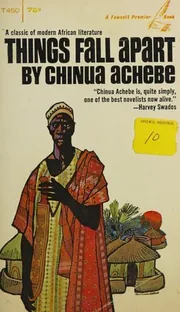
Things Fall Apart
by Chinua Achebe · 1958
Widely taught in schools and suited to mature teens and adults.
192 pages, about 3 to 4.5 hours.
A compact, clear-eyed tragedy of a man and his clan. 68% taste match
The story
Things Fall Apart is a historical novel by Chinua Achebe, first published in 1958. It was his debut, and it belongs to the tradition of Nigerian and African fiction in English. The story is set in the late 19th century in Umuofia, a fictional Igbo clan in southeastern Nigeria, and centers on Okonkwo, a wrestling champion who has made his name through personal achievement and who is known across the nine villages. His family, his history and the customs of Igbo society are laid out first, before the narrative turns to how colonial rule and Christian missionaries arrive and affect him, his household and the wider community.
The book deals with British colonialism, Christianity, masculinity and race relations. Its cast includes Okonkwo's relatives and neighbors such as Nwoye, Ezinma, Ikemefuna, Uchendu and Unoka, alongside the missionary Mr. Brown, James Smith and the District Commissioner. Part of the action takes place in Mbanta. The novel runs to about 192 pages in a typical edition, and it appears in 94 editions in all. A sequel, No Longer at Ease, followed in 1960.
Characters
Chinua AchebeIgboOkonkwoNwoyeEzinmaIkemefuna
Setting
UmuofiaNigeriaMbanta
Period
late 19th century
Themes
20th century literatureChristianitymasculinityBritish colonialismLANGUAGE & LITERARY STUDIESliteratureRace relationsMen
- Want to read 1,796
- Reading now 180
- Read 147
- Stopped 1
Most people shelving it are saving it for later.
Of 2124 readers who put it on a shelf, 85% want to read it, 8% are reading it now, 7% have finished it and 0% stopped before the end.
By the numbers
- The median edition runs 192 pages. Counting about 275 words a page and an adult reading pace of 250 words a minute, that is about 3.5 hours of reading.
- Open Library tracks 94 editions from 59 publishers, the earliest dated 1958 and the latest 2017, across 10 languages.
- On reader demand it ranks in the top 1% of the classic books in our catalog (8,749 of them).
- Libraries shelve it under Dewey 823.914 and Library of Congress class PR-6051.00000000.C5 T5 1983b.
 BookWard’s take
A compact, clear-eyed tragedy of a man and his clan
Achebe's debut is short, and it earns every page. The prose is plain and exact, with a distinctive voice that carries proverbs and folk tales without ornament. Okonkwo is drawn with enough contradiction that his pride and fear feel like a person's, not a type. Igbo customs are shown through ritual, wrestling, feasts and quarrels rather than explained in lectures. The ending is firmly resolved, and it is unsparing. The pace is steady rather than fast, and the book is restrained rather than sentimental. If you value tight, original, airtight storytelling, this is a strong fit.
At about 192 pages it is short and compact, which suits BookWard's preference for tight books.
The first part moves at a deliberate, scene-by-scene pace before events quicken later on.
As an early African novel in English, it offered a perspective and form that were new in its time.
The prose is clear and plain, and its force comes from rhythm and restraint rather than ornament.
Events spring chiefly from Okonkwo's temperament and fears, though the wider history presses on him.
The arc bends toward loss and collapse, with little consolation offered.
A conventional three-part structure, ordered and direct rather than formally experimental.
Humor appears in proverbs and village talk, but the overall tone is serious.
It deals with violence, loss and cultural collapse, handled seriously rather than gratuitously.
Feeling is strong but held in check, and it lands hardest through understatement.
See all 50 dialsEvery position, side by side with this book
Where it lines up
- OriginalityBookWard 9 · book 9
- Sagging middleBookWard 8 · book 8
- LengthBookWard 1 · book 2
Where it pulls apart
- OpeningBookWard 10 · book 6
- EraBookWard 7 · book 1
- OutlookBookWard 7 · book 2
At about 192 pages it is short and compact, which suits BookWard's preference for tight books.
It opens by establishing Okonkwo's standing and the clan's customs, a measured start rather than an instant grab.
It avoids familiar colonial-story tropes by rendering Igbo life from the inside, which BookWard values.
Cause and consequence follow tightly from character and custom, so events feel inevitable and coherent.
The first part moves at a deliberate, scene-by-scene pace before events quicken later on.
As an early African novel in English, it offered a perspective and form that were new in its time.
Okonkwo is drawn with real contradiction, and the people around him feel individual rather than typed.
The ending is decisive and complete, closing the story's arc without leaving the main questions open.
Achebe's telling is spare and unsentimental, letting events land without cushioning.
Its darker turns grow out of character and custom, so they feel earned rather than staged.
This is fiction, so rigor of argument does not apply.
Achebe's narration is unmistakable, shaped by proverbs and a calm, authoritative storyteller's tone.
It is firmly a story, though it carries serious ideas about tradition, change and colonialism.
Customs and beliefs are shown through ritual, work and conflict rather than explained outright.
The book holds its momentum across all three parts, with no stretch that loses its purpose.
The prose is clear and plain, and its force comes from rhythm and restraint rather than ornament.
Events spring chiefly from Okonkwo's temperament and fears, though the wider history presses on him.
The arc bends toward loss and collapse, with little consolation offered.
A conventional three-part structure, ordered and direct rather than formally experimental.
Humor appears in proverbs and village talk, but the overall tone is serious.
The language is accessible, though unfamiliar customs and names ask for some attention.
The narration stays close to Okonkwo and his community, mostly through a single central lens.
The story moves forward in order across Okonkwo's life, without time jumps.
Spiritual belief runs through the clan's world, but the story itself is grounded and realistic.
A sizable community of family members and neighbors surrounds Okonkwo, each with a clear place.
It balances one man's household against the fate of a clan and a changing region.
Okonkwo's fears and pride sit alongside wrestling, farming, feasts and conflict, in roughly equal measure.
Conversation, storytelling and proverbs carry much of the book, though it is not dialogue-heavy.
Family bonds and marriage structures matter, but romance is not a driver of the story.
Most readers will find pre-colonial Igbo society unfamiliar, and the book draws them in without explanation.
It is set in the late 19th century, far from the present day.
First published in 1958, it remains widely read and taught around the world.
The narrator is steady and trustworthy, guiding readers through the clan's world.
Okonkwo's choices are judged with nuance, and neither tradition nor change is made simple.
Detail is selective: enough about land, ritual and food to anchor scenes, without lingering.
This is a novel, so nonfiction style does not apply.
This is a novel, so personal versus detached nonfiction perspective does not apply.
It stands on its own, though a sequel, No Longer at Ease, followed in 1960.
The story builds toward consequence rather than surprise, with few jolts of plot.
It unsettles easy assumptions about tradition, masculinity and empire.
It deals with violence, loss and cultural collapse, handled seriously rather than gratuitously.
Feeling is strong but held in check, and it lands hardest through understatement.
Where humor appears it is dry, folk-wise and understated.
Violence occurs at key moments and carries real weight, though it is not constant.
Sexual content is minimal and not a focus.
Colonial power, religion and cultural conflict are central to the story's meaning.
The language is plain English, with proverbs and Igbo terms that add texture without blocking the way.
The narration observes more than it editorializes, leaving readers to weigh events themselves.
It looks back to a vanishing world, though its closing note points toward the colonial future.
It is clear-eyed about the costs of pride and change, and offers little in the way of idealism.
Review written by BookWard, dial version 1, November 2026.
Who is Things Fall Apart right for?
Widely taught in schools and suited to mature teens and adults. It includes scenes of violence and death that some younger readers may find upsetting.
The language is accessible, though unfamiliar customs and names ask for some attention.
It deals with violence, loss and cultural collapse, handled seriously rather than gratuitously.
Feeling is strong but held in check, and it lands hardest through understatement.
Violence occurs at key moments and carries real weight, though it is not constant.
Book CompanionThings Fall Apart: ideas, characters, themes
A proud man's rigid sense of strength collides with a changing world, and both he and his clan are broken by it.
- A world shown from inside. The first part lays out Okonkwo's family, history and Igbo customs before colonial rule enters the story.
- Pride and fear. Okonkwo has made his name through personal achievement and is known across the nine villages.
- Three-part shape. Part one builds the clan's world, while parts two and three bring in missionaries and colonial authority.
- Colonialism and religion. British rule and Christianity arrive and press on Okonkwo, his household and the wider community.
- Debut and legacy. Published in 1958, it is widely seen as the archetypal modern African novel in English.
Characters
Okonkwo
Protagonist
A wrestling champion and leader in the Igbo clan of Umuofia, known across the nine villages.
Nwoye
Okonkwo's son
A member of Okonkwo's household whose path is shaped by the changes reaching the clan.
Ezinma
Okonkwo's daughter
A member of his family who figures in the household at the story's center.
Ikemefuna
Boy in Okonkwo's household
A figure linked to Okonkwo's family and to the clan's customs.
Mr. Brown
Missionary
A Christian missionary whose arrival marks the new influence entering the community.
Themes
How Okonkwo's idea of strength shapes his choices and his relationships.
The impact of British rule on a community and its way of life.
What happens when a long-standing culture meets forces it cannot easily absorb.
The clash between Igbo belief and arriving Christian missions.
How a man's dread of weakness can drive him toward ruin.
Discussion questions
- How does Achebe show Igbo society before presenting colonial rule, and why does that order matter?
- Is Okonkwo a sympathetic character, and does the book ask us to judge him?
- How do the missionaries change the community, and who is drawn to them?
- What do the proverbs and stories add to the way the book is told?
- What does the title suggest about the way the story unfolds?
Personalize your Book Companion
This is the general edition. In BookWard, the Companion is written for you: your reading profile, your notes, and spoiler-safe to the page you are on.
Buy, listen or borrow Things Fall Apart
Each link opens a search for this book on that store, in a new tab.
Read on a device
Borrow
Reviews and community
If you liked Things Fall Apart
A hunted, drinking priest and the faith he cannot shed
Arrow of GodChinua AchebeA proud priest and a changing world, told without a false note
The river betweenNgũgĩ wa ThiongʼoTwo ridges, two faiths, and one young man holding the line
Black BoyRichard WrightA hungry boy in the Jim Crow South, told without flinching
Sources: Open Library.
Track Things Fall Apart and find your next favorite
Add it to your shelf, rate what you have read, and BookWard will recommend what fits you.
Free to start. No credit card needed.