It suits mature teens and adults, and is widely read in schools and book groups.
290 pages, about 4.5 to 7 hours.
A hungry boy in the Jim Crow South, told without flinching. 61% taste match
What it covers
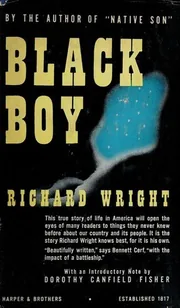
Black Boy is a memoir by the American author Richard Wright, first published in 1945. It follows his childhood and youth in the Jim Crow South, beginning with his earliest memories at the age of four and tracing his growth from boyhood into young manhood. The account is set in the early twentieth century, and Wright, who lived from 1908 to 1960, writes about his own family and home life in Mississippi, Arkansas and Tennessee.
The book looks closely at segregation and the social conditions that shaped daily life for African American families in the South. It also follows Wright's later move to Chicago, where he builds his career as a writer and becomes involved with the Communist Party. Readers interested in autobiography, African American authors, and the history of race and everyday life in the United States will find it a fitting choice. The edition runs to roughly 290 pages.
One winter morning in the long-ago, four-year-old days of my life I found myself standing before a fireplace, warming my hands over a mound of glowing coals, listening to the wind whistle past the house outside.
Setting
MississippiSouthern States
Period
20th century
Themes
Social life and customsAfrican American authorsBiographiesAfrican AmericansÉcrivains américainsChildhood and youthBiographyYouth
- Want to read 226
- Reading now 17
- Read 23
Most people shelving it are saving it for later.
Of 266 readers who put it on a shelf, 85% want to read it, 6% are reading it now, 9% have finished it and 0% stopped before the end.
By the numbers
- The median edition runs 290 pages. Counting about 275 words a page and an adult reading pace of 250 words a minute, that is about 5.3 hours of reading.
- Open Library tracks 64 editions from 39 publishers, the earliest dated 1945 and the latest 2020, across 3 languages.
- On reader demand it ranks in the top 5% of the classic books in our catalog (8,749 of them).
- Libraries shelve it under Dewey 975.00496073 and Library of Congress class PS-3545.00000000.R815 Z96 2005.
 BookWard’s take
A hungry boy in the Jim Crow South, told without flinching
Richard Wright's memoir opens at the age of four, standing before a fireplace, and quickly pulls you into a childhood shaped by hunger, family strain and the rules of segregation. The voice is unmistakably his, blunt and watchful. The self-portrait is drawn with real honesty, and the tone stays restrained, refusing to soften what happened. There is no shock for effect here, since the darkness comes from the world he describes rather than from any show of it. It leans toward story over argument, though the ideas are everywhere. At 290 pages it moves steadily from Mississippi toward Chicago and a writing life, and it holds up as a plain, powerful account of how a young man became a writer.
At roughly 290 pages it is moderate in size, longer than a short memoir but never sprawling.
The chapters move through childhood and youth at a steady clip, with room for reflection.
It reshaped American autobiography, and its frankness about race and the South still feels fresh.
The prose is direct and clear, with a plain force rather than ornament.
The drive comes from Wright's own growth and inner development more than from plotted events.
It is sobering and often bleak, though his drive toward writing offers a thread of hope.
It follows a conventional chronological memoir shape from early childhood onward.
It is a serious book, with little room for lightness given its subject.
It deals with hunger, segregation and cruelty, and it stays dark throughout.
The feeling is strong and often angry, though conveyed with control.
See all 50 dialsEvery position, side by side with this book
Where it lines up
- SentimentBookWard 8 · book 8
- OriginalityBookWard 9 · book 8
- Character depthBookWard 8 · book 9
Where it pulls apart
- LengthBookWard 1 · book 4
- Rigor (nonfiction)BookWard 9 · book 5
- OpeningBookWard 10 · book 8
At roughly 290 pages it is moderate in size, longer than a short memoir but never sprawling.
It begins with a vivid early memory at a fireplace and draws the reader in from the first lines.
It avoids the stock shapes of the triumphant life story and offers a specific, unsoftened account.
Events follow cleanly from one stage of his life to the next, and cause and consequence stay clear.
The chapters move through childhood and youth at a steady clip, with room for reflection.
It reshaped American autobiography, and its frankness about race and the South still feels fresh.
Wright draws himself with candor, including his anger, hunger and stubbornness, which fits BookWard's taste well.
It follows his move toward Chicago and a writing life, closing a clear phase of his story.
It resists easy comfort and tells hard things plainly, which suits BookWard's preference for restraint.
Its darkness is the documented reality of Jim Crow life, not shock added for effect.
It is a personal memoir rather than a documented study, so its authority comes from lived experience.
Wright's voice is blunt, observant and unmistakably his own, a real strength here.
It is led by his lived story, though ideas about race and society run through every scene.
It mostly shows events in scene, with reflective passages added where Wright steps back.
The account stays purposeful as it moves between places and phases of his life.
The prose is direct and clear, with a plain force rather than ornament.
The drive comes from Wright's own growth and inner development more than from plotted events.
It is sobering and often bleak, though his drive toward writing offers a thread of hope.
It follows a conventional chronological memoir shape from early childhood onward.
It is a serious book, with little room for lightness given its subject.
The language is accessible, though the subject matter asks for emotional attention.
It is told entirely from Wright's own point of view.
The account runs in order from his earliest memories through young manhood.
It is wholly grounded in real life and lived experience.
Family and the people around him populate the story, a moderate cast across several places.
The focus is one life and one family, though it speaks to a whole society.
It balances what happens to him with how he thinks and feels about it.
Scenes carry spoken exchanges, but the narration does most of the work.
Romance plays a minor role beside family, work and survival.
The Jim Crow South of the early twentieth century will be unfamiliar to many readers.
It looks back on the early twentieth century and was published in 1945.
Its honest depiction of racism in America keeps it widely read and discussed.
Wright narrates his own life directly, and the reader can trust his account as his own.
The injustice is clear, though Wright is willing to examine complicated reactions, his own included.
Places and moments are rendered with concrete, sensory detail.
It reads as a narrative memoir rather than an analytical study.
It is intimately personal, written by the person who lived it.
It stands as a complete, self-contained memoir.
As a memoir it relies on lived events, not engineered surprises.
It confronts racism and cruelty head on and does not aim to comfort.
It deals with hunger, segregation and cruelty, and it stays dark throughout.
The feeling is strong and often angry, though conveyed with control.
Humor is scarce and mostly dry, appearing only in passing.
It describes racial violence and its threat, treated seriously rather than lingered on.
Sexual content is minimal and not a focus.
Race, segregation and later the Communist Party put politics near the center.
The language is mostly plain, with some period and regional speech.
Wright shares his own views and judgments openly as he reflects on events.
It looks back on a childhood and youth, though with an eye to a larger future.
Wright is clear-eyed and often skeptical, though a belief in writing and change survives.
Review written by BookWard, dial version 1, November 2026.
Who is Black Boy right for?
It suits mature teens and adults, and is widely read in schools and book groups. It deals frankly with racism, hunger and violence, which may call for context and discussion.
The language is accessible, though the subject matter asks for emotional attention.
It deals with hunger, segregation and cruelty, and it stays dark throughout.
The feeling is strong and often angry, though conveyed with control.
It describes racial violence and its threat, treated seriously rather than lingered on.
Book CompanionBlack Boy: ideas, characters, themes
Black Boy follows Richard Wright from his earliest memories in the Jim Crow South toward a writing life, showing how segregation shaped a mind and a self.
- Starts in early memory. The memoir begins when Wright is four years old, standing before a fireplace, and builds outward from that small scene.
- Three Southern states. His youth moves through Mississippi, Arkansas and Tennessee, with family and home life at the center.
- Segregation shapes daily life. The book examines how the social conditions of the Jim Crow South affected African American families day to day.
- A move to Chicago. It follows him north, where he builds his career as a writer and becomes involved with the Communist Party.
- Acclaim and controversy. It was widely praised for its honest and profound depiction of racism, though its reception was also controversial.
Characters
Richard Wright
Author and narrator
The memoir's subject and voice, traced from a four-year-old boy to a young man.
Themes
How Jim Crow rules and attitudes shaped everyday life and opportunity.
The movement from innocence to experience over childhood and youth.
The pressures and bonds inside the household where Wright grows up.
What it means to be a man, Black and Southern in America.
How a literary life becomes a path out and a way to understand his world.
Discussion questions
- How does opening with a four-year-old's memory shape the way you read the rest of the book?
- What does Wright's restrained, direct style add to the force of what he describes?
- How does the move from the South to Chicago change the story?
- Why might the book have been both celebrated and controversial when it appeared?
- Which scenes show most clearly how segregation worked in ordinary daily life?
Personalize your Book Companion
This is the general edition. In BookWard, the Companion is written for you: your reading profile, your notes, and spoiler-safe to the page you are on.
Buy, listen or borrow Black Boy
Each link opens a search for this book on that store, in a new tab.
Read on a device
Borrow
Reviews and community
If you liked Black Boy
A Burundian childhood breaks apart as history reaches the street
Im Westen nichts NeuesErich Maria RemarqueA short, unsparing war novel that still lands hard
The Plot Against AmericaPhilip RothRoth's alternate 1940s Newark, seen through a frightened child's eyes
Black like meJohn Howard GriffinA white Texan darkens his skin and records six weeks of Jim Crow
Sources: Open Library.
Track Black Boy and find your next favorite
Add it to your shelf, rate what you have read, and BookWard will recommend what fits you.
Free to start. No credit card needed.