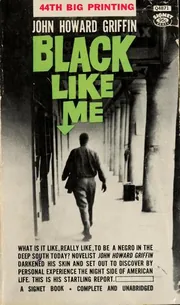
Black like me
by John Howard Griffin · 1960
It suits older teens and adults, and is widely taught in high school and college.
189 pages, about 3 to 4.5 hours.
A white Texan darkens his skin and records six weeks of Jim Crow. 59% taste match
What it covers
Black Like Me is a work of nonfiction by the journalist John Howard Griffin, first published in 1960. It sits at the meeting point of history, biography, and the study of race relations in the American South. The author, a native of Mansfield, Texas, had his skin temporarily darkened so that he could live as a black man and see life on the other side of the color line.
The book follows his travels through the Deep South during the era of Jim Crow laws, when the region was racially segregated. Over six weeks he moved through Louisiana, Mississippi, Alabama, Arkansas, and Georgia, and the account looks at the social conditions faced by African Americans in those states. Sepia Magazine financed the trip in exchange for the right to print his account first as a series of articles. The period covered runs through the early 1960s, and the material touches on religion and the place of Afro-American churches in community life. It is a first-person record of a single journey, written by the man who made it. The book is a staple of high school and college reading lists and has appeared in 43 editions, with a median length of 189 pages.
For years the idea had haunted me, and that night it returned more insistently than ever.
Setting
Southern StatesTexasUnited States
Period
1951-To 1964
Themes
African AmericansAfro-American churchesAfro-AmericansBiographyHistoryRace relationsReligionSocial conditions
- Want to read 291
- Reading now 16
- Read 21
Most people shelving it are saving it for later.
Of 328 readers who put it on a shelf, 89% want to read it, 5% are reading it now, 6% have finished it and 0% stopped before the end.
By the numbers
- The median edition runs 189 pages. Counting about 275 words a page and an adult reading pace of 250 words a minute, that is about 3.5 hours of reading.
- Open Library tracks 43 editions from 20 publishers, the earliest dated 1960 and the latest 2011, across 2 languages.
- On reader demand it ranks in the top 6% of the classic books in our catalog (8,749 of them).
- Libraries shelve it under Dewey 301.45196073076 and Library of Congress class PS-3566.00000000.I5214 F57 2001.
 BookWard’s take
A white Texan darkens his skin and records six weeks of Jim Crow
John Howard Griffin had his skin temporarily darkened and traveled through Louisiana, Mississippi, Alabama, Arkansas, and Georgia as a black man, then wrote down what he met. At 189 pages it is tight and short, and the first sentence, 'For years the idea had haunted me,' sets the journey going almost at once, which suits a reader who likes a fast opening. It also avoids the feel of a formula: this is a single first-person record of a real experiment, not a familiar template. The perspective is personal and the narration openly opinionated. Rigor is the honest caveat: this is lived testimony, closer to anecdote than to a data-heavy study. It is also challenging in a way that has kept it on school reading lists for decades.
At 189 pages it is compact and never overstays, which matches BookWard's liking for short books.
A six-week journey told in sequence keeps moving, a little more measured than BookWard's brisk preference.
A white man living as a black man in the Jim Crow South for a first-person account was a bold, distinctive concept.
The writing is plain and direct, in service of the testimony, a little plainer than BookWard's middle ground.
The drama lives in the narrator's shifting understanding more than in any external plot machinery.
It confronts segregation's cruelty, with moments of decency, but the overall outlook is sober.
It follows a straightforward chronological record of the trip, more conventional than BookWard's middle.
The subject is grave, and humor is essentially absent.
It documents cruelty and humiliation under segregation, serious but not gratuitous.
The indignity and fear Griffin faces give the account real emotional force.
See all 50 dialsEvery position, side by side with this book
Where it lines up
- LengthBookWard 1 · book 2
- PaceBookWard 8 · book 7
- OriginalityBookWard 9 · book 8
Where it pulls apart
- Rigor (nonfiction)BookWard 9 · book 4
- OpeningBookWard 10 · book 8
- Familiar tropesBookWard 10 · book 8
At 189 pages it is compact and never overstays, which matches BookWard's liking for short books.
The very first line announces a long-held idea, and the premise pulls you into the experiment quickly.
A real-life undercover journey across the color line is a fresh frame, not a stock formula, which BookWard values.
The experiment is laid out step by step and the account stays consistent, which BookWard rewards.
A six-week journey told in sequence keeps moving, a little more measured than BookWard's brisk preference.
A white man living as a black man in the Jim Crow South for a first-person account was a bold, distinctive concept.
It centers one narrator's changing perceptions, with others seen mainly through his encounters, so depth is solid but narrow.
A journey with a defined span reaches a natural close, though the larger social problem it exposes stays unresolved.
It is moved and moving without being syrupy, though it is less restrained than BookWard prefers.
The darkness comes from documented conditions, not shock for effect, which earns it BookWard's respect.
It is firsthand testimony of one man's trip, so it leans anecdotal against BookWard's high bar for rigor.
A personal, urgent first-person voice gives the account a recognizable character.
It reads as a journey narrative driven by lived events more than as an argument built on ideas.
Griffin often states what he feels and sees directly, more than BookWard's show-it-in-scene taste.
A travel-by-stage structure keeps fresh episodes arriving, so momentum mostly holds through the journey.
The writing is plain and direct, in service of the testimony, a little plainer than BookWard's middle ground.
The drama lives in the narrator's shifting understanding more than in any external plot machinery.
It confronts segregation's cruelty, with moments of decency, but the overall outlook is sober.
It follows a straightforward chronological record of the trip, more conventional than BookWard's middle.
The subject is grave, and humor is essentially absent.
The language is accessible and widely taught to high schoolers, so it asks little in reading effort.
The story is told from Griffin's single perspective throughout.
Events are recounted in the order they happened over six weeks.
It is nonfiction, fully grounded in a documented journey.
People appear along the road, but the focus stays on the narrator, so the cast stays modest.
It is one man's intimate journey, though it speaks to a whole region's conditions.
It balances what Griffin does and what he feels, with reflection carrying as much weight as movement.
Encounters with strangers drive much of the account, giving conversation a moderate presence.
This is not a book about romance.
For many readers the Jim Crow South of this era is an unfamiliar world seen from an unfamiliar side.
It documents the early 1960s, a past era, though its themes still feel current.
Its continued place on school reading lists shows lasting relevance beyond its moment.
A straightforward first-person witness reports his own experience, so the narrator is reliable.
The book takes a clear moral stand against segregation and racial injustice.
Settings and encounters are rendered clearly, though the emphasis is on events over lush detail.
It is a first-person narrative of a journey instead of an analytical study.
It is written as a deeply personal account by the man who lived it.
It stands alone as a single, self-contained account.
The book unfolds as a record of events, with few narrative surprises beyond the premise.
It confronts uncomfortable truths about race and asks readers to look hard at them.
It documents cruelty and humiliation under segregation, serious but not gratuitous.
The indignity and fear Griffin faces give the account real emotional force.
Humor plays almost no part in this serious account.
Hostility and threat are present, but the book relies more on testimony than graphic scenes.
Sexual content is not a feature of this account.
Race relations under Jim Crow is its central subject, so politics is front and center.
The prose is plain and approachable for a wide audience.
Griffin interprets his own experience and speaks plainly about what he concludes.
It documents a specific past while pressing for change, so it looks back more than ahead.
It appeals to conscience and a more just society, leaning idealistic despite the hard material.
Review written by BookWard, dial version 1, November 2026.
Who is Black like me right for?
It suits older teens and adults, and is widely taught in high school and college. It deals frankly with racism, humiliation, and the threat of violence.
The language is accessible and widely taught to high schoolers, so it asks little in reading effort.
It documents cruelty and humiliation under segregation, serious but not gratuitous.
The indignity and fear Griffin faces give the account real emotional force.
Hostility and threat are present, but the book relies more on testimony than graphic scenes.
Book CompanionBlack like me: ideas, characters, themes
By living as a black man in the segregated South for six weeks, Griffin tries to understand race by experiencing the other side of the color line.
- The experiment. Griffin, a white Texan, has his skin temporarily darkened so he can pass as a black man in the Deep South.
- The route. Over six weeks he travels through Louisiana, Mississippi, Alabama, Arkansas, and Georgia.
- The financing. Sepia Magazine funds the project in exchange for first rights to print the account as a series of articles.
- The setting. The trip takes place under Jim Crow laws, when the region was racially segregated.
- Community and faith. The material touches on religion and the role of Afro-American churches in community life.
Characters
John Howard Griffin
Narrator and author
A journalist from Mansfield, Texas, who undertakes the journey and records what he experiences.
Themes
How a person is treated changes dramatically depending on skin color.
The everyday reality of Jim Crow laws in the American South.
Understanding another's life by living it, at least in part.
The responsibility of reporting what you have seen firsthand.
Discussion questions
- What does Griffin gain from the experiment that he could not learn by interviewing people?
- Is a temporary disguise a fair way to understand a lifetime of discrimination? Why or why not?
- How does the book's first-person perspective shape what we see and what we miss?
- Which parts of the book feel dated, and which feel current?
- Why do you think this book remains on school reading lists?
Personalize your Book Companion
This is the general edition. In BookWard, the Companion is written for you: your reading profile, your notes, and spoiler-safe to the page you are on.
Buy, listen or borrow Black like me
Each link opens a search for this book on that store, in a new tab.
Read on a device
Borrow
Reviews and community
If you liked Black like me
One free man's kidnapping and twelve years in bondage, told plainly
Black BoyRichard WrightA hungry boy in the Jim Crow South, told without flinching
Narrative of the life of Frederick DouglassFrederick DouglassA short, plain-spoken memoir that still lands with force
Between Shades of GrayRuta SepetysA girl's drawings carry a family through Stalin's Siberian deportation
Sources: Open Library.
Track Black like me and find your next favorite
Add it to your shelf, rate what you have read, and BookWard will recommend what fits you.
Free to start. No credit card needed.