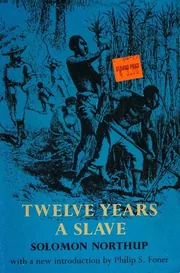
Twelve years a slave
by Solomon Northup · 1853
Best suited to mature teens and adults, and often read in school and college history courses.
234 pages, about 3.5 to 5.5 hours.
One free man's kidnapping and twelve years in bondage, told plainly. 64% taste match
What it covers
Twelve Years a Slave is a first-person memoir by Solomon Northup, first published in 1853. It belongs to the tradition of American slave narratives and personal accounts, and it is also a work of history and biography. Northup was born in 1808 and lived as a free man in New York for more than thirty years before his life changed course.
The book tells how he traveled to Washington, was kidnapped, and was sold into slavery in 1841. He spent the next twelve years in bondage on a cotton plantation in Louisiana, until he was rescued in January 1853. His account describes plantation life in the antebellum United States and the experience of the enslaved from within it. Readers interested in nineteenth-century American history, African American biography, or firsthand writing by people who survived slavery will find it a direct record of one man's captivity and return. The median edition runs about 234 pages.
Characters
Solomon Northup
Setting
LouisianaUnited StatesMarylandBaltimoreMei guo
Period
19th century1810-1890
Themes
SlaveryPlantation lifeHistoryBiographyAfrican AmericansSlavesSlaves' writings, AmericanPersonal narratives
- Want to read 287
- Reading now 18
- Read 23
Most people shelving it are saving it for later.
Of 328 readers who put it on a shelf, 88% want to read it, 5% are reading it now, 7% have finished it and 0% stopped before the end.
By the numbers
- The median edition runs 234 pages. Counting about 275 words a page and an adult reading pace of 250 words a minute, that is about 4.3 hours of reading.
- Open Library tracks 1029 editions from 182 publishers, the earliest dated 1853 and the latest 2024, across 9 languages.
- On reader demand it ranks in the top 5% of the classic books in our catalog (8,749 of them).
- Libraries shelve it under Dewey 306.362092 and Library of Congress class E--0444.00000000.N87.
Read it
The text of this edition is free to read online.
3 ebook providers carry it and a scanned copy is on the Internet Archive.
 BookWard’s take
One free man's kidnapping and twelve years in bondage, told plainly
Solomon Northup's memoir is a first-person record of a free New Yorker kidnapped in Washington in 1841 and sold into slavery on a Louisiana cotton plantation. It opens on a promise of fast money and moves briskly from there, which makes for a strong hook. At 234 pages it is tight, and the account stays sustained rather than sagging. Its power comes from restraint: the prose is plain and the telling is controlled, never straining for sentiment. It earns its darkness because the events are documented fact, not effect. It is more narrative than analytical, so it will not satisfy anyone wanting rigorous argument, but as a witness account of antebellum plantation life it is direct, specific and hard to look away from.
At 234 pages it is compact for a work covering twelve years of a life, which fits BookWard's love of short books.
The narrative moves steadily from kidnapping to rescue without long detours, a little gentler than BookWard's fast preference.
As a firsthand account it offers a perspective few books can, though it belongs to a known tradition of slave narratives.
The 19th-century prose is clear and direct instead of ornate, close to BookWard's plainer side.
Events drive the book, though they matter because of what they do to Northup, so it sits near the middle.
Bleak for most of its length, lifted by the eventual rescue, which keeps it from being hopeless.
A conventional chronological memoir from freedom to captivity to return.
Almost no humor; the subject and tone are wholly serious.
Deals with kidnapping, bondage and abuse, so it is very dark.
Intense in effect, even though the telling is restrained.
See all 50 dialsEvery position, side by side with this book
Where it lines up
- EndingBookWard 8 · book 8
- SentimentBookWard 8 · book 8
- Shock for effectBookWard 9 · book 9
Where it pulls apart
- OpeningBookWard 10 · book 8
- Familiar tropesBookWard 10 · book 8
- Internal logicBookWard 10 · book 8
At 234 pages it is compact for a work covering twelve years of a life, which fits BookWard's love of short books.
The promise of fast money and the sudden turn into captivity pull the reader in early, close to BookWard's taste for a quick start.
A lived account, not a constructed story, so it avoids formula; this suits BookWard well.
Events follow cause and effect in a documented sequence, giving the airtight feel BookWard values.
The narrative moves steadily from kidnapping to rescue without long detours, a little gentler than BookWard's fast preference.
As a firsthand account it offers a perspective few books can, though it belongs to a known tradition of slave narratives.
Northup is drawn from the inside, and others appear through his eyes, so depth is real but concentrated on one man.
The rescue in January 1853 gives a clear, resolved close, in line with BookWard's preference.
The telling stays controlled and factual instead of pleading for tears, which BookWard rewards.
The brutality is the historical record, not decoration, so the darkness is earned.
A personal memoir with named places and dates, solid as testimony but not a scholarly apparatus.
Northup's plain, measured first-person voice is distinctive and carries the weight of a witness.
It is led by what happened to one man, with ideas arising from events rather than argument.
Mostly narrated events, with some direct explanation of how plantation life worked, leaning slightly toward telling.
The account stays purposeful across its length, with no obvious slack, matching BookWard's taste.
The 19th-century prose is clear and direct instead of ornate, close to BookWard's plainer side.
Events drive the book, though they matter because of what they do to Northup, so it sits near the middle.
Bleak for most of its length, lifted by the eventual rescue, which keeps it from being hopeless.
A conventional chronological memoir from freedom to captivity to return.
Almost no humor; the subject and tone are wholly serious.
Readable and clear, though the subject and 19th-century phrasing ask some effort and emotional stamina.
A single first-person narrator carries the entire account.
It runs in straight chronological order from kidnapping through twelve years to rescue.
Entirely grounded in documented reality.
Many masters, fellow captives and others appear over twelve years, but the focus stays on Northup.
Intimate in viewpoint, though it opens onto the wider system of slavery in the antebellum South.
Leans toward events and actions, with Northup's feelings present but secondary.
Reported conversations appear regularly but narration carries most of the account.
Not a romance; family appears as what he lost and longs to regain.
Plantation life in antebellum Louisiana is unfamiliar territory to most modern readers.
Published in 1853 and set in the 19th century, firmly in the past.
Its testimony about slavery has remained essential reading for over a century and a half.
A sincere eyewitness telling his own story; the reader is meant to trust him.
Slavery is presented as a plain wrong with no ambiguity.
Places, labor and daily routines are described with concrete, rich detail.
It reads as a story told in sequence, not an analytical study.
Wholly personal, told by the man who lived it.
A standalone memoir.
The kidnapping is a sharp turn, but the rest follows a largely foreseeable course.
A confronting, uncomfortable read that asks the reader to face brutal history.
Deals with kidnapping, bondage and abuse, so it is very dark.
Intense in effect, even though the telling is restrained.
Essentially no humor of any kind.
Beatings and cruelty feature prominently as part of the record.
Some abuse is referenced, but it is not the focus.
The subject is slavery itself, so political and moral stakes are unavoidable.
19th-century prose and some period speech add mild density.
Northup states clear judgments about slavery and those who practiced it.
A retrospective account of events already lived.
Hope survives in his determination to return, but the book is no idealistic fable.
Review written by BookWard, dial version 1, November 2026.
Who is Twelve years a slave right for?
Best suited to mature teens and adults, and often read in school and college history courses. It contains kidnapping, beatings and other scenes of cruelty that some readers will find distressing.
Readable and clear, though the subject and 19th-century phrasing ask some effort and emotional stamina.
Deals with kidnapping, bondage and abuse, so it is very dark.
Intense in effect, even though the telling is restrained.
Beatings and cruelty feature prominently as part of the record.
Book CompanionTwelve years a slave: ideas, characters, themes
A free man's kidnapping and twelve years in bondage, recorded in his own plain words, shows slavery from the inside.
- A free life interrupted. Northup was born in 1808 and lived as a free man in New York for more than thirty years before his life changed.
- The lure to Washington. He traveled to Washington in 1841 on the promise of fast money and was drugged, beaten and sold.
- Twelve years in Louisiana. He spent the next twelve years in captivity on a cotton plantation.
- Plantation life from within. The book describes antebellum plantation life and the experience of the enslaved as someone living it.
- Rescue and return. He was rescued in January 1853, the year the book first appeared.
Characters
Solomon Northup
Narrator and author
A free New Yorker, born in 1808, who is kidnapped and held in slavery for twelve years before being rescued.
Themes
How quickly a free life can be taken away.
The power of a firsthand account as historical evidence.
The brutality of bondage and the will to survive it.
Holding on to who you are when stripped of your status.
How legal and social systems enabled slavery.
Discussion questions
- Why might Northup have chosen such a plain, restrained style to tell his story?
- How does knowing he was born free change the way you read his captivity?
- What does the memoir show about how ordinary people took part in slavery?
- How does a firsthand account differ from a history written long afterward?
- What responsibilities do readers have when encountering testimony like this?
Personalize your Book Companion
This is the general edition. In BookWard, the Companion is written for you: your reading profile, your notes, and spoiler-safe to the page you are on.
Buy, listen or borrow Twelve years a slave
Each link opens a search for this book on that store, in a new tab.
Read on a device
Borrow
Reviews and community
If you liked Twelve years a slave
A pianist's plain, restrained record of Warsaw's destruction and his survival
Black like meJohn Howard GriffinA white Texan darkens his skin and records six weeks of Jim Crow
Incidents in the Life of a Slave GirlHarriet A. JacobsA formerly enslaved mother tells her own story, plainly and with force
Narrative of the life of Frederick DouglassFrederick DouglassA short, plain-spoken memoir that still lands with force
Sources: Open Library.
Track Twelve years a slave and find your next favorite
Add it to your shelf, rate what you have read, and BookWard will recommend what fits you.
Free to start. No credit card needed.