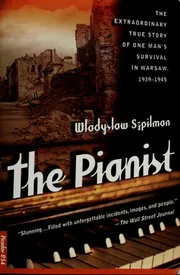
Śmierć Miasta
by Władysław Szpilman · 1946
Best suited to mature teens and adults.
222 pages, about 3.5 to 5 hours.
A pianist's plain, restrained record of Warsaw's destruction and his survival. 59% taste match
What it covers
Śmierć Miasta is a memoir by Władysław Szpilman, first published in 1946. It is a personal narrative of the Holocaust, told by a Polish pianist who lived through the destruction of Warsaw during the war years of 1939 to 1945. The account begins with his work as a pianist in a cafe on Nowolipki Street, in the middle of the Warsaw ghetto, where he played before the ghetto's population was swept away.
The book follows the author's survival in occupied Warsaw, including the loss of his family, who were taken away on the deportation trains. It sits among biographies and wartime testimonies of musicians and of the Polish Jewish community, and it covers the period from the early twentieth century through 1945. The narrative is a single man's record of persecution, genocide and endurance in a city that was nearly erased. Many editions have appeared over the decades, with about 55 in print, typically running around 222 pages.
I began my wartime career as a pianist in the Cafe Nowoczesna, which was in Nowolipki Street in the very heart of the Warsaw ghetto.
Characters
Władysław SzpilmanW¿adys¿aw Szpilman
Setting
PolandWarsawWarsaw (Poland)PologneVarsovie (Pologne)
Period
1900-1945
Themes
BiographyJewsHolocaust, Jewish (1939-1945)Jewish musiciansPersonal narrativesWorld War, 1939-1945Polish Personal narrativesGenocide
- Want to read 195
- Reading now 4
- Read 16
Most people shelving it are saving it for later.
Of 215 readers who put it on a shelf, 91% want to read it, 2% are reading it now, 7% have finished it and 0% stopped before the end.
By the numbers
- The median edition runs 222 pages. Counting about 275 words a page and an adult reading pace of 250 words a minute, that is about 4.1 hours of reading.
- Open Library tracks 55 editions from 37 publishers, the earliest dated 1946 and the latest 2021, across 13 languages.
- On reader demand it ranks in the top 10% of the classic books in our catalog (8,749 of them).
- Libraries shelve it under Dewey 943.805 and Library of Congress class DS-0134.72000000.S97 A3 2003.
 BookWard’s take
A pianist's plain, restrained record of Warsaw's destruction and his survival
Szpilman wrote this in 1946, within a year or so of the events, and the closeness shows. It is a personal narrative of the Holocaust that moves briskly and refuses to decorate what it describes. The restraint is the first thing to notice: it lets the facts carry the grief rather than reaching for it. It also earns its darkness, because the horror is the record, not a device. At 222 pages it is tight, and the pace never lets up. Where it departs from the more hopeful books I usually lean toward is in its outlook, which is far bleaker, and in its moral clarity, which is stark rather than ambiguous. It reads as testimony, not scholarship, yet it feels scrupulously honest throughout.
At 222 pages it is short and compressed, which fits BookWard's love of tight books.
The narrative moves steadily through years of occupation without lingering, a little under BookWard's fast preference.
The perspective of a musician surviving the ruins is distinctive, though the Holocaust setting is widely documented.
The prose is plain and direct, a notch more spare than BookWard's middling taste.
Survival events drive it, though the author's inner endurance gives it some character focus.
The tone is largely bleak, with only faint threads of endurance, well below BookWard's hopeful lean.
A straightforward chronological memoir with no formal experiments, near BookWard's conventional-leaning middle.
There is almost no comedy in a record of genocide, and it is rightly absent.
It depicts the Holocaust and the destruction of a city, as dark as content gets.
The feeling is intense underneath, even though the telling is composed.
See all 50 dialsEvery position, side by side with this book
Where it lines up
- Shock for effectBookWard 9 · book 9
- Story or ideasBookWard 3 · book 3
- LengthBookWard 1 · book 2
Where it pulls apart
- OpeningBookWard 10 · book 8
- Internal logicBookWard 10 · book 8
- Rigor (nonfiction)BookWard 9 · book 6
At 222 pages it is short and compressed, which fits BookWard's love of tight books.
A firsthand witness account has no borrowed tropes, which BookWard values highly.
Events follow a clear, traceable sequence of survival, close to the airtight clarity BookWard prefers.
The narrative moves steadily through years of occupation without lingering, a little under BookWard's fast preference.
The perspective of a musician surviving the ruins is distinctive, though the Holocaust setting is widely documented.
The author draws himself and those he loses with economy, giving real weight but not extended interiority.
The war's end brings a measured sense of resolution while the loss remains unresolved.
Szpilman keeps emotion in check and lets facts speak, which matches BookWard's restrained preference closely.
The darkness is the historical record itself, so it is earned and never used for effect.
It is firsthand testimony rather than analysis, honest and precise but not a scholarly apparatus.
The calm, unadorned voice of a survivor is recognisable and personal, a little short of idiosyncratic.
This is story-led testimony, carried by events and not by argument, which agrees with BookWard.
Events are shown in scene and experience, not explained, in line with BookWard's preference.
The account stays purposeful across its span, with only brief stretches of waiting and hiding.
The prose is plain and direct, a notch more spare than BookWard's middling taste.
Survival events drive it, though the author's inner endurance gives it some character focus.
The tone is largely bleak, with only faint threads of endurance, well below BookWard's hopeful lean.
A straightforward chronological memoir with no formal experiments, near BookWard's conventional-leaning middle.
There is almost no comedy in a record of genocide, and it is rightly absent.
The prose is easy to follow, though the subject asks a great deal emotionally.
Everything is seen through one man's eyes, narrower than BookWard's taste for many viewpoints.
The story runs forward through the war years in order, a little more linear than BookWard likes.
This is entirely grounded in documented history.
Family, fellow Jews and others pass through, giving a moderately sized human cast.
It is one man's story set against a city nearly erased, intimate in focus and vast in backdrop.
The weight falls on what happens around him and what he must do to survive.
Spoken exchanges appear in moments but do not dominate the account.
Romance plays no part in this account.
Wartime Warsaw and its ghetto are unfamiliar territory for most readers, which BookWard enjoys.
It is set in 1939 to 1945 and published in 1946, firmly in the past.
Testimony of this kind keeps its force across generations and has stayed in print.
The author reports what he lived through, a reliable and direct witness.
The moral lines are unmistakable, far clearer than BookWard's ambiguity-leaning taste.
Ruined streets and hiding places are sketched sharply but without lavish detail.
It reads as a lived story, wholly narrative and not analytical.
This is a deeply first-person account, the opposite of detached.
It is a self-contained standalone memoir.
Reversals come from circumstance and chance, not from plotting for surprise.
It confronts the reader with genocide and loss, a deeply challenging read that BookWard welcomes.
It depicts the Holocaust and the destruction of a city, as dark as content gets.
The feeling is intense underneath, even though the telling is composed.
Humor is nearly absent, and what exists is dry at most.
Persecution, deportation and killing are present throughout, depicted with plain matter-of-factness.
There is essentially no sexual content.
Occupation and persecution are the setting, so politics is present but the focus stays on lived experience.
The language is plain and accessible.
The author reports more than he editorializes, though his judgments are felt.
It looks back at events just ended, firmly toward the past.
It records cruelty unflinchingly while keeping faith in survival, leaning somewhat cynical.
Review written by BookWard, dial version 1, November 2026.
Who is Śmierć Miasta right for?
Best suited to mature teens and adults. It depicts persecution, deportation, killing and the loss of family, and may be distressing.
The prose is easy to follow, though the subject asks a great deal emotionally.
It depicts the Holocaust and the destruction of a city, as dark as content gets.
The feeling is intense underneath, even though the telling is composed.
Persecution, deportation and killing are present throughout, depicted with plain matter-of-factness.
Book CompanionŚmierć Miasta: ideas, characters, themes
A Polish Jewish pianist records how he lost his family and survived while the city of Warsaw was destroyed around him.
- Cafe on Nowolipki Street. The account begins with Szpilman playing piano in a cafe within the Warsaw ghetto, before its population was swept away.
- Loss of family. His family is taken away on the deportation trains, a separation that shapes everything that follows.
- Survival in occupied Warsaw. The narrative follows his endurance through years of occupation in a city nearly erased.
- Immediate testimony. First published in 1946, it was written close to the events it records.
- Restraint as method. The telling stays composed and plain, letting the facts carry their own weight.
Characters
Władysław Szpilman
Author and narrator
A Polish Jewish pianist who survives the destruction of Warsaw and tells his own story.
Szpilman's family
The people he loses
They are taken away on the deportation trains, and their loss defines his survival.
Themes
What it takes, and what it costs, to endure while others are killed.
Recording the dead and the vanished so they are not forgotten.
A musician's identity persists through extreme dehumanization.
Warsaw itself is a casualty, nearly erased alongside its people.
Discussion questions
- Why might Szpilman choose such a restrained tone for events this extreme?
- What does it mean that his profession as a pianist sits at the center of the story?
- How does writing so soon after the war shape what the book includes?
- What does the family's farewell at the trains show about how loss is endured?
- How does a single survivor's account differ from a broader history of the period?
Personalize your Book Companion
This is the general edition. In BookWard, the Companion is written for you: your reading profile, your notes, and spoiler-safe to the page you are on.
Buy, listen or borrow Śmierć Miasta
Each link opens a search for this book on that store, in a new tab.
Read on a device
Borrow
Reviews and community
If you liked Śmierć Miasta
One free man's kidnapping and twelve years in bondage, told plainly
A Long Way GoneIshmael BeahA child soldier's memoir, told plainly and painfully
Black like meJohn Howard GriffinA white Texan darkens his skin and records six weeks of Jim Crow
Im Westen nichts NeuesErich Maria RemarqueA short, unsparing war novel that still lands hard
Sources: Open Library.
Track Śmierć Miasta and find your next favorite
Add it to your shelf, rate what you have read, and BookWard will recommend what fits you.
Free to start. No credit card needed.