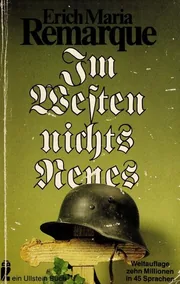
Im Westen nichts Neues
by Erich Maria Remarque · 1928
It suits mature teens and adults, and it is often read in school.
248 pages, about 4 to 6 hours.
A short, unsparing war novel that still lands hard. 65% taste match
The story
Im Westen nichts Neues, first published in 1928, is a historical novel by Erich Maria Remarque, a German veteran of the First World War. The story is narrated by Paul Bäumer, a young man who joins the German army along with his schoolmates. Among the soldiers he serves beside are Albert Kropp, Haie Westhus, Fredrich Müller, Stanislaus Katczinsky and Tjaden. The setting is the war years of 1914 to 1918, with the action unfolding on the front between Germany and France.
The novel follows how the first shelling in the trenches shatters the ideals these young men carried into the army, and how they live through years of fighting. It also deals with the lasting physical and mental toll of combat on German soldiers, and with the distance many of them feel from civilian life. The book is semi-autobiographical and has been widely translated, including into English, as All Quiet on the Western Front.
To the biographer and student of literature, Erich Maria Remarque, who has been called the "recording angel of the Great War," was an enigma, a man rife with contradictions and contrasts.
Characters
Paul BäumerAlbert KroppHaie WesthusFredrich MüllerStanislaus KatczinskyTjaden
Setting
GermanyFrance
Period
1914-191820th centry
Themes
World War, 1914-1918SoldiersGerman languageHistoryRemarque, erich maria, 1898-1970Trench warfareCampaignsIntrenchments
- Want to read 701
- Reading now 38
- Read 164
Most people shelving it are saving it for later.
Of 903 readers who put it on a shelf, 78% want to read it, 4% are reading it now, 18% have finished it and 0% stopped before the end.
By the numbers
- The median edition runs 248 pages. Counting about 275 words a page and an adult reading pace of 250 words a minute, that is about 4.5 hours of reading.
- Open Library tracks 226 editions from 144 publishers, the earliest dated 1928 and the latest 2020, across 14 languages.
- On reader demand it ranks in the top 1% of the classic books in our catalog (8,749 of them).
- Libraries shelve it under Dewey 838 and Library of Congress class PT-2635.00000000.E68 I615.
 BookWard’s take
A short, unsparing war novel that still lands hard
Remarque's 1928 novel is narrated by Paul Bäumer, who enlists with his schoolmates and watches their ideals collapse under the first bombardment. It is a short book, and that suits it: the pace stays brisk, and a tight, fast read like this is a pleasure. The characters have real depth, since a handful of named comrades become individuals rather than types, and the shock is earned by the subject, never used for effect. Restrained sentiment keeps the grief from turning syrupy. It is more idea-driven than most war fiction, leaning on what the front does to a generation, which makes it a touch more reflective than a story-led reader might expect. Still, few books of its era feel this direct, and few have stayed this vital.
At 248 pages it says what it has to say and stops, which matches BookWard's love of tight books.
Short episodes keep it moving, though it is more measured than a thriller, a little under BookWard's pace.
Few novels of its time treated the common soldier's experience with such plain candor, which BookWard rewards.
The language is clear and unadorned, in the plainer half of BookWard's range.
What happens matters because of its effect on Paul and his friends, so character leads, as BookWard likes.
It is bleak about war's toll and the survivors' future, darker than BookWard's mildly hopeful lean.
A linear first-person account in short chapters, fairly conventional, like BookWard's usual middle ground.
Humor appears only as grim comradely relief, so it sits well on the serious side, below BookWard's taste.
The book is heavy with death and despair, darker than BookWard's middle.
Feeling runs deep under a plain surface, close to BookWard's slightly intense lean.
See all 50 dialsEvery position, side by side with this book
Where it lines up
- SentimentBookWard 8 · book 8
- Shock for effectBookWard 9 · book 9
- Authorial voiceBookWard 9 · book 9
Where it pulls apart
- OpeningBookWard 10 · book 8
- Familiar tropesBookWard 10 · book 8
- Internal logicBookWard 10 · book 8
At 248 pages it says what it has to say and stops, which matches BookWard's love of tight books.
It opens straight in the soldiers' world with little throat-clearing, close to BookWard's wish for an immediate hook.
It helped define the war novel, so it feels fresh in intent even where later books borrowed its moves.
Events follow cleanly from the front's conditions, and nothing strains belief, which BookWard values highly.
Short episodes keep it moving, though it is more measured than a thriller, a little under BookWard's pace.
Few novels of its time treated the common soldier's experience with such plain candor, which BookWard rewards.
Paul and his comrades emerge as distinct people through small details, close to the depth BookWard wants.
The ending closes firmly on its themes rather than leaving things open, in line with BookWard's taste.
Grief is stated plainly and kept free of sweetness, which BookWard prefers.
The brutality comes from the subject and serves the point rather than selling the book, as BookWard likes.
This is a novel, so rigor as a nonfiction measure does not apply.
Paul's weary, direct narration is unmistakable and carries the whole book, a strong match for BookWard.
It is driven by what war does to a generation as much as by plot, tilting more toward ideas than BookWard usually does.
Most of it is shown through scenes and incidents, with reflection arriving in short bursts, close to BookWard's preference.
The short, episodic structure keeps tension up throughout, with no real dead stretch.
The language is clear and unadorned, in the plainer half of BookWard's range.
What happens matters because of its effect on Paul and his friends, so character leads, as BookWard likes.
It is bleak about war's toll and the survivors' future, darker than BookWard's mildly hopeful lean.
A linear first-person account in short chapters, fairly conventional, like BookWard's usual middle ground.
Humor appears only as grim comradely relief, so it sits well on the serious side, below BookWard's taste.
The language is easy to read, though the subject is heavy, so it is not a demanding book to follow.
Everything comes through Paul alone, a single viewpoint where BookWard leans toward several.
The story moves forward through the war years, so the timeline stays linear.
It is wholly grounded in the real front, with nothing fantastical.
A small circle of comrades stays in focus, matching BookWard's lean toward manageable casts.
It stays close to a few men in the trenches rather than sweeping across the whole war, so it feels intimate.
It balances Paul's inner reflections with the events of combat, landing near the middle.
The comrades talk often, but the book leans more on narration and incident than on conversation.
Love is a very minor thread here, well below BookWard's middle.
The trenches are alien to most readers today, which gives the setting an unfamiliar edge, as BookWard likes.
It is set in the First World War, firmly in the past, unlike BookWard's present-day lean.
Its portrait of war's cost still reads as current, a strong match for BookWard's weight on staying power.
Paul tells his own story with no sign of deceit, so he reads as reliable.
It makes its case against pointless slaughter clearly, though it leaves some questions about duty open.
Description is functional and sharp rather than lavish, a little under BookWard's lean toward richness.
This is fiction, so a nonfiction style does not apply.
As a novel, the personal-or-detached nonfiction measure does not apply.
It is a standalone novel.
It builds on loss and attrition more than on plot surprises, so twists are few.
It confronts the reader with the cost of war and offers little comfort, which suits BookWard's appetite for challenge.
The book is heavy with death and despair, darker than BookWard's middle.
Feeling runs deep under a plain surface, close to BookWard's slightly intense lean.
What humor exists is dry and grim, on the quieter side.
Battle and its wounds are depicted without flinching, so there is a good deal on the page.
Sexual content is slight and not central.
It argues against the war and the rhetoric that sent young men to it, but stays rooted in lived experience rather than debate.
The language is plain and easy to follow, well below BookWard's middle.
Paul's view of the war is strong and unmistakable, a little more opinionated than neutral.
It looks back on a lost generation more than toward the future.
It ends up deeply disillusioned about glory and patriotism, far from BookWard's idealistic lean.
Review written by BookWard, dial version 1, November 2026.
Who is Im Westen nichts Neues right for?
It suits mature teens and adults, and it is often read in school. It contains graphic scenes of wartime death and injury and a deeply despairing tone.
The language is easy to read, though the subject is heavy, so it is not a demanding book to follow.
The book is heavy with death and despair, darker than BookWard's middle.
Feeling runs deep under a plain surface, close to BookWard's slightly intense lean.
Battle and its wounds are depicted without flinching, so there is a good deal on the page.
Book CompanionIm Westen nichts Neues: ideas, characters, themes
War destroys the ideals of the young men sent to fight it and leaves even survivors cut off from ordinary life.
- A classmate enlistment. Paul Bäumer joins the German army together with his schoolmates, and their eager start sets up everything that follows.
- The first bombardment. The first shelling in the trenches breaks the world of duty and progress these young men believed in.
- Comradeship at the front. Paul serves beside Albert Kropp, Haie Westhus, Fredrich Müller, Stanislaus Katczinsky and Tjaden, and these bonds hold his days together.
- Trauma and distance. The book charts the physical and mental toll of combat and the detachment soldiers feel from civilian life.
- A vow against hatred. Paul clings to a promise to fight the hatred that sets men of one generation against each other in different uniforms.
Characters
Paul Bäumer
Narrator and young soldier
He enlists with his schoolmates and tells the story of what the war does to them.
Stanislaus Katczinsky
Fellow soldier
One of the comrades Paul serves beside at the front.
Albert Kropp
Fellow soldier
A comrade in Paul's circle of friends and fighters.
Tjaden
Fellow soldier
Another of the men who share Paul's life in the trenches.
Themes
The war ends the ideals and certainties the young men carried into it.
Bonds between soldiers become a lifeline amid the horror.
The book questions what the fighting achieves and who it serves.
Combat leaves lasting damage to body and mind.
Those who fought struggle to belong again in civilian life.
Discussion questions
- How does the first bombardment change the way Paul and his friends see their duty?
- Why might Remarque tell the story through one narrator rather than many?
- What do the comrades give Paul that nothing else in the war can?
- How does the book treat the soldiers on the other side?
- Why does a novel from 1928 still feel current to readers today?
Personalize your Book Companion
This is the general edition. In BookWard, the Companion is written for you: your reading profile, your notes, and spoiler-safe to the page you are on.
Buy, listen or borrow Im Westen nichts Neues
Each link opens a search for this book on that store, in a new tab.
Read on a device
Borrow
Reviews and community
If you liked Im Westen nichts Neues
A hungry boy in the Jim Crow South, told without flinching
Petit paysGaël FayeA Burundian childhood breaks apart as history reaches the street
A Long Way GoneIshmael BeahA child soldier's memoir, told plainly and painfully
Śmierć MiastaWładysław SzpilmanA pianist's plain, restrained record of Warsaw's destruction and his survival
Sources: Open Library.
Track Im Westen nichts Neues and find your next favorite
Add it to your shelf, rate what you have read, and BookWard will recommend what fits you.
Free to start. No credit card needed.