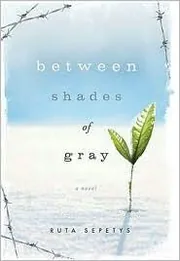
Between Shades of Gray
by Ruta Sepetys · 1999
It suits teenagers and older readers who can handle a serious historical subject.
348 pages, about 5.5 to 8 hours.
A girl's drawings carry a family through Stalin's Siberian deportation. 59% taste match
The story
Between Shades of Gray is a work of historical fiction by Ruta Sepetys, first published in 1999 and shelved among juvenile and children's fiction. It is set in 1941, during the period of Soviet occupation of Lithuania, and follows Lina Vilkas, a fifteen-year-old girl who loves to paint and draw. Soviet officers arrive at her home one night and take her family from the life they have known.
Lina, her mother Elena, and her younger brother Jonas are put on a crowded train and carried north across the Arctic Circle to a work camp in Siberia, while her father is held apart from them. Under Stalin's orders the family must dig for beets in harsh conditions. Lina uses her art to record what happens around her, hoping her drawings will reach her father and tell him they are alive. The story covers years of deportation and survival, and it deals with labor camps, the Soviet Union, and the wartime history of Europe in the twentieth century. The cast also includes Andrius Arvydas, Mr. Stalas, Nikolai Kretzsky, Mrs. Arvydas, Janina, and Joana. The book runs about 348 pages and has appeared in 20 editions.
Characters
Lina VilkasAndrius ArvydasMr. StalasNikolai KretzskyMrs. ArvydasElena Vilkas
Setting
Siberia (Russia)LithuaniaSoviet UnionSiberiaArctic Circle
Period
20th centurySoviet occupation, 1940-19411925-1953
Themes
Labor campsSurvivalHistorySurvivalismWorld War, 1939-1945Deportations from LithuaniaConcentration campsResilience (Personality trait)
- Want to read 174
- Reading now 11
- Read 30
Most people shelving it are saving it for later.
Of 215 readers who put it on a shelf, 81% want to read it, 5% are reading it now, 14% have finished it and 0% stopped before the end.
By the numbers
- The median edition runs 348 pages. Counting about 275 words a page and an adult reading pace of 250 words a minute, that is about 6.4 hours of reading.
- Open Library tracks 20 editions from 18 publishers, the earliest dated 1999 and the latest 2021, across 5 languages.
- On reader demand it ranks in the top 4% of the modern books in our catalog (15,152 of them).
- Libraries shelve it under Dewey 813.6 and Library of Congress class PS-3619.00000000.
 BookWard’s take
A girl's drawings carry a family through Stalin's Siberian deportation
Ruta Sepetys opens on the night Soviet officers come for fifteen-year-old Lina Vilkas and her family, and the story never loosens its grip from there. The hook is immediate: the knock at the door arrives almost at once. The pace runs quick as well, since the train north and the camp keep things moving. Lina's habit of drawing to record what she sees gives her a distinct way of looking, which suits a reader who wants more than types. The feeling in the book is the thing to watch, because the subject invites emotion and the novel leans toward it more than I tend to like. Still, this history deserves to stay in view, and the book is likely to linger long after the last page.
At 348 pages it is mid-length, longer than BookWard's love of tight books but not sprawling.
The train journey and camp life keep moving across years, a little steadier than slow-burn but short of breathless.
The setting is less often covered than other wartime stories, though the survival frame itself is well worn.
Plain, accessible prose written for young readers, well short of ornate.
Plot drives the journey, but Lina's inner life is close behind, so it sits slightly toward character.
Survival and love run through it, but against a bleak backdrop, so hope is present but hard won.
A straightforward account of the family's ordeal with no formal experiment.
The subject is grim and serious, with little room for humour.
Deportation, forced labor and survival under Stalin make this a dark book.
Separation from her father and the family's struggle make the feeling intense.
See all 50 dialsEvery position, side by side with this book
Where it lines up
- OpeningBookWard 10 · book 9
- PaceBookWard 8 · book 7
- Character depthBookWard 8 · book 7
Where it pulls apart
- Rigor (nonfiction)BookWard 9 · book 4
- LengthBookWard 1 · book 4
- Familiar tropesBookWard 10 · book 7
At 348 pages it is mid-length, longer than BookWard's love of tight books but not sprawling.
A night raid on Lina's home starts the story at once, exactly what BookWard wants from an opening.
The subject is a familiar one in historical fiction for young readers, though the Siberian deportation setting keeps it fresher than most.
Events follow cleanly from the deportation and the camp's rules, which suits BookWard's liking for airtight cause and effect.
The train journey and camp life keep moving across years, a little steadier than slow-burn but short of breathless.
The setting is less often covered than other wartime stories, though the survival frame itself is well worn.
Lina's artist's eye gives her a distinct inner life, close to the depth BookWard looks for.
The story follows Lina's survival through to a conclusion, which fits BookWard's preference for resolution.
A tale of family love and endurance leans toward feeling, a touch warmer than BookWard's restrained taste.
The darkness comes from real history and its cruelty is the point, so it feels earned rather than staged.
It is fiction rooted in real events, so it carries historical weight without nonfiction's evidence.
Lina's perspective as an observer who draws gives the telling a recognisable stamp.
This is a story-led book; the history is carried through Lina's experience, not argued as ideas.
History comes mostly through what Lina sees and endures, with some explaining where context is needed.
The long deportation could drag, but the shifting hardships tend to keep it sustained.
Plain, accessible prose written for young readers, well short of ornate.
Plot drives the journey, but Lina's inner life is close behind, so it sits slightly toward character.
Survival and love run through it, but against a bleak backdrop, so hope is present but hard won.
A straightforward account of the family's ordeal with no formal experiment.
The subject is grim and serious, with little room for humour.
Accessible to read, though the content asks for emotional stamina.
The story stays with Lina alone, a single viewpoint.
Events move forward in order through the years of deportation.
Entirely grounded in real historical events and places.
Fellow deportees and camp figures fill out the world beyond the family, a moderate-sized cast.
A family's story set against the wider sweep of Soviet deportations and the Arctic journey.
Lina's observations and her drawing balance her inner life against the outward ordeal.
Conversation among the deportees matters, but the book is not dialogue-heavy.
Attachments exist, but the focus is on survival and family.
A Siberian labor camp and the long journey there will be unfamiliar to most readers.
Set in 1941 and the years after, firmly in the past.
Stories of endurance under oppression hold their relevance well beyond their moment.
Lina tells what she lives, and there is no sign of her bending the truth.
The wrong done to the family is clear, so the moral lines are plain.
Cold, hunger and the camp are drawn vividly, with an artist's attention to detail.
Told close and personal through Lina's eyes, not from a detached distance.
A standalone story.
Surprises come from the harshness of events more than from plot reversals.
The subject asks readers to face a hard piece of history, which makes it more challenging than comforting.
Deportation, forced labor and survival under Stalin make this a dark book.
Separation from her father and the family's struggle make the feeling intense.
Humour is minimal and, where it appears, dry.
Camp cruelty and deprivation are part of the story, handled for a young audience.
Little to none in a book aimed at younger readers.
The Soviet occupation and Stalin's orders are the engine of the plot, so politics is front and center.
Plain language throughout, suited to a young audience.
Lina's view shapes the telling, but the book mostly lets events speak.
It looks back at a historical episode and the memory of it.
Strength, love and hope win out over the surrounding cruelty, tilting it toward idealism.
Review written by BookWard, dial version 1, November 2026.
Who is Between Shades of Gray right for?
It suits teenagers and older readers who can handle a serious historical subject. It deals with forced labor, deprivation and loss, which some younger readers may find upsetting.
Accessible to read, though the content asks for emotional stamina.
Deportation, forced labor and survival under Stalin make this a dark book.
Separation from her father and the family's struggle make the feeling intense.
Camp cruelty and deprivation are part of the story, handled for a young audience.
Book CompanionBetween Shades of Gray: ideas, characters, themes
A teenage girl uses drawing to record and survive the Soviet deportation of her family to Siberia, hoping her art will reach her father.
- The night of the arrest. Soviet officers take Lina and her family from their Lithuanian home in 1941, and everything they knew is gone.
- The train north. Crowded into a dirty train car, the family crosses the Arctic Circle toward a work camp.
- Work under Stalin's orders. In the coldest reaches of Siberia the deportees are forced to dig for beets in cruel conditions.
- Art as testimony. Lina draws what happens around her, at great risk, to send word to her father's prison camp.
- Years of survival. The story spans years and thousands of miles, driven by strength, love and hope.
Characters
Lina Vilkas
Protagonist
A fifteen-year-old Lithuanian girl who loves to paint and draw and documents events through her art.
Elena Vilkas
Lina's mother
Travels with her children to the Siberian work camp.
Jonas Vilkas
Lina's younger brother
Deported alongside Lina and their mother.
Andrius Arvydas
Fellow deportee
Part of the circle of people Lina meets along the way.
Themes
What people do, and endure, to stay alive in the harshest conditions.
Using drawing to record the truth and keep hope alive.
The pull between the family kept together and the father held apart.
How Stalin's regime tore ordinary people from their lives.
The small strengths that keep people going through years of hardship.
Discussion questions
- Why does Lina keep drawing despite the danger, and what do her drawings accomplish?
- How does the book show the cost of the family's separation from the father?
- What does the journey north reveal about the scale of the deportations?
- How do the deportees hold on to their identity under such conditions?
- Why might a story like this still matter to readers today?
Personalize your Book Companion
This is the general edition. In BookWard, the Companion is written for you: your reading profile, your notes, and spoiler-safe to the page you are on.
Buy, listen or borrow Between Shades of Gray
Each link opens a search for this book on that store, in a new tab.
Read on a device
Borrow
Reviews and community
If you liked Between Shades of Gray
A boy's betrayal in Kabul, and the long road back
A Thousand Splendid SunsKhaled HosseiniTwo Afghan women, one marriage, and thirty years of war
Petit paysGaël FayeA Burundian childhood breaks apart as history reaches the street
Black like meJohn Howard GriffinA white Texan darkens his skin and records six weeks of Jim Crow
Sources: Open Library.
Track Between Shades of Gray and find your next favorite
Add it to your shelf, rate what you have read, and BookWard will recommend what fits you.
Free to start. No credit card needed.