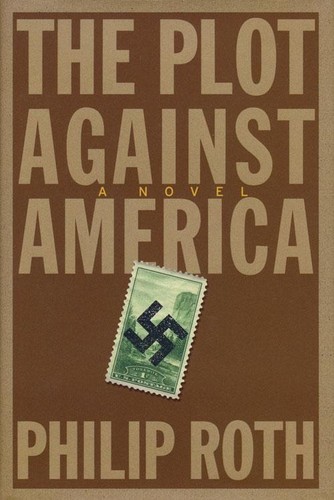
The Plot Against America
by Philip Roth
★ Top 10 book of 2004 · #7 on Best Books of 2004
In this alternate history, Charles Lindbergh defeats Roosevelt in 1940, and antisemitism becomes more accepted in American life. Young Philip Roth narrates his Newark family's persecution, a story that is also about the confusions of growing up.
Best for: Readers who enjoy alternate history and thoughtful fiction about family, fear, and politics
The Plot Against America is #7 on BookWard's Best Books of 2004, out of 48 2004 books that cleared our data bar.
What The Plot Against America is about
What if Charles Lindbergh, the famous aviator, beat Franklin Roosevelt in the 1940 election? Philip Roth imagines exactly that, and tells it through young Philip, a boy in a Jewish family in Newark, New Jersey. Philip lives with his parents, Herman and Bess, and his older brother Sandy.
Lindbergh wins with the slogan 'Vote for Lindbergh, or vote for war,' then makes deals with Nazi Germany and Japan. The big events arrive at the family's door. Government schemes move Jewish families and children away from their homes, a cousin goes off to fight in Canada's army, and an aunt grows close to the new White House. Roth draws on Lindbergh's real isolationist views. It suits readers who enjoy alternative history and want to see how fear reshapes ordinary life, in a story that feels uneasy and sad in equal measure.
The Plot Against America on the Best Books of 2004
The Plot Against America came out in 2004. Of the 48 books first published in 2004 that met BookWard's data bar, it ranks #7 on our Best Books of 2004 list.
Why it made the list: 440 readers have shelved it on Open Library; readers rate it 4 out of 5 (47 ratings). The list ranks each year’s books on how many readers have picked them up, how highly readers rate them, and how many are reading them right now.
Nearby on the 2004 list
- Alexander Hamilton Ron Chernow, #5
- She Comes First Ian Kerner, #6
- When He Was Wicked Julia Quinn, #8
- Rising Storm Erin Hunter, #9
See all Best Books of 2004 Best books by year
More years: Best Books of 2003 Best Books of 2005.
The numbers behind it
- Readers: 351 want to read it, 18 are reading it now and 71 have read it, according to Open Library.
- Ratings: 4 out of 5 from 47 Open Library ratings.
| Signal | This book (0 to 100) | Weight |
|---|---|---|
| Reach | 88 | 55% |
| Reader love | 52 | 25% |
| Being read right now | 81 | 20% |
Questions about The Plot Against America
When was The Plot Against America published?
The Plot Against America by Philip Roth was first published in 2004.
Was The Plot Against America one of the best books of 2004?
The Plot Against America is #7 on BookWard's Best Books of 2004, out of 48 2004 books that cleared our data bar. 440 readers have shelved it on Open Library; readers rate it 4 out of 5 (47 ratings).
Why is The Plot Against America on the Best Books of 2004 list?
440 readers have shelved it on Open Library; readers rate it 4 out of 5 (47 ratings).
More of the best books of 2004
- Darkly Dreaming Dexter Jeffry P. Lindsay, #1
- Rich Dad, Poor Dad for Teens Robert T. Kiyosaki, #2
- The Ruins of Gorlan John Flanagan, #3
- Blink Malcolm Gladwell, #4
- Alexander Hamilton Ron Chernow, #5
- She Comes First Ian Kerner, #6
See the full Best Books of 2004, the Top 100, or new books on Rising.
How we know
This page uses public data: Open Library reader counts and ratings, and Wikipedia page views for recent years. The description is paraphrased from real source text. Rankings reflect reading interest, not quality or sales, and can be affected by data gaps. Lists update monthly.
Suits mature teens and adults interested in historical and political fiction.
Depends on the edition you pick.
Roth's alternate 1940s Newark, seen through a frightened child's eyes. 64% taste match
 BookWard’s take
Roth's alternate 1940s Newark, seen through a frightened child's eyes
Roth keeps the large political what-if at the edge of the frame and puts a Newark family at the center. That choice makes the book personal rather than a thought experiment, and it is why the characters feel so fully drawn. Young Philip narrates, so the history arrives as a child experiences it: confusing, close to home, and frightening. The internal logic is strong, because each shift in the Roths' lives follows plausibly from the one before. The opening hooks quickly with Lindbergh's rise, though the pace is steady rather than fast. Roth also shows welcome restraint with sentiment, letting dread build through ordinary scenes instead of announcing it. It reads closer to a family novel than to a political tract.
A full-length novel with room for family scenes and political developments, longer than BookWard's taste for tight books.
The tempo is measured, driven by dread and family life rather than action, a little slower than BookWard prefers.
Setting a national political reversal inside one Newark household is a distinctive approach that BookWard rewards.
Roth's prose is fluent and precise, with some richness but little showy ornament.
The plot is provided by history, but what holds the book is how one family and one boy respond to it.
The prevailing mood is fear and erosion of security, so the outlook is largely bleak with limited consolation.
The structure follows a conventional chronological telling through one narrator, a bit more traditional than BookWard's middle ground.
Humor is rare in this story of persecution, though family life brings small, human touches.
The subject is antisemitism, fear and loss, giving it a serious, shadowed tone without being relentless.
Philip's confusion and terror give the book real emotional force, delivered through family life.
See all 50 dialsEvery position, side by side with this book
Where it lines up
- OriginalityBookWard 9 · book 9
- Authorial voiceBookWard 9 · book 9
- Internal logicBookWard 10 · book 9
Where it pulls apart
- LengthBookWard 1 · book 6
- OpeningBookWard 10 · book 8
- Familiar tropesBookWard 10 · book 8
A full-length novel with room for family scenes and political developments, longer than BookWard's taste for tight books.
Lindbergh's surprise rise to the nomination gives the story momentum early, close to BookWard's preference for a fast start.
Alternate history is a familiar mode, but Roth's domestic, childlike angle on it feels fresh and avoids the usual set pieces.
The Lindbergh presidency unfolds with consequences that follow from one another, which suits BookWard's liking for airtight worlds.
The tempo is measured, driven by dread and family life rather than action, a little slower than BookWard prefers.
Setting a national political reversal inside one Newark household is a distinctive approach that BookWard rewards.
The Roth family, seen through Philip's young eyes, is drawn with specificity, matching BookWard's taste for deeply drawn people.
The narrative resolves its main threads, if not with total tidiness, which broadly fits BookWard's preference for closure.
Roth leans toward unadorned observation over sweetness, though the child's perspective adds some tenderness.
Its darkness arises from plausible political consequences rather than shock for its own sake, which BookWard values.
This is a novel, so the nonfiction rigor dial does not apply.
Roth's recollecting narrator has an unmistakable, personal voice that stands out clearly against generic fiction.
The premise is idea-driven, but it is carried by story and family scenes, so it leans toward story-led.
Much of the political change is conveyed through events and household reactions, though the narrator does explain context.
The slow accumulation of dread mostly holds attention, with occasional stretches of quieter domestic detail.
Roth's prose is fluent and precise, with some richness but little showy ornament.
The plot is provided by history, but what holds the book is how one family and one boy respond to it.
The prevailing mood is fear and erosion of security, so the outlook is largely bleak with limited consolation.
The structure follows a conventional chronological telling through one narrator, a bit more traditional than BookWard's middle ground.
Humor is rare in this story of persecution, though family life brings small, human touches.
The prose is accessible, but the subject matter and mounting unease ask for some emotional stamina.
The story is told almost entirely through young Philip, keeping the perspective narrow.
Events move forward in order through the Lindbergh years, with a remembering narrator adding only light framing.
Its alternate history stays grounded and realistic, with no supernatural elements.
A family, neighbors, relatives and public figures make a moderately large but manageable cast.
A national political shift is rendered at kitchen-table scale, so it feels more intimate than epic.
Philip's fears and perceptions share the stage with public events that reshape the family's world.
Family arguments and conversations carry much of the story, giving dialogue a solid presence.
Romance plays a minor part, with family and politics taking the focus.
The setting is a historical Newark that feels concretely familiar through detail, even as events diverge.
It is set in the early 1940s, firmly in the past, though written in 2004.
Its portrait of a society tipping toward prejudice stays relevant well beyond the moment of publication.
Philip recalls events as a reliable witness, with a child's limited understanding rather than deceit.
The wrongs of antisemitism are clear, though people's responses to them are more mixed.
Newark streets, homes and daily routines are depicted with rich, concrete detail.
It is a self-contained novel.
The what-if premise brings developments that are surprising, yet they follow from earlier events.
Its steady portrayal of persecution and helplessness is uncomfortable and asks something of the reader.
The subject is antisemitism, fear and loss, giving it a serious, shadowed tone without being relentless.
Philip's confusion and terror give the book real emotional force, delivered through family life.
What humor exists is understated and wry rather than broad.
The threat of violence looms large, with limited graphic depiction.
Sexual content is slight and not a focus.
Politics drives the premise and shapes every household decision, putting it at the front of the book.
The language is clear and readable, with few barriers.
The narrator observes more than he lectures, so the narration is not especially opinionated.
It looks back to a period and to a remembered childhood.
The book shows ideals tested and eroded, more cynical than idealistic.
Review written by BookWard, dial version 1, November 2026.
Who is The Plot Against America right for?
Suits mature teens and adults interested in historical and political fiction. It deals with antisemitism, persecution and the fear of a young narrator, which some readers will find distressing.
The prose is accessible, but the subject matter and mounting unease ask for some emotional stamina.
The subject is antisemitism, fear and loss, giving it a serious, shadowed tone without being relentless.
Philip's confusion and terror give the book real emotional force, delivered through family life.
The threat of violence looms large, with limited graphic depiction.
Book CompanionThe Plot Against America: ideas, characters, themes
If a charismatic, isolationist hero won the presidency in 1940, an ordinary Jewish family in Newark would watch their sense of belonging in America slowly come apart.
- The premise. Charles Lindbergh defeats Franklin D. Roosevelt in the 1940 election, running under a slogan that frames the choice as Lindbergh or war.
- A child's vantage. The story is narrated through young Philip, so politics arrives as confusion, fear and the changing mood at home.
- Real roots. Roth drew on Lindbergh's actual isolationist views as spokesman for the America First Committee, and on his own Newark childhood.
- Treaties with dictators. Lindbergh signs agreements with Germany and Japan, the Iceland Understanding and the Hawaii Understanding, promising not to interfere with their expansion.
- A family under strain. The new presidency takes a toll on the Roths, including Philip's cousin Alvin, who joins the Canadian Army and returns home changed.
Characters
Philip Roth
Narrator and central character
A young boy in Newark whose coming of age unfolds alongside the political changes around him.
Herman Roth
Philip's father
The head of the Roth household, trying to protect his family as the country changes.
Bess Roth
Philip's mother
The other anchor of the household as the family faces mounting pressure.
Alvin
Philip's cousin
Joins the Canadian Army to fight in Europe and comes back with his ideals destroyed.
Rabbi Lionel Bengelsdorf
Newark rabbi
A Conservative rabbi who endorses Lindbergh, complicating the community's response.
Themes
How prejudice becomes more acceptable in everyday American life.
The lasting emotional toll on a child and a family living under threat.
How we understand the past when it could easily have gone another way.
What it means to feel like an outsider in the country you call home.
A boy's growing awareness of a world he cannot control.
Discussion questions
- How does telling the story through a child change what the reader understands about the political events?
- Why might Roth have chosen to keep the focus on one family rather than on Washington?
- What does the Roths' experience suggest about how quickly a society's norms can shift?
- How do different characters, including those who support Lindbergh, respond to the changing climate?
- What does the book suggest about the way we perceive history?
Personalize your Book Companion
This is the general edition. In BookWard, the Companion is written for you: your reading profile, your notes, and spoiler-safe to the page you are on.
Buy, listen or borrow The Plot Against America
Each link opens a search for this book on that store, in a new tab.
Read on a device
Borrow
Reviews and community
If you liked The Plot Against America
A hungry boy in the Jim Crow South, told without flinching
FlashlightSusan ChoiA family wrecked by one night on a breakwater
The Dead ZoneStephen KingA coma, a touch, and a choice only Johnny can make
Presumed InnocentScott TurowA prosecutor investigates a murder, then stands accused of it
Find your own best books
Add what you have read, rate it, and BookWard will recommend what to read next.
Free to start. No credit card needed.