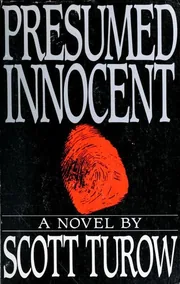
Presumed Innocent
by Scott Turow · 1987
Best suited to adult readers, and mature teens who enjoy legal mysteries.
432 pages, about 7 to 10 hours.
A prosecutor investigates a murder, then stands accused of it. 67% taste match
The story
Presumed Innocent is a legal thriller by Scott Turow, first published in 1987 and the author's first novel. It belongs to the tradition of American mystery fiction built around courtrooms, prosecutors and murder trials, and it takes up the idea of the presumption of innocence from the point of view of a lawyer who knows the system from the inside.
The story is narrated by Rusty Sabich, chief deputy prosecutor in the Midwestern setting of Kindle County. When a colleague, Carolyn Polhemus, is murdered, Rusty is given the job of finding her killer. Events turn against him, and he ends up charged with the crime himself. Other figures in the book include his boss Raymond Horgan, the investigator Dan Lipranzer, his wife Barbara Sabich, and the defense attorney Alejandro Stern. The novel runs to roughly 432 pages in a typical edition and has been issued in dozens of printings. It was adapted as a 1990 film starring Harrison Ford and as a 2024 Apple TV+ series starring Jake Gyllenhaal.
I should feel sorrier," Raymond Horgan says.
Characters
Carolyn PolhemusRaymond HorganDan LipranzerBarbara SabichAlejandro Stern
Setting
Kindle County
Themes
thrillersbondagemurder trialsPublic prosecutorsPresumption of innocenceDetective and mystery storiesLegal storiesAmerican Detective and mystery stories
- Want to read 146
- Reading now 5
- Read 19
Most people shelving it are saving it for later.
Of 170 readers who put it on a shelf, 86% want to read it, 3% are reading it now, 11% have finished it and 0% stopped before the end.
By the numbers
- The median edition runs 432 pages. Counting about 275 words a page and an adult reading pace of 250 words a minute, that is about 7.9 hours of reading.
- Open Library tracks 46 editions from 34 publishers, the earliest dated 1987 and the latest 2023, across 8 languages.
- On reader demand it ranks in the top 10% of the modern books in our catalog (15,152 of them).
- Libraries shelve it under Dewey 813.54 and Library of Congress class PS-3570.00000000.U754 P7 1987.
 BookWard’s take
A prosecutor investigates a murder, then stands accused of it
Turow's debut puts a prosecutor inside the machinery he has served for years, and the pull is immediate: the first line drops you into a conversation about an election, and a colleague's murder follows. Rusty Sabich narrates, and his voice is the book's great asset, a dry, exact, lawyerly intelligence that stays with you. The real engine is internal logic; the procedure feels built, not decorated. This is a thriller driven by character more than by chase, so the pace is steady rather than frantic, and the prose is controlled and plain. The ending is where the book earns its reputation. If you like your mysteries fair, grown-up and tightly reasoned, this is a landmark of the form.
At 432 pages it is mid-sized for a legal thriller, longer than BookWard's tight ideal but earned by its procedure.
Steady and procedural rather than breakneck, a little slower than BookWard's preferred briskness.
A prosecutor accused of the crime he investigates was a sharp angle on a familiar genre.
Clean, controlled and unshowy, closer to plain than ornate.
The mystery drives events, but it works through one man's guarded psychology.
A grim, suspicious book about institutions and private betrayal, leaning bleak.
A conventional investigation-then-trial arc told in sequence.
Serious throughout, with only the occasional dry aside.
Murder and betrayal at the center, handled in a mostly restrained way.
Feeling runs beneath a controlled surface and surfaces in key moments.
See all 50 dialsEvery position, side by side with this book
Where it lines up
- Character depthBookWard 8 · book 8
- EndingBookWard 8 · book 8
- SentimentBookWard 8 · book 8
Where it pulls apart
- LengthBookWard 1 · book 5
- Familiar tropesBookWard 10 · book 6
- OpeningBookWard 10 · book 7
At 432 pages it is mid-sized for a legal thriller, longer than BookWard's tight ideal but earned by its procedure.
A colleague's murder arrives early and the narrator is soon drawn in, which suits BookWard's appetite for an immediate pull.
Courtroom and whodunit conventions are present, but the insider prosecutor viewpoint keeps them from feeling stock.
The investigation and trial are built as a fair, carefully reasoned chain, which is exactly what BookWard prizes.
Steady and procedural rather than breakneck, a little slower than BookWard's preferred briskness.
A prosecutor accused of the crime he investigates was a sharp angle on a familiar genre.
Rusty's inner life as narrator is drawn with real depth, close to BookWard's own taste.
The book resolves its central question decisively, which fits BookWard's liking for closure.
Narration is cool and guarded, with little indulgence, which BookWard likes.
The darkness grows out of the plot and character instead of being added for effect.
Legal procedure and courtroom detail are handled with a precision that reads as authoritative.
Rusty's measured, self-examining narration gives the book a clear and recognizable voice.
Story leads, though the presumption of innocence runs under the whole plot as a guiding idea.
Legal process is explained through the narrator's account as much as shown in scene.
The investigation and trial keep tension moving, with few slack stretches.
Clean, controlled and unshowy, closer to plain than ornate.
The mystery drives events, but it works through one man's guarded psychology.
A grim, suspicious book about institutions and private betrayal, leaning bleak.
A conventional investigation-then-trial arc told in sequence.
Serious throughout, with only the occasional dry aside.
Accessible to read, though legal detail asks for attention.
Everything is filtered through Rusty alone.
Events unfold in a largely linear way from the murder onward.
Firmly grounded in a realistic American legal world.
A manageable circle of colleagues, family and lawyers.
Intimate in focus, centered on one man, one case and one marriage.
Much of the tension sits in Rusty's thoughts and doubts.
Interviews, hearings and courtroom exchanges carry much of the story.
Relationships matter to the plot, but romance is not the point.
Kindle County and its prosecutor's office are fictional but easy to recognize.
Written in 1987 and set in its own time, now a period piece.
Its themes of justice and suspicion have kept it in print and been adapted twice.
Rusty tells his own story under suspicion, so his account invites scrutiny.
Guilt, loyalty and justice resist tidy lines.
Detail serves procedure and atmosphere more than scenery.
Its mystery plotting is built around reversals and revelations.
A morally uncomfortable story that rewards close attention.
Murder and betrayal at the center, handled in a mostly restrained way.
Feeling runs beneath a controlled surface and surfaces in key moments.
What humor exists is dry and sparing.
The murder drives the plot, but the book dwells on its aftermath, not its depiction.
Sexual relationships are woven into the plot and motive.
An election campaign and office politics frame the story's institutional world.
Plain language, with some legal terminology.
The narrator's own judgments color everything we see.
A story preoccupied with the past and what it hides.
Skeptical about institutions, though not without a belief in fair process.
Review written by BookWard, dial version 1, November 2026.
Who is Presumed Innocent right for?
Best suited to adult readers, and mature teens who enjoy legal mysteries. It deals with murder, a sexual relationship at the center of the case, and adultery.
Accessible to read, though legal detail asks for attention.
Murder and betrayal at the center, handled in a mostly restrained way.
Feeling runs beneath a controlled surface and surfaces in key moments.
The murder drives the plot, but the book dwells on its aftermath, not its depiction.
Book CompanionPresumed Innocent: ideas, characters, themes
A prosecutor sworn to uphold the system finds himself standing inside it as the accused.
- The setup. Rusty Sabich, chief deputy prosecutor in Kindle County, is assigned to find the killer of his colleague Carolyn Polhemus.
- The reversal. Events turn against him until he is charged with the murder himself.
- The narrator. Rusty tells the story in the first person, so we see the case through the accused.
- The institution. His boss Raymond Horgan, investigator Dan Lipranzer and defense attorney Alejandro Stern show the legal world at work.
- The title idea. The presumption of innocence is tested from the viewpoint of someone who knows the system from within.
Characters
Rusty Sabich
Narrator and chief deputy prosecutor
He investigates a colleague's murder and is then accused of it.
Carolyn Polhemus
The murder victim
A member of the prosecutor's staff whose death sets the story in motion.
Raymond Horgan
Rusty's boss
The prosecutor whose re-election campaign frames the opening.
Dan Lipranzer
Investigator
Works the case from the investigative side.
Alejandro Stern
Defense attorney
The lawyer on the other side of the courtroom.
Themes
The legal principle that the accused is innocent until proven guilty, tested in practice.
How law works when those who run it become its subjects.
What we can and cannot know about another person's actions.
The strain private bonds face under public suspicion.
How office politics and campaigns shape professional lives.
Discussion questions
- How does Rusty's position as a prosecutor change the way you read his account of events?
- Does the first-person narration make you trust him more or less as the case builds?
- What does the book suggest about the gap between legal innocence and actual innocence?
- How does the election backdrop shape the way the investigation is handled?
- Why do you think this story has been adapted for both film and television?
Personalize your Book Companion
This is the general edition. In BookWard, the Companion is written for you: your reading profile, your notes, and spoiler-safe to the page you are on.
Buy, listen or borrow Presumed Innocent
Each link opens a search for this book on that store, in a new tab.
Read on a device
Borrow
Reviews and community
If you liked Presumed Innocent
A travel writer drifts into Cold War spying, with a childhood fire behind him
The SafekeepYael van der WoudenA cold, controlled summer that slowly turns on its reader
PassingNella LarsenA short, sharp novel about friendship, identity, and a secret in Harlem
Le rouge et le noirStendhalA provincial climber's ambition, studied with cold clarity across 518 pages
Sources: Open Library.
Track Presumed Innocent and find your next favorite
Add it to your shelf, rate what you have read, and BookWard will recommend what fits you.
Free to start. No credit card needed.